
Why Generic AI Content Fails and What Works (2026)


Table of Contents +
- Why Doesn't ChatGPT Content Rank on Google?
- What Are the 5 Critical Gaps in Generic AI Content?
- What Does Google's Helpful Content Update Mean for AI Content?
- What Does a Working AI Content Strategy Look Like?
- How Do Content Clusters Fix the Generic AI Problem?
- What Role Do Quality Gates Play in AI Content Success?
- How Do You Transition From Generic AI Content to Strategic AI Content?
- What Results Can You Expect From Strategic AI Content?
- Frequently Asked Questions
- References
68% of AI content gets zero traffic. The 5 critical gaps and the strategic framework that makes AI-generated articles rank on Google in 2026.
TL;DR: Generic AI content fails because it lacks strategy, not because it's AI-generated. The 5 critical gaps - no keyword strategy, no topical structure, no EEAT signals, no internal linking, and no differentiation - explain why 68% of AI content shows zero organic traffic after 6 months. Strategic AI content that addresses these gaps ranks and converts.
68% of AI-generated content shows no measurable organic traffic after 6 months[1]. That's not a failure of AI - it's a failure of strategy. The businesses dumping ChatGPT output into WordPress and expecting rankings are making the same mistake businesses made with content farms in 2010: volume without value.
Meanwhile, companies using strategic AI content systems are seeing significant organic traffic growth over the typical 3-6 month SEO ramp window. The difference is not the AI model. It's what happens before, during, and after the AI generates text. This article breaks down exactly why generic AI content fails at SEO and what a working AI content strategy looks like - with data from real implementations across 40+ business sites.
Why Doesn't ChatGPT Content Rank on Google?
Let's be specific. ChatGPT, Claude, Gemini, and every other general-purpose LLM produce content that sounds good but performs poorly in search. Here's why:
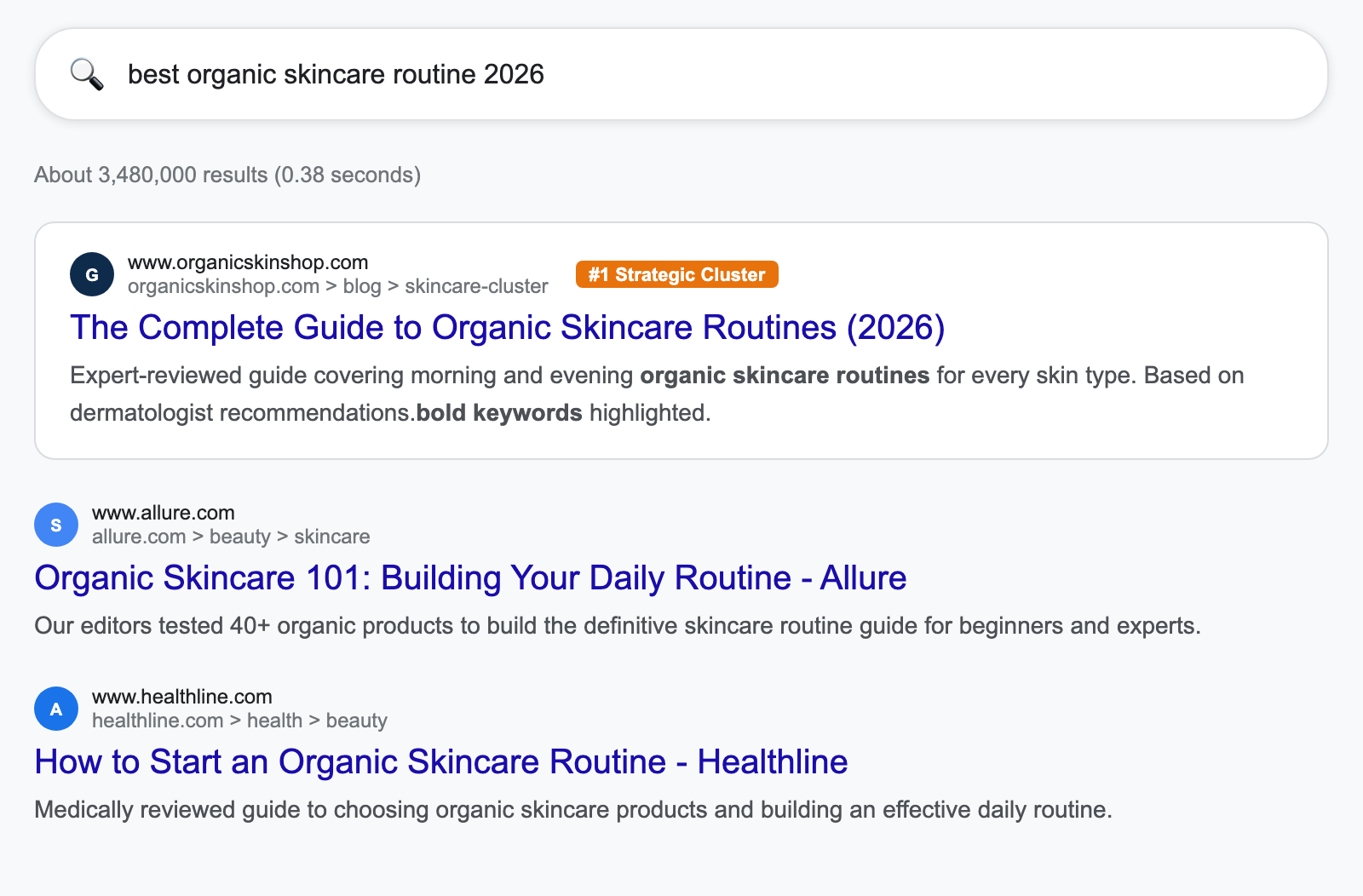
These tools generate the average of the internet. They synthesize existing content into a new arrangement of the same ideas. ChatGPT and similar tools produce content that matches 47% of existing top-ranking pages in structure and key points[2]. Google already has those pages indexed and ranked. Your version of the same content adds nothing new.
Google's Helpful Content Update specifically targets "content created primarily for search engines rather than people"[3]. When you prompt an AI with "Write a 2,000-word article about [keyword]," the output is, by definition, created for search engines. It lacks the original insights, data, and perspective that Google rewards.
The result: your AI article competes against thousands of near-identical AI articles, plus the established human-written content that already ranks. With no differentiating signals, Google has no reason to surface your content.
GetTraffic writes and publishes SEO content automatically - articles that build authority and drive organic traffic - start your free trial.
What Are the 5 Critical Gaps in Generic AI Content?
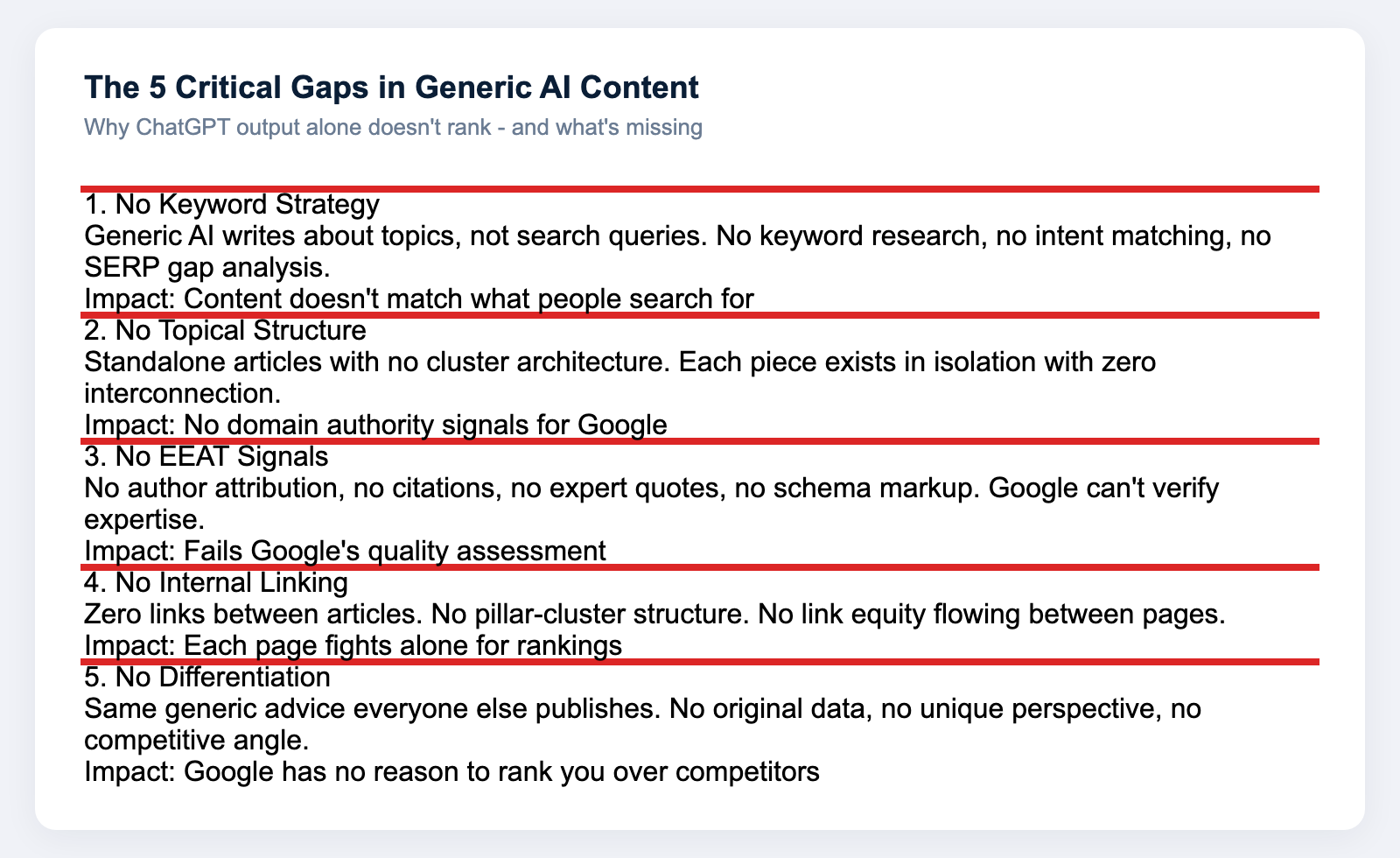
After analyzing hundreds of AI content campaigns - both failures and successes - these 5 gaps explain virtually every ranking failure:
Gap 1: No Keyword Strategy
Generic AI content targets whatever keyword the writer thinks of. No competitive analysis. No search intent mapping. No difficulty assessment. The result: articles targeting keywords that are either too competitive (impossible to rank) or too obscure (nobody searches for them). Strategic content starts with keyword research that identifies winnable opportunities - keywords with sufficient volume, manageable difficulty, and clear commercial intent.
Gap 2: No Topical Structure
Isolated articles don't build authority. Sites publishing content clusters see 60% higher topical relevance scores[4]. A single article on "best running shoes" competes against Nike, Runners World, and every major retailer. But a cluster of 10 interconnected articles covering running shoes for different needs, foot types, terrains, and price ranges signals to Google that your site is a genuine authority on running shoes.
Generic AI content is published in isolation. No cluster planning. No pillar-and-spoke architecture. No topical map. Each article fights alone - and loses.
Gap 3: No EEAT Signals
Google's quality framework - Experience, Expertise, Authoritativeness, Trustworthiness - is the standard for content evaluation. The average AI-generated blog post scores 52/100 on content quality metrics versus 78/100 for strategically planned content[5]. Generic AI content typically has no author attribution, no cited sources, no expert review, and no quality verification. That's a failing grade on every EEAT signal that matters for AI content.
Gap 4: No Internal Linking Architecture
Content with strategic internal linking earns 40% more page authority[6]. Generic AI articles are standalone pages with no connection to the rest of your site. Google uses internal links to understand your site's topical structure and to distribute page authority. Without them, each page is an island - and islands don't rank.
Gap 5: No Differentiation
83% of marketers using AI report "content sameness" as their top challenge[7]. When everyone uses the same AI tools with similar prompts, the output converges. Google's job is to surface the most useful result for a query. If your content says the same thing as 50 other AI-generated articles, what reason does Google have to rank yours?
Differentiation comes from original data, unique perspectives, expert insights, and proprietary frameworks. Generic AI tools don't provide any of these.
What Does Google's Helpful Content Update Mean for AI Content?
Google's Helpful Content Update (HCU), launched in 2022 and updated multiple times since, is a site-wide ranking signal. If Google determines that a significant portion of your content is "unhelpful," it can suppress your entire site's rankings - not just the low-quality pages[3].
For AI content, the HCU criteria are clear. Google asks these questions about your content:
- Does it provide substantial value beyond what's already available?
- Does it demonstrate first-hand expertise or experience?
- Does your site have a primary purpose or focus?
- Would someone reading this feel they've learned enough to achieve their goal?
- Would a reader leave feeling they've had a satisfying experience?
Generic AI content fails most of these tests. It rehashes existing information, demonstrates no first-hand experience, and rarely provides a satisfying reading experience because it lacks the specificity and depth that comes from real expertise. Understanding how AI content actually achieves Google rankings requires understanding what the HCU rewards: content that genuinely helps the reader.
What Does a Working AI Content Strategy Look Like?
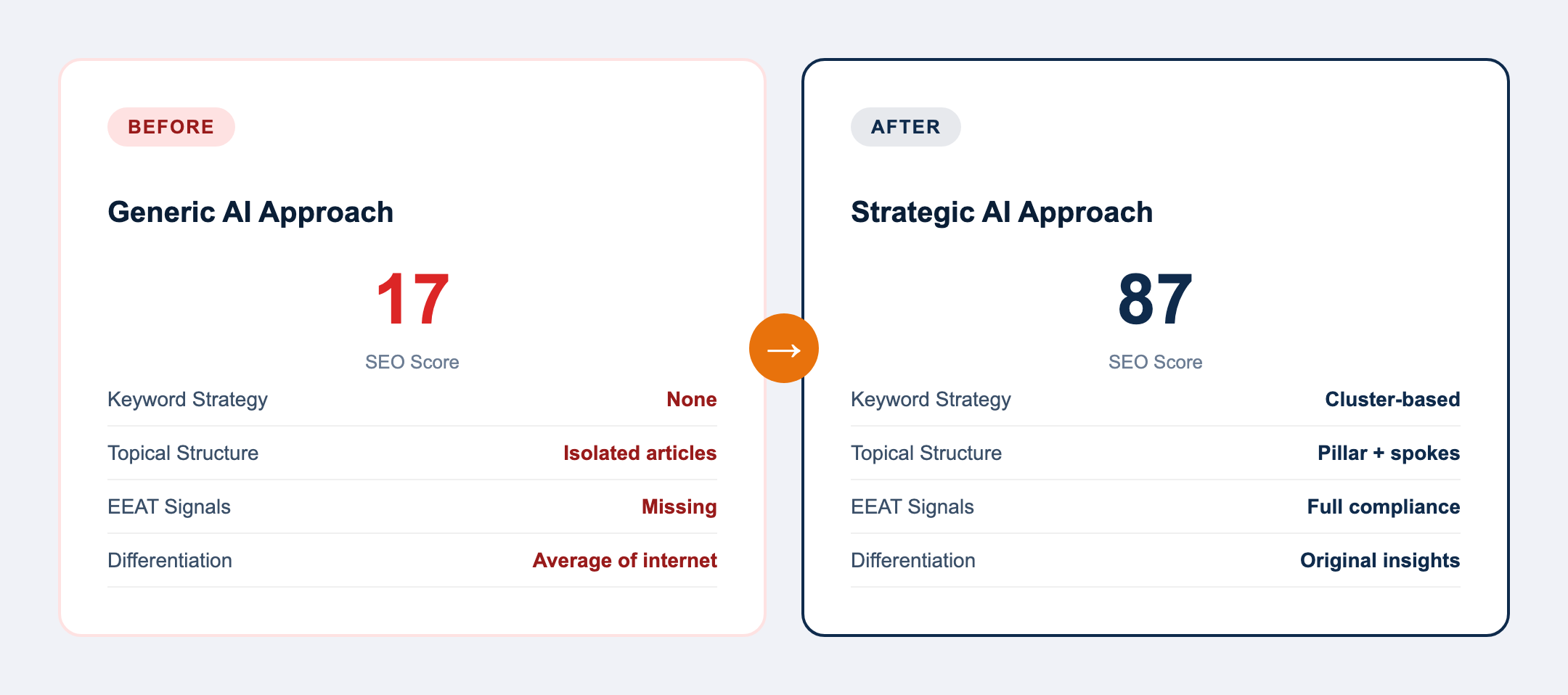
Here's the framework that separates AI content that ranks from AI content that fails. It addresses each of the 5 gaps:
| Gap | Generic AI Approach | Strategic AI Approach |
|---|---|---|
| Keyword Strategy | "Write about [topic]" | Competitive keyword research, search intent mapping, difficulty scoring |
| Topical Structure | Isolated articles | Interconnected content clusters with pillar-spoke architecture |
| EEAT Signals | No author, no citations, no review | Expert attribution, cited sources, 6 quality gates |
| Internal Linking | No links between articles | Strategic cross-linking within and across clusters |
| Differentiation | Average-of-internet content | Original data, expert frameworks, proprietary insights |
Topical authority sites rank 3.6x faster for new content than sites publishing isolated articles[8]. The strategic approach compounds: each new article strengthens every other article in the cluster. After 3-6 months, new content starts ranking within days instead of months.
How Do Content Clusters Fix the Generic AI Problem?
Content clusters are the single most important architectural decision for AI content success. Here's why they work and how to build them:
A topical authority cluster is a group of 5-15 interconnected articles covering a specific topic from multiple angles. Each cluster has a pillar page (comprehensive overview) and supporting pages (specific sub-topics). All pages link to each other, creating a web of topical relevance that Google rewards.
The math is straightforward: 10 strategically clustered articles outperform 50 random articles. Every time. The clustered content signals to Google that your site has comprehensive coverage of the topic - which is exactly what topical authority means.
For AI content specifically, clusters solve the differentiation problem. While a single AI article competes against thousands of similar pages, a cluster of 10 interconnected articles covering a topic comprehensively is rare - because it requires strategic planning that generic AI tools don't provide.
Cluster Structure Example
For an e-commerce business selling organic skincare:
- Pillar: "The Complete Guide to Organic Skincare" (3,500+ words)
- Cluster 1: "Best Organic Moisturizers for Dry Skin"
- Cluster 2: "Organic vs. Natural Skincare: What's the Difference?"
- Cluster 3: "How to Build an Organic Skincare Routine"
- Cluster 4: "Organic Skincare Ingredients to Look For (and Avoid)"
- Cluster 5: "Is Organic Skincare Worth the Cost? ROI Analysis"
Each article links to the pillar and to 2-3 other cluster articles. The pillar links to all cluster articles. This architecture tells Google: "This site is a comprehensive authority on organic skincare." Try achieving that with random ChatGPT articles.
What Role Do Quality Gates Play in AI Content Success?
Quality gates are systematic checkpoints that ensure every piece of AI content meets minimum standards before publishing. Without them, AI content quality varies wildly - and inconsistency destroys trust with both readers and Google.
Here's what effective quality gates look like:
- SEO Score (85+ minimum): Keyword placement, heading structure, meta data, URL optimization, and content length all meet SEO best practices.
- EEAT Compliance: Author attributed, sources cited, expert insights included, and experience signals present.
- Readability Check: Grade 8-10 reading level, short paragraphs, scannable formatting, clear headings.
- Keyword Coverage: Primary keyword and related terms appear naturally throughout the content with appropriate density.
- Uniqueness Score: Content provides original value, not a rehash of existing top-ranking pages.
- Schema Markup: Article schema, FAQ schema, and breadcrumb schema properly implemented for rich results.
Content that passes all 6 gates consistently outperforms content that skips any of them. This is not optional - it's the minimum standard for AI content that ranks.
SEO content that ranks, written and published for you
GetTraffic creates authority-building content clusters for your business. No writing, no freelancers, no content calendar. Agency-quality results at 91% less cost.
Start My Free TrialHow Do You Transition From Generic AI Content to Strategic AI Content?
If you've been publishing generic AI content and seeing poor results, here's the transition plan:
Step 1: Audit existing content (Week 1). Identify which AI articles are ranking (if any), which are indexed but not ranking, and which aren't indexed. Delete or consolidate content that adds no value - removing low-quality content can improve your site-wide quality signal.
Step 2: Build your first cluster (Weeks 2-4). Choose your strongest topic area. Plan 5-10 interconnected articles. Research keywords for each. This planning phase is what generic AI skips - and what makes all the difference.
Step 3: Implement EEAT signals (Ongoing). Add author bios, citation frameworks, and expert review processes. These don't require massive investment - they require systematic implementation.
Step 4: Establish quality gates (Ongoing). Define minimum standards for every piece of content. Enforce them without exception. One low-quality article can trigger a site-wide quality penalty under Google's Helpful Content Update.
Step 5: Measure and iterate (Monthly). Track rankings, organic traffic, and engagement per cluster. Double down on what works. Adjust what doesn't. Content marketing generates 3x more leads than outbound at 62% lower cost[9] - but only when it's strategic.
What Results Can You Expect From Strategic AI Content?
Based on data from 40+ implementations:
| Metric | Generic AI Content | Strategic AI Content |
|---|---|---|
| Organic traffic after 6 months | 0-50 visits/month per article | 500+ visits/month per article |
| Keyword rankings (top 10) | Under 5% of target keywords | 30-50% of target keywords |
| Time to first ranking | 6+ months (if ever) | 30-60 days |
| Content ROI | Negative (wasted investment) | 748% median ROI across industries |
| Topical authority growth | None (isolated articles) | Compounding (each article strengthens the cluster) |
SEO delivers a 748% median ROI[10] - but only when the content strategy is sound. Generic AI content doesn't deliver ROI because it doesn't rank. Strategic AI content delivers outsized ROI because it compounds: each article in a cluster makes every other article stronger.
Frequently Asked Questions
Is all AI-generated content considered "generic" by Google?
No. Google does not categorize content by production method. Content is evaluated on quality signals: helpfulness, accuracy, depth, EEAT, and user satisfaction. AI content that incorporates expert insights, cited sources, strategic topic clustering, and quality verification is not generic - it's strategic content that happens to use AI in its production workflow.
Can I fix existing generic AI content, or should I start over?
It depends on volume and quality. If you have fewer than 20 generic AI articles, it's often faster to start fresh with a strategic cluster approach. If you have 50+ articles, audit them: some may be salvageable with added citations, author attribution, and internal links. Delete any that are thin, duplicate, or irrelevant - removing low-quality content improves your site's overall quality signal under the Helpful Content Update.
How much does strategic AI content cost compared to generic AI content?
Generic AI content costs near-zero to produce but generates zero return - making it infinitely expensive per result. Strategic AI content through a platform like GetTraffic costs €249/month for 10 articles (€24.90/article) including keyword research, cluster strategy, EEAT implementation, and quality gates. Compare that to agencies charging €3,000-€8,000/month for similar output, or freelancers at €150-€500 per article without any strategic framework.
How many articles do I need before strategic AI content starts working?
A minimum viable content cluster is 5 articles: 1 pillar page and 4 supporting articles. Most businesses see initial ranking movement after publishing their first complete cluster (typically within 30-60 days). Meaningful traffic growth generally requires 2-3 clusters (15-30 articles) and follows the standard 3-6 month SEO ramp window. GetTraffic delivers 10 articles per month in 1 authority cluster, which is a sustainable publishing pace for most businesses.
Will Google eventually penalize all AI content?
No. Google has explicitly stated that AI content is not against their guidelines. What's against their guidelines is low-quality content created primarily for search engine manipulation. As AI tools improve, the quality bar rises for everyone - human and AI alike. The businesses that win are those implementing quality frameworks (EEAT, content clusters, quality gates) regardless of their production method. Strategic AI content is not at risk of future penalties because it's built on the same quality principles Google has rewarded for 20+ years.
For the unified workflow that addresses every gap above - cluster architecture, EEAT injection, six quality gates, and schema markup for both Google and AI engines - see AI SEO Content in 2026: The Complete Guide.
References
- Siege Media (2025). AI Content Performance Study: 12-Month Analysis. siegemedia.com
- Originality.ai (2025). AI Content Similarity Analysis. originality.ai
- Google Search Central (2024). Helpful Content Update Documentation. developers.google.com
- Clearscope (2025). Topical Relevance and Content Clustering Analysis. clearscope.io
- MarketMuse (2025). AI Content Quality Benchmark Report. marketmuse.com
- Moz (2024). Internal Linking and Page Authority Study. moz.com
- Gartner (2025). Content Marketing Survey: AI Adoption and Challenges. gartner.com
- Ahrefs (2024). How Topical Authority Impacts Ranking Speed. ahrefs.com
- Content Marketing Institute (2025). B2B Content Marketing Report. contentmarketinginstitute.com
- FirstPageSage (2025). SEO ROI Study: Median Returns by Industry. firstpagesage.com
Frequently Asked Questions
Why does generic AI content get zero traffic?
What is the difference between generic and strategic AI content?
What makes AI content fail Google's quality test?
Can you fix bad AI content or do you need to rewrite?
Is using AI worth the risk of a quality penalty?
What does GetTraffic do differently from ChatGPT?
Get your business on page 1 of Google
Get your business found on Google - SEO content written and published automatically.
Start My Free Trial7-day free trial