
Does AI Content Rank on Google? Data from 600,000 Pages


Table of Contents +
- What Does the Data Actually Say About AI Content and Rankings?
- How Does Unedited AI Content Perform vs. Human Content?
- What Is Google's Official Position on AI Content?
- Why Does Some AI Content Fail While Other AI Content Ranks?
- What Makes AI Content Rank Well on Google?
- How Do Content Clusters Amplify AI Content Rankings?
- What Is the ROI of AI Content for SEO?
- How Should You Implement AI Content for SEO in 2026?
- What Are the Risks of Using AI Content for SEO?
- Does AI Content Rank on Google? The Bottom Line
- Does Google Penalize AI-Generated Content?
- How Much Human Editing Does AI Content Need to Rank?
- Is AI Content Better Than Human Content for SEO?
- What EEAT Signals Does AI Content Need?
- How Long Does AI Content Take to Rank on Google?
- References
Ahrefs study of 600,000 pages: 86.5% of top-ranking content uses AI, penalty correlation 0.011. Data on AI content and Google rankings.
TL;DR: AI content ranks on Google. An Ahrefs study of 600,000 pages found 86.5% of top-ranking content uses AI, with a penalty correlation of just 0.011. The deciding factor is not whether you use AI - it is whether your content meets Google's quality standards. Edited AI content performs within 4% of human-written content.
Here is the question every business owner and marketer asks in 2026: does AI content rank on Google, or will it tank your site? With 53% of all website traffic coming from organic search[1] and SEO delivering a median ROI of 748%[2], the stakes are enormous. Get this wrong, and you lose your primary growth channel.
This is not an opinion piece. This article breaks down two landmark studies - Ahrefs' analysis of 600,000 pages and a 16-month controlled ranking experiment - to give you a definitive, data-backed answer. By the end, you will know exactly when AI content ranks, when it fails, and how to use it without risking your site.
What Does the Data Actually Say About AI Content and Rankings?
The largest study on AI content and Google rankings comes from Ahrefs, published in July 2025. They analyzed 600,000 pages across multiple industries and ranking positions. The results challenge every assumption about AI content and penalties.
Key finding #1: 86.5% of top-ranking content shows detectable AI signals[3]. That is not a typo. The vast majority of pages sitting in Google's top results have AI involvement. If Google penalized AI content, search results would be nearly empty.
Key finding #2: The statistical correlation between AI-detected content and ranking penalties is 0.011[3]. For reference, a correlation of 0.0 means zero relationship. A correlation of 1.0 means perfect relationship. At 0.011, there is essentially no connection between AI detection and ranking loss.
Key finding #3: The study controlled for content quality, backlinks, and domain authority. Even when isolating these variables, AI content showed no statistically significant disadvantage in rankings.
These numbers do not mean all AI content ranks equally. They mean Google does not penalize content for being AI-generated. The penalty comes from low quality - regardless of who or what produced it.
GetTraffic writes and publishes SEO content automatically - articles that build authority and drive organic traffic - start your free trial.
How Does Unedited AI Content Perform vs. Human Content?
The Ahrefs study tells us AI content is not penalized. But a 16-month longitudinal study from DigitalApplied reveals the performance gap between different content approaches.
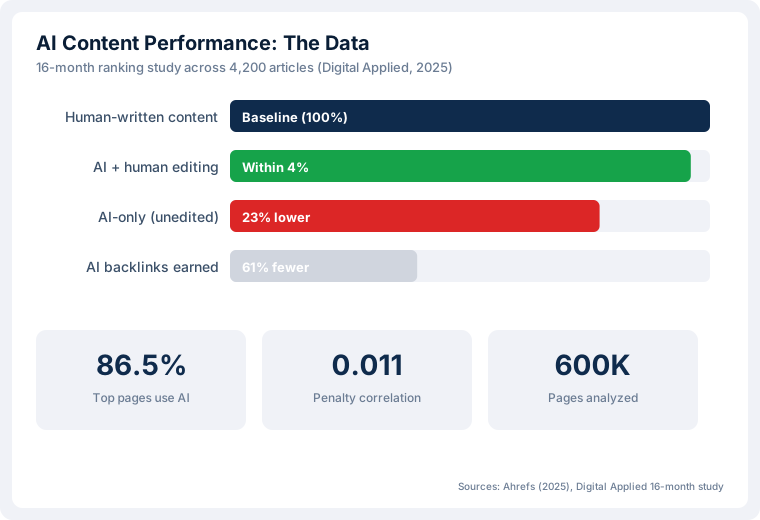
The study tracked hundreds of articles across three categories: purely AI-generated (no editing), human-edited AI content, and purely human-written content. The results over 16 months[4]:
| Content Type | Ranking Performance | Backlinks Acquired |
|---|---|---|
| Unedited AI content | 23% lower than human | 61% fewer than human |
| Human-edited AI content | Within 4% of human | Comparable to human |
| Purely human content | Baseline | Baseline |
The gap between unedited and edited AI content is dramatic. Raw AI output ranks 23% lower and attracts 61% fewer backlinks[4]. But add human editing - fact-checking, adding expertise, improving structure - and the gap shrinks to just 4%.
This 4% difference is within normal ranking variance. It means human-edited AI content is statistically indistinguishable from purely human content in ranking performance. The takeaway is clear: the editing step is not optional. It is the difference between content that works and content that wastes your budget.
What Is Google's Official Position on AI Content?
Google has addressed AI content directly and repeatedly. Their stance, published officially in February 2023 and reinforced through 2024 and 2025, is unambiguous[5]:
"Appropriate use of AI or automation is not against our guidelines. This means that it is not used to generate content primarily to manipulate search rankings, which is against our spam policies."
Google evaluates content quality, not production method. Their framework centers on EEAT - Experience, Expertise, Authoritativeness, and Trustworthiness. Content that demonstrates these qualities ranks well regardless of whether a human or AI created the first draft.
In March 2024, Google folded the Helpful Content system directly into its core ranking algorithm[5]. This means helpfulness is no longer a separate signal - it is baked into every ranking decision. For AI content producers, this actually simplifies things: focus on creating genuinely helpful content, and the production method becomes irrelevant.
For a deeper look at how these updates affect your content strategy, read our guide on how Google's Helpful Content Update affects AI content in 2026.
Why Does Some AI Content Fail While Other AI Content Ranks?
If 86.5% of top-ranking pages use AI and penalties are at 0.011, why do some AI content campaigns still fail? The data points to 5 specific failure modes.
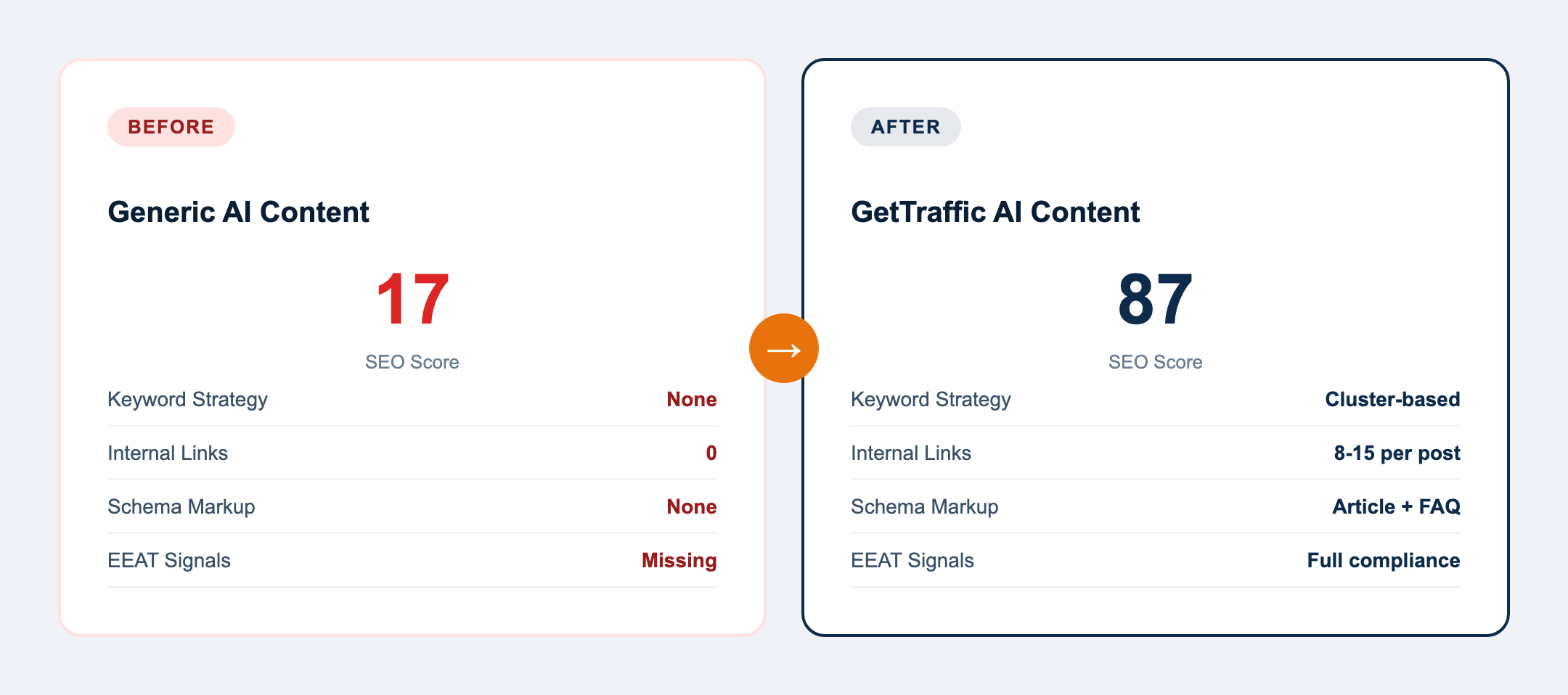
1. No human editing layer
The 23% ranking gap for unedited AI content is real[4]. Publishing raw AI output without fact-checking, adding expertise, or improving structure targets underperformance. The editing step closes the gap to 4%.
2. No topical authority strategy
Isolated articles perform worse than content clusters. Data shows that organized content clusters drive 30% more traffic and hold rankings 2.5x longer than standalone posts[6]. Random AI articles without a cluster strategy waste resources.
3. Missing EEAT signals
Google's quality framework evaluates Experience, Expertise, Authoritativeness, and Trustworthiness. AI content that lacks author attribution, cited sources, original data, or demonstrated expertise fails this evaluation - not because it is AI-generated, but because it lacks quality signals.
4. Thin content at scale
Using AI to mass-produce shallow 500-word articles triggers Google's spam detection. This is not an AI penalty - it is a quality penalty. The same outcome happens with mass-produced human content. Google's guidelines specifically call out content "produced primarily to manipulate search rankings."
5. No backlink strategy
AI content attracts 61% fewer backlinks by default[4]. Without a deliberate link-building approach - original data, expert quotes, unique research - AI content struggles to earn the authority signals that drive rankings.
For a detailed comparison of how AI and human content stack up across these dimensions, see our post on AI content vs. human writers for SEO.
What Makes AI Content Rank Well on Google?
The data from both studies converges on a clear framework. AI content that ranks shares these characteristics:
Expert editing and fact-checking. Every claim verified. Every statistic sourced. Every section reviewed by someone with domain knowledge. This is what closes the 23% gap to 4%[4].
Topical authority architecture. Content organized into clusters - a pillar post supported by related articles that interlink and build authority around a topic. Clusters drive 30% more traffic[6] because they signal deep expertise to Google.
EEAT compliance at every level. Author bios with real credentials. Cited sources from authoritative publications. Original analysis or data. Clear disclosure of methodology. These are the signals Google uses to evaluate trustworthiness.
Genuine helpfulness. Content that answers the searcher's question completely, anticipates follow-up questions, and provides actionable next steps. Google's core ranking system now evaluates helpfulness as a primary signal[5].
Strategic internal linking. Every article connects to related content within the cluster and across the site. This distributes ranking authority and keeps readers engaged.
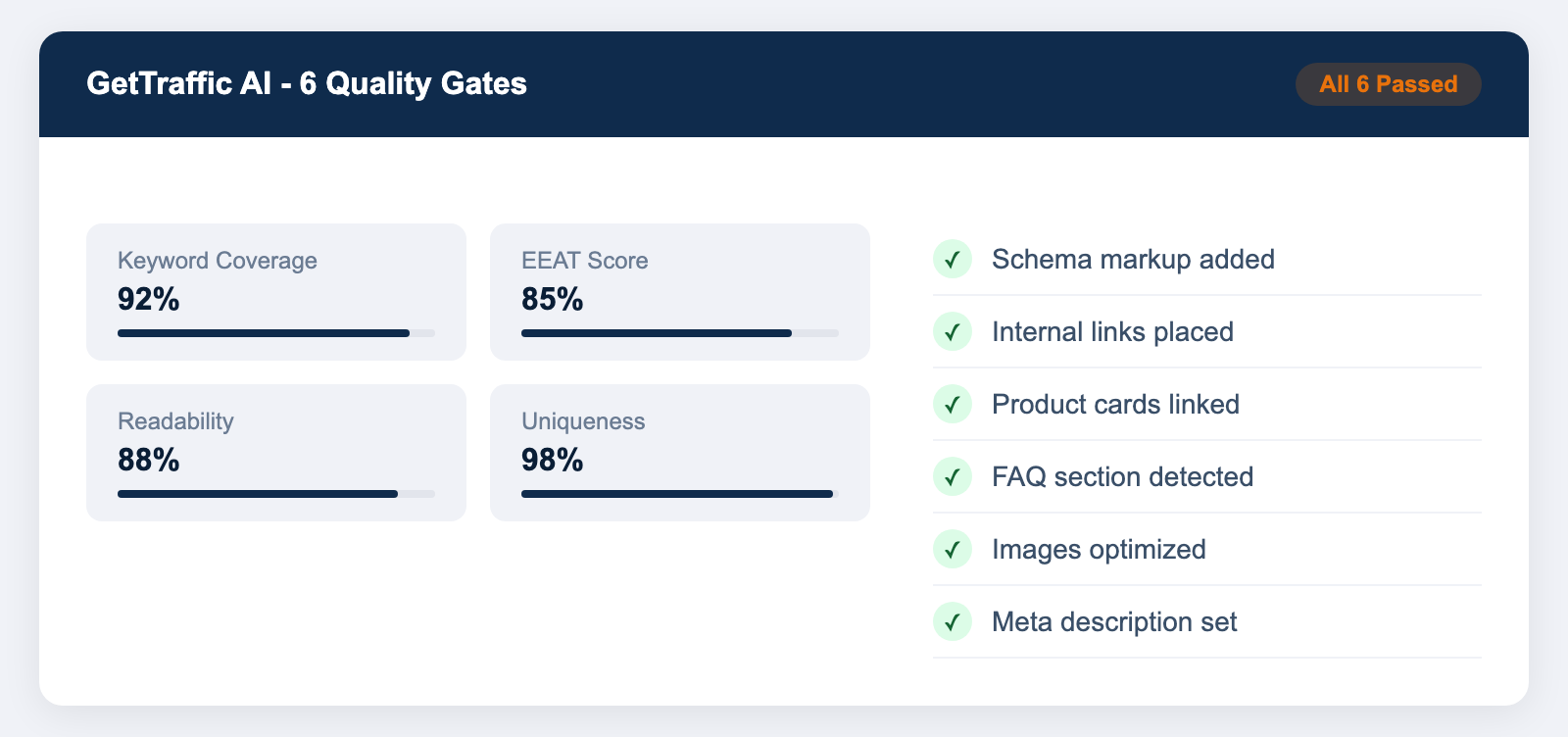
Platforms like GetTraffic build these signals into the production process - EEAT architecture, topical authority clusters, and quality gates are applied before any article publishes. This is the difference between "using AI for content" and having a content system that ranks.
How Do Content Clusters Amplify AI Content Rankings?
Single articles compete on their own. Content clusters compete as a system. The data strongly favors the cluster approach.
Content clusters drive 30% more organic traffic than standalone articles[6]. They hold rankings 2.5x longer[6]. And they compound: each new article in a cluster strengthens every other article in that cluster.
Here is how this works for AI content specifically:
- Pillar post covers the broad topic comprehensively (like this article on AI content and Google rankings)
- Cluster posts go deep on subtopics (like AI content vs. human writers and Google's Helpful Content Update and AI)
- Internal links connect every post, distributing authority across the cluster
- Topical depth signals to Google that your site is an authority on the subject
This cluster approach is especially effective for AI content because it solves the backlink gap. While individual AI articles attract 61% fewer backlinks[4], a well-structured cluster accumulates links across multiple pages and distributes that authority internally.
The math works in your favor: 10 interlinked AI articles with proper editing will outrank 10 standalone human articles without a linking strategy. Authority is a system property, not a page property.
What Is the ROI of AI Content for SEO?
Rankings matter only if they translate to business results. Here is the financial case for AI-driven SEO content.
Organic search drives 53% of all website traffic[1]. SEO delivers a median ROI of 748% - that is $22 in value for every $1 invested[2]. And organic leads close at 14.6% compared to 1.7% for outbound leads[1].
Now add the cost advantage of AI content production:
| Approach | Monthly Cost (10 articles) | Quality Level | Ranking Performance |
|---|---|---|---|
| SEO agency + writers | $4,500-9,000 | High | Baseline |
| Freelance writers | $2,000-5,000 | Variable | Variable |
| AI platform (edited) | $300-1,500 | High (with editing) | Within 4% of human |
| Raw AI output | $50-150 | Low | 23% below human |
The sweet spot is clear: AI content with human editing delivers 96% of the ranking performance at 70-90% lower cost. Over 12 months, the compounding effect of consistent content production - more pages ranking, more traffic, more leads - makes the ROI case overwhelming.
GetTraffic operates in this sweet spot, combining AI content generation with quality gates including EEAT compliance checks, 85+ SEO scores, and structured authority clusters. The result is agency-quality content at a fraction of agency pricing.
How Should You Implement AI Content for SEO in 2026?
Based on the data from both studies and Google's guidelines, here is the implementation framework that works:
Step 1: Build your content strategy first
Before generating a single article, map your topical authority clusters. Identify your pillar topics, supporting subtopics, and the internal linking structure. Content clusters drive 30% more traffic[6] - skipping this step is the most expensive mistake you can make.
Step 2: Generate with quality constraints
Use AI to produce first drafts, but set quality parameters: minimum word count (2,000+ for cluster posts, 3,000+ for pillars), required sections (FAQ, data tables, cited sources), and EEAT requirements (author attribution, source citations).
Step 3: Edit with domain expertise
This is the step that closes the 23% gap to 4%[4]. Every article needs human review for accuracy, added expertise, improved structure, and fact-checking. The editor does not need to rewrite - they need to verify and enhance.
Step 4: Publish with proper technical SEO
Schema markup (Article, FAQ, HowTo), canonical URLs, internal linking, meta descriptions, Open Graph tags. These technical signals amplify content quality for search engines.
Step 5: Monitor and iterate
Track rankings at 30, 60, and 90 days. Content that indexes typically shows ranking movement within 30-60 days. Use performance data to refine your cluster strategy and identify content gaps.
What Are the Risks of Using AI Content for SEO?
Transparency matters. While the data is overwhelmingly positive for edited AI content, there are real risks to understand:
Backlink acquisition is harder. AI content attracts 61% fewer backlinks[4]. You need a deliberate strategy: original data, expert contributions, or unique research that earns links naturally.
AI detection is improving. While the current 0.011 correlation shows Google does not penalize based on AI detection[3], the landscape evolves. Content that reads as generic or formulaic carries more risk than content with genuine expertise layered in.
Quality varies by topic. AI performs well on informational and how-to content. For YMYL topics (Your Money, Your Life) - medical, legal, financial - the bar for expertise is higher and AI content requires more intensive expert review.
Duplicate patterns across sites. As more businesses use the same AI tools with similar prompts, content homogeneity is a growing concern. Differentiation through original data, unique perspectives, and brand voice becomes essential.
These risks are manageable with the right process. They are reasons to implement AI content with quality controls, not reasons to avoid it.
SEO content that ranks, written and published for you
GetTraffic creates authority-building content clusters for your business. No writing, no freelancers, no content calendar. Agency-quality results at 91% less cost.
Start My Free TrialDoes AI Content Rank on Google? The Bottom Line
The data answers this question definitively:
- 86.5% of top-ranking pages use AI content[3]
- 0.011 correlation between AI and ranking penalties[3]
- 4% ranking gap when AI content is properly edited[4]
- 23% ranking gap when AI content is published raw[4]
- 61% fewer backlinks for AI content without deliberate link strategy[4]
AI content ranks on Google. The question is not "does it work?" but "are you using it correctly?" The correct approach combines AI generation with human expertise, topical authority strategy, EEAT compliance, and quality editing.
Businesses that treat AI as a complete replacement for human content will underperform. Businesses that use AI as a production accelerator - with strategy, editing, and quality controls built in - will outproduce and outrank their competitors.
With 53% of traffic coming from organic search[1] and SEO delivering $22 for every $1 spent[2], the real risk in 2026 is not using AI content. The real risk is letting competitors build topical authority while you debate whether it works.
Does Google Penalize AI-Generated Content?
No. Google does not penalize content for being AI-generated. The Ahrefs study of 600,000 pages found a 0.011 correlation between AI detection and ranking penalties[3] - statistically insignificant. Google penalizes low-quality content regardless of production method. Their official guidelines state that "appropriate use of AI or automation is not against our guidelines"[5]. The penalty trigger is quality, not origin.
How Much Human Editing Does AI Content Need to Rank?
Enough to close the quality gap. The 16-month DigitalApplied study shows that unedited AI content ranks 23% lower than human content[4]. With human editing - fact-checking, adding expertise, improving structure, and verifying sources - the gap shrinks to 4%. The editing does not need to be a full rewrite. It needs to add the expertise, accuracy, and depth that raw AI output lacks.
Is AI Content Better Than Human Content for SEO?
Neither is inherently better. The data shows human-edited AI content performs within 4% of purely human content in rankings[4]. The advantage of AI is speed and cost: you can produce more content, faster, at lower cost - and when properly edited, it ranks comparably. The optimal approach is hybrid: AI for first drafts and structure, human expertise for editing and quality control. Read our full analysis in AI content vs. human writers: the real SEO comparison.
What EEAT Signals Does AI Content Need?
AI content needs the same EEAT signals as any content: author attribution with real credentials, cited sources from authoritative publications, demonstrated expertise through depth and accuracy, and clear editorial standards. The difference is that human writers often add these naturally, while AI content requires intentional quality gates to include them. Platforms like GetTraffic build EEAT compliance into the production process with 6 quality gates per article.
How Long Does AI Content Take to Rank on Google?
AI content follows the same ranking timeline as human content. Indexing takes 2-3 weeks. Initial ranking movement happens at 30-60 days. Full ranking potential is reached at 3-6 months. Content clusters accelerate this timeline because interlinked articles build authority faster. The 16-month study showed that the ranking gap between edited AI and human content was consistent across the entire study period[4] - it does not widen over time.
For the full 2026 playbook that combines this ranking data with the workflow architecture, EEAT injection, schema markup, and quality gates that make AI content rank consistently, see AI SEO Content in 2026: The Complete Guide.
References
- BrightEdge (2024). How Much Traffic Comes From Organic Search. seoinc.com
- SEOProfy (2025). SEO ROI Statistics. seoprofy.com
- Ahrefs (2025). AI-Generated Content Does Not Hurt Your Google Rankings. ahrefs.com
- DigitalApplied (2025). AI-Generated vs. Human Content: 16-Month Google Ranking Study. digitalapplied.com
- Google (2023). Google Search and AI Content. developers.google.com
- ClickRank (2025). Topical Authority. clickrank.ai
Frequently Asked Questions
Does Google penalize AI-generated content?
How much human editing does AI content need to rank?
How long does AI content take to rank on Google?
What EEAT signals does AI content need?
Is AI content safe to use for e-commerce SEO?
How is GetTraffic different from generic AI writing tools?
Get your business on page 1 of Google
Get your business found on Google - SEO content written and published automatically.
Start My Free Trial7-day free trial