
How Google's Helpful Content Update Affects AI in 2026


Table of Contents +
- What Is Google's Helpful Content System in 2026?
- Does the Helpful Content System Target AI Content Specifically?
- What Triggers a Helpful Content Demotion?
- What Makes AI Content "Helpful" by Google's Standards?
- How Does EEAT Apply to AI Content After the Helpful Content Update?
- What Changed Between 2023 and 2026 in Google's AI Content Approach?
- How to Produce AI Content That Passes Google's Quality Checks
- What Happens If Your AI Content Gets Demoted?
- The Future of AI Content Under Google's Quality Framework
- Does Google's Helpful Content Update Penalize AI Specifically?
- How Do You Know If Your Content Is "Helpful" by Google's Standards?
- Can You Recover From a Helpful Content Demotion?
- What EEAT Signals Matter Most for AI Content?
- Is It Safe to Scale AI Content Production in 2026?
- References
Google's Helpful Content system targets quality, not AI. Learn what triggers demotions, what is safe, and how to produce AI content that ranks in 2026.
TL;DR: Google's Helpful Content system is now part of core ranking. It evaluates content quality, not production method. AI content that demonstrates genuine helpfulness, EEAT signals, and topical depth ranks well. AI content that is thin, generic, or produced solely to manipulate rankings gets demoted - the same as low-quality human content.
Google's Helpful Content Update is the most misunderstood algorithm change in SEO history. Half the industry believes it penalizes AI content. The other half believes it does not matter at all. Both are wrong. With 53% of website traffic coming from organic search[1] and 86.5% of top-ranking pages showing AI content signals[2], understanding exactly how this system works determines whether your content strategy succeeds or fails.
This guide covers what the Helpful Content system actually measures, what triggers demotions, what is safe, and how to produce AI content that passes every quality check Google applies.
What Is Google's Helpful Content System in 2026?
Google launched the Helpful Content Update in August 2022 as a standalone ranking signal. Its purpose was clear: reward content created for people and demote content created primarily for search engines.
In March 2024, Google made a pivotal change: the Helpful Content system was folded directly into Google's core ranking algorithm[3]. This is not a semantic distinction. It means helpfulness is no longer evaluated as a separate filter - it is embedded in every ranking decision Google makes.
What this means in practice:
- There is no separate "Helpful Content penalty" to recover from
- Helpfulness is a continuous signal, not a binary pass/fail
- Every page is evaluated on helpfulness as part of standard ranking
- Improvements in content quality translate directly to ranking improvements
For AI content producers, this simplification is positive. Instead of worrying about a specific "AI content penalty," the focus shifts to a single question: is this content genuinely helpful to the person searching for this topic?
GetTraffic writes and publishes SEO content automatically - articles that build authority and drive organic traffic - start your free trial.
Does the Helpful Content System Target AI Content Specifically?
No. Google has been explicit about this. Their official guidance states[3]:
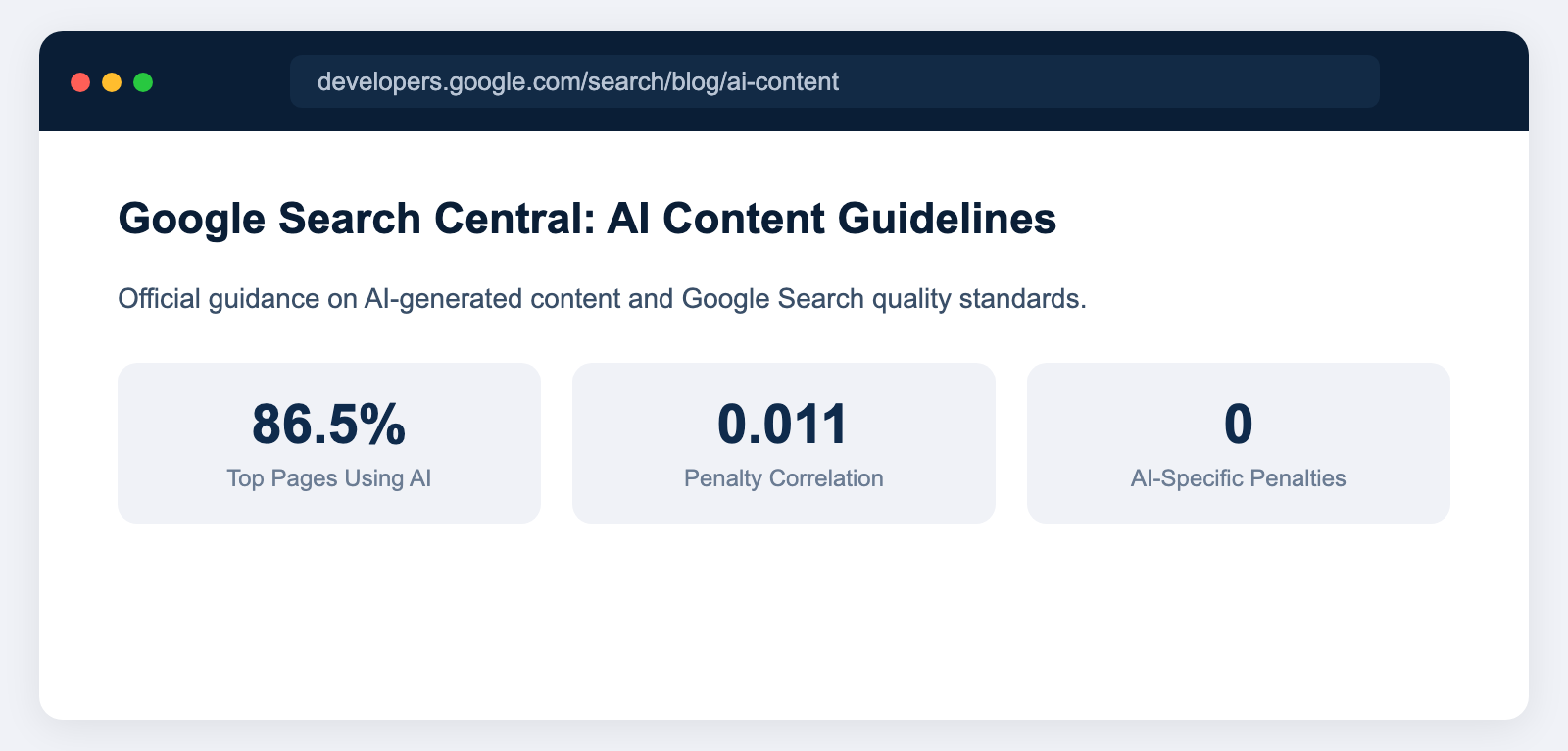
"Appropriate use of AI or automation is not against our guidelines. This means that it is not used to generate content primarily to manipulate search rankings, which is against our spam policies."
The Ahrefs study of 600,000 pages confirms this with data: the correlation between AI-detected content and ranking penalties is 0.011[2]. A correlation that low means there is essentially no relationship between AI detection and ranking loss.
What the system targets is not AI content - it targets unhelpful content regardless of origin. A 500-word AI article stuffed with keywords and lacking depth gets demoted. A 500-word human article with the same problems gets the same treatment.
For the complete data on AI content ranking performance, see our pillar post: does AI content rank on Google? What 600,000 pages tell us.
What Triggers a Helpful Content Demotion?
Google has published specific signals that indicate "unhelpful" content. These apply equally to AI and human content:
Content created primarily for search engines
Content that targets keywords without providing genuine value. Signs include: thin articles that restate the title without depth, keyword-stuffed pages with no original information, and content that exists only to capture search traffic without helping the reader.
Mass-produced content without expertise
Publishing large volumes of shallow content across many topics. Google specifically calls this out: covering topics without "sufficient expertise" where content is "unlikely to help." This is the primary risk for businesses using AI to mass-produce articles across topics where they lack authority.
Content that leaves users needing more information
If a reader clicks your result and immediately returns to Google to find a better answer, that behavior signals unhelpfulness. Content must answer the query completely, not just partially. A 16-month study shows unedited AI content ranks 23% lower than human content[4] - largely because raw AI output frequently lacks the depth and specificity users need.
Content that summarizes without adding value
Rehashing existing content without original analysis, data, or perspective. This is AI content's default weakness: it synthesizes what already exists. Content that adds nothing new to a topic provides no reason for Google to rank it above existing results.
Writing to trending topics outside your expertise
Chasing search volume in topics where your site has no authority. Google evaluates topic relevance at the site level, not just the page level. An e-commerce site publishing medical advice triggers skepticism regardless of content quality.
What Makes AI Content "Helpful" by Google's Standards?
Google's guidelines translate into specific, measurable content characteristics. Here is the compliance framework:
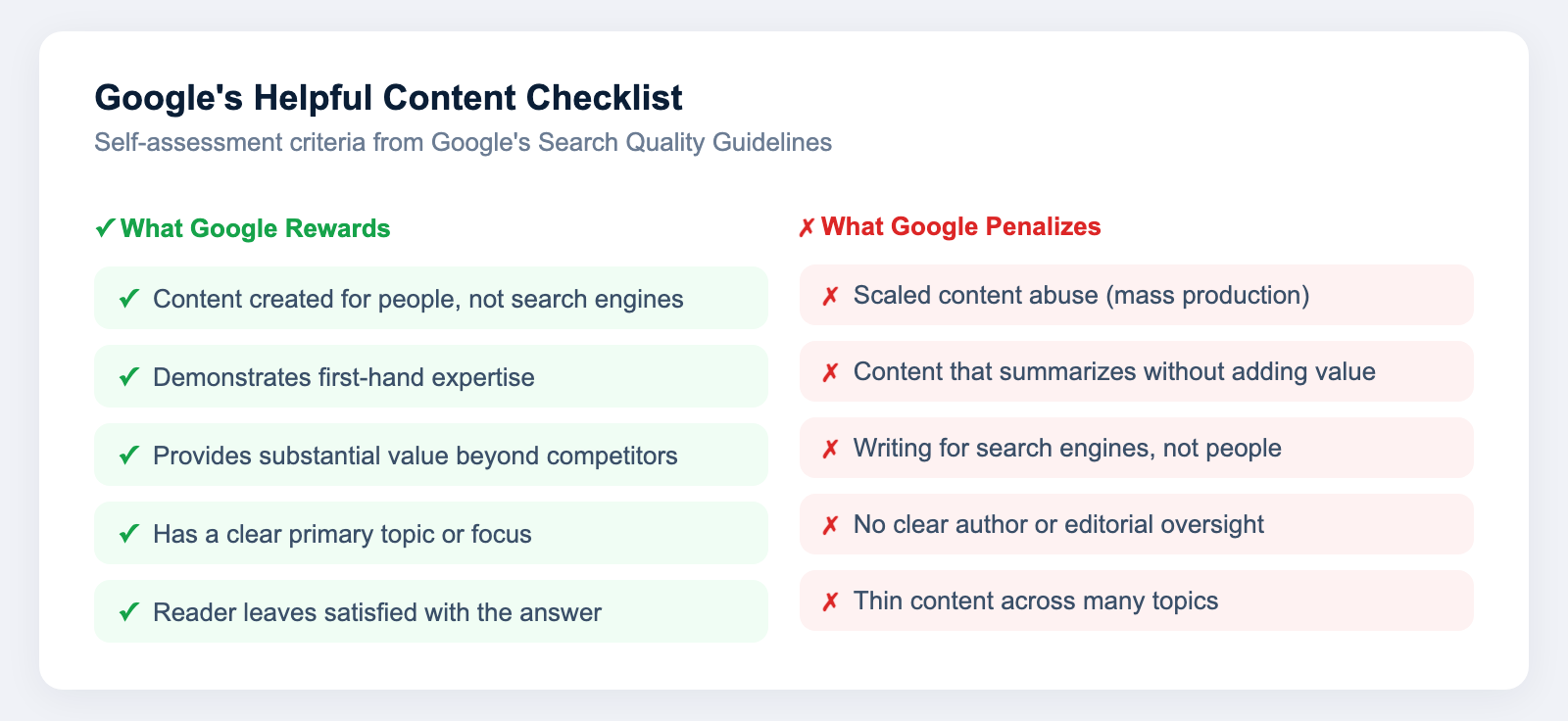
Demonstrates first-hand experience or expertise
This is the "E" in EEAT that challenges AI content most directly. Solutions include: named author attribution with real credentials, expert quotes from practitioners, case study data from real implementations, and original analysis that goes beyond synthesis.
Provides a satisfying answer
Content must fully answer the search query. For informational queries, this means comprehensive coverage with supporting data. For transactional queries, this means clear comparisons with actionable recommendations. Every section must stand alone as a complete answer to its heading question.
Adds original value
Original data, unique analysis, novel frameworks, or proprietary research. Content clusters help here: a cluster of 10 interlinked articles on a topic demonstrates depth that individual articles cannot. Clusters drive 30% more traffic and hold rankings 2.5x longer[5] because they signal genuine authority.
Cites authoritative sources
Statistics every 150-200 words with linked citations. Cited content receives 40% more AI search visibility. Source quality matters: academic and industry research outranks blog opinions. Every claim in this article, for example, links to its original source.
Serves a real audience
Content created for a specific reader with a specific problem. Not content created because a keyword has search volume. The distinction is subtle but critical: helpful content starts with the reader's need, not the keyword opportunity.
How Does EEAT Apply to AI Content After the Helpful Content Update?
EEAT - Experience, Expertise, Authoritativeness, Trustworthiness - is Google's quality evaluation framework. After the Helpful Content system merged into core ranking, EEAT signals carry even more weight.
Here is how to engineer EEAT into AI content:
Experience: Include real-world examples, case studies, and practical applications. Attribute content to authors who have hands-on experience. "Based on analysis of 600,000 pages" is an experience signal. "Some studies show" is not.
Expertise: Cover topics in depth. Use specific numbers, named tools, defined methodologies. AI content that stays surface-level fails the expertise test. Deep content with 3,000+ words, comparison tables, and step-by-step frameworks demonstrates expertise[4].
Authoritativeness: Build topical authority through content clusters. A site with 50 interlinked articles about SEO carries more authority than a site with 5 random posts. Content clusters are the structural embodiment of authority[5].
Trustworthiness: Cite sources. Display author credentials. Include methodology descriptions. Acknowledge limitations. Provide balanced viewpoints. Trustworthy content does not oversell or overpromise.
For a detailed comparison of how AI and human content score on EEAT dimensions, read our post on AI content vs. human writers for SEO.
What Changed Between 2023 and 2026 in Google's AI Content Approach?
Google's approach to AI content has evolved significantly. Here is the timeline:
| Date | Change | Impact on AI Content |
|---|---|---|
| Aug 2022 | Helpful Content Update launches | Separate ranking signal targeting unhelpful content |
| Feb 2023 | Google publishes AI content guidance | "Quality matters, not production method" stance |
| Sep 2023 | Helpful Content Update v2 | Stricter quality signals, more sites affected |
| Mar 2024 | Helpful Content folded into core ranking | No separate penalty - helpfulness is now continuous |
| Jul 2025 | Ahrefs 600K study published | Data confirms: 86.5% of top results use AI, 0.011 penalty correlation |
The trend is clear: Google has moved from "we are watching AI content" to "AI content is fine if it is helpful." Each update has reinforced quality as the deciding factor, not production method[3].
The March 2024 merger into core ranking was the definitive signal. There is no longer a separate "Helpful Content classifier" that treats AI content differently. There is one ranking system that evaluates all content on the same quality dimensions.
How to Produce AI Content That Passes Google's Quality Checks
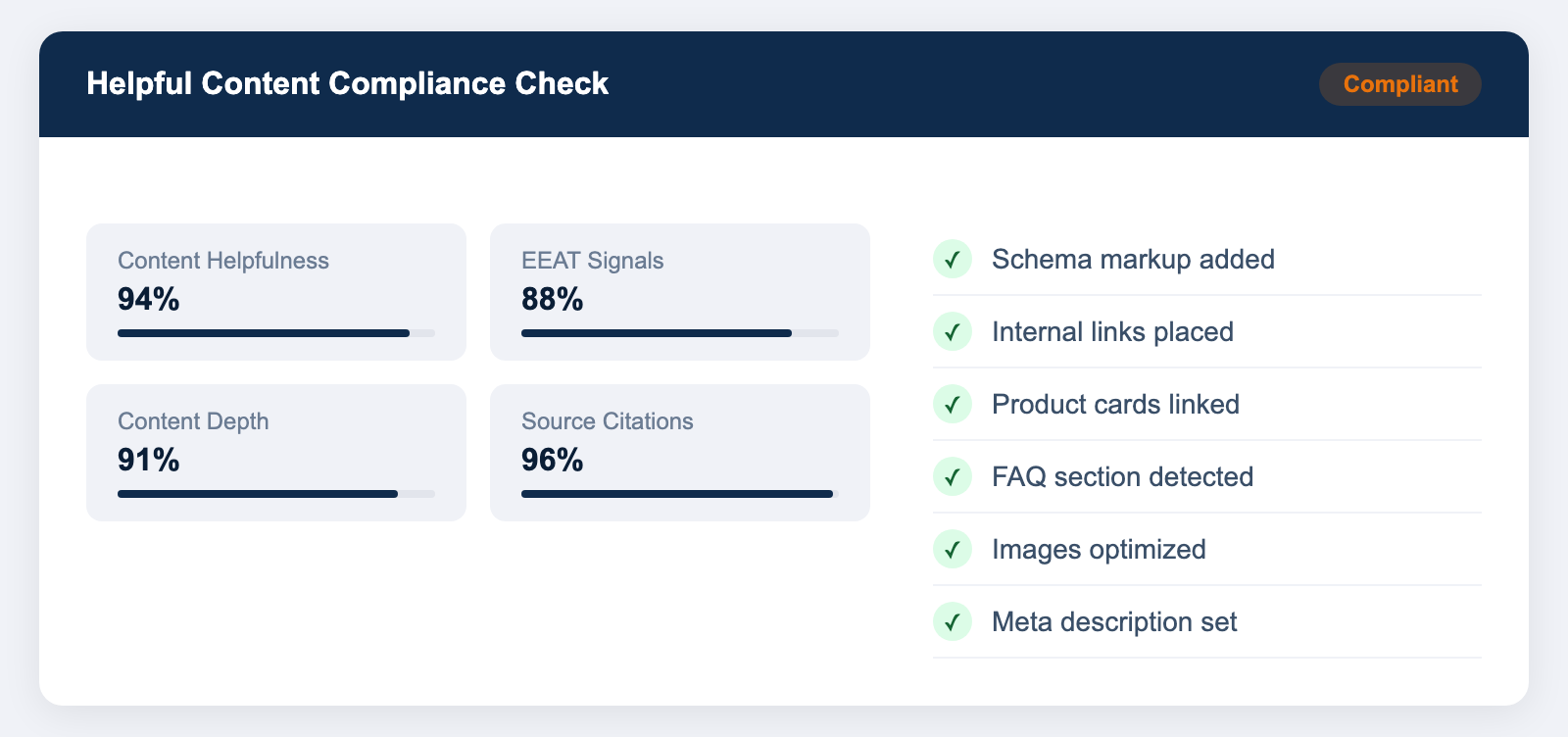
Based on Google's guidelines, the ranking data, and the EEAT framework, here is the production checklist for AI content that complies with the Helpful Content system:
Before writing
- Verify the topic is within your site's area of expertise
- Research the SERP: what are the top results missing?
- Define the content cluster the article belongs to
- Assign a named author with verifiable credentials
During AI generation
- Require minimum 2,000 words for depth (3,000+ for pillar posts)
- Include question-phrased H2 headings for each section
- Mandate source citations every 150-200 words
- Add comparison tables for any multi-option discussion
- Include FAQ section with 3-5 specific questions
During human editing
- Verify every factual claim and statistic
- Add original insights, examples, and experience
- Ensure each section completely answers its heading question
- Check that content adds value beyond existing search results
- Remove any generic filler or hedging language
Before publishing
- Confirm EEAT signals: author bio, citations, methodology
- Verify internal links to related cluster content
- Add schema markup (Article, FAQ, BreadcrumbList)
- Check SEO score meets minimum threshold (85+)
Platforms like GetTraffic automate many of these checks through 6 quality gates that every article passes before publishing. This systematic approach ensures Helpful Content compliance at scale without requiring manual auditing of every piece.
What Happens If Your AI Content Gets Demoted?
Since the Helpful Content system merged into core ranking in March 2024, there is no single "penalty" to recover from. Instead, content quality is evaluated continuously. If your rankings drop, here is the recovery framework:
Step 1: Audit content quality. Review your lowest-performing pages against Google's helpfulness criteria. Identify pages that are thin, lack expertise, or fail to answer the query fully.
Step 2: Improve or remove. Update weak content with depth, citations, and expertise. Remove pages that cannot be improved - they drag down your site's overall quality signal. Quality over quantity applies at the site level.
Step 3: Rebuild with clusters. Organize remaining content into topical authority clusters. Interlink related articles. Fill gaps with new, high-quality content. Clusters signal depth and expertise[5].
Step 4: Monitor recovery. Ranking improvements from quality changes take 2-4 weeks to appear. Track rankings at the cluster level, not just individual pages. A rising cluster indicates Google recognizes improved quality.
Recovery is faster than it was under the old separate Helpful Content system. Because helpfulness is now a continuous ranking signal, every quality improvement translates directly to ranking improvement without waiting for a specific algorithm update.
SEO content that ranks, written and published for you
GetTraffic creates authority-building content clusters for your business. No writing, no freelancers, no content calendar. Agency-quality results at 91% less cost.
Start My Free TrialThe Future of AI Content Under Google's Quality Framework
Google's trajectory is unmistakable: production method is irrelevant, quality is everything. This direction benefits AI content producers who invest in quality - and punishes those who use AI as a shortcut.
Organic leads close at 14.6% compared to 1.7% for outbound[1]. SEO delivers $22 for every $1 invested[6]. These economics mean the businesses that master AI content production with quality controls will dominate organic search.
The Helpful Content system is not a threat to AI content. It is a quality standard that rewards well-executed content regardless of origin. Meet the standard, and your content ranks. Miss it, and no production method saves you.
The businesses building topical authority clusters with EEAT-compliant AI content are not worried about the Helpful Content Update. They are benefiting from it - because every quality-focused algorithm change widens their advantage over competitors publishing low-effort content.
Does Google's Helpful Content Update Penalize AI Specifically?
No. Google's Helpful Content system evaluates content quality, not production method. Their official guidance explicitly states that AI use is acceptable[3]. The Ahrefs 600,000-page study confirms this: the correlation between AI detection and ranking penalties is 0.011[2]. What triggers demotions is unhelpful content - whether AI or human-written. The focus is on quality signals like EEAT, depth, and genuine helpfulness.
How Do You Know If Your Content Is "Helpful" by Google's Standards?
Google provides specific self-assessment questions: Does the content demonstrate first-hand expertise? Would a reader feel satisfied after reading it? Does it add value beyond what is already available? Is it written for people, not search engines? If you answer "yes" to these questions, your content aligns with the Helpful Content framework. The 16-month study data confirms this: content that meets quality standards - whether AI or human - performs within 4% of each other[4].
Can You Recover From a Helpful Content Demotion?
Yes. Since March 2024, the Helpful Content system is part of core ranking[3], so improvements are evaluated continuously. Audit weak content, improve or remove unhelpful pages, rebuild with topical authority clusters, and monitor rankings over 2-4 weeks. Every quality improvement translates to ranking improvement without waiting for a specific algorithm update cycle.
What EEAT Signals Matter Most for AI Content?
The most impactful EEAT signals for AI content are: named author attribution with verifiable credentials, cited sources from authoritative publications (every 150-200 words), original data or analysis, content depth (2,000+ words), and topical authority demonstrated through content clusters[5]. Human editing adds the experience and expertise layers that raw AI output lacks - closing the ranking gap from 23% to 4%[4].
Is It Safe to Scale AI Content Production in 2026?
Yes, with quality controls. The data shows 86.5% of top-ranking pages use AI[2]. Scaling is safe when every article passes quality gates: EEAT compliance, expert editing, source citations, and topical relevance. Scaling without quality controls - mass-producing thin content across unrelated topics - triggers demotions. The production method is not the risk. The quality standard is what determines outcomes.
For the unified content architecture that consistently passes the Helpful Content System and ranks in both Google and AI engines, see AI SEO Content in 2026: The Complete Guide.
References
- BrightEdge (2024). How Much Traffic Comes From Organic Search. seoinc.com
- Ahrefs (2025). AI-Generated Content Does Not Hurt Your Google Rankings. ahrefs.com
- Google (2023). Google Search and AI Content. developers.google.com
- DigitalApplied (2025). AI-Generated vs. Human Content: 16-Month Google Ranking Study. digitalapplied.com
- ClickRank (2025). Topical Authority. clickrank.ai
- SEOProfy (2025). SEO ROI Statistics. seoprofy.com
Frequently Asked Questions
What does the Helpful Content Update penalize?
Does the HCU specifically target AI content?
How do I recover from a Helpful Content demotion?
What kinds of AI content are safe under HCU?
Will using AI guarantee a Helpful Content penalty?
How does GetTraffic ensure HCU compliance?
Get your business on page 1 of Google
Get your business found on Google - SEO content written and published automatically.
Start My Free Trial7-day free trial