
AI Content vs. Human Writers: Real SEO Comparison (2026)


Table of Contents +
- How Do AI and Human Content Compare in Google Rankings?
- What Does Quality Look Like for AI vs. Human Content?
- How Do Costs Compare Between AI Content and Human Writers?
- What About Speed and Scale?
- How Does the Backlink Gap Affect Long-Term SEO Performance?
- When Should You Use AI Content vs. Human Writers?
- What Does the Hybrid Workflow Look Like in Practice?
- What Will AI Content vs. Human Content Look Like in 2027?
- The Bottom Line: AI Content vs. Human Writers for SEO
- Can Google Detect AI Content?
- Is It Worth Hiring Human Writers for SEO in 2026?
- How Much Does AI Content Cost Compared to Human Writers?
- References
AI content vs. human writers for SEO: rankings within 4% when edited, 70-90% lower cost, 61% fewer backlinks. Full data comparison.
TL;DR: Human-edited AI content performs within 4% of purely human content in Google rankings. Unedited AI content ranks 23% lower. The best approach is hybrid: AI for speed and scale, human expertise for quality and trust. The data does not support choosing one over the other.
The AI vs. human content debate generates more heat than light. Marketers argue in absolutes - "AI content is garbage" or "human writers are obsolete" - while the data tells a more nuanced story. With organic search driving 53% of all website traffic[1] and organic leads closing at 14.6% vs. 1.7% for outbound[1], the content production method you choose directly impacts revenue.
This comparison uses data from the Ahrefs 600,000-page study and a 16-month controlled ranking experiment to compare AI and human content across every metric that matters: quality, cost, speed, rankings, and backlinks. No opinions - just numbers.
How Do AI and Human Content Compare in Google Rankings?
Rankings are the metric that matters most for SEO. A 16-month longitudinal study tracked hundreds of articles across three production methods to measure ranking performance over time[2].
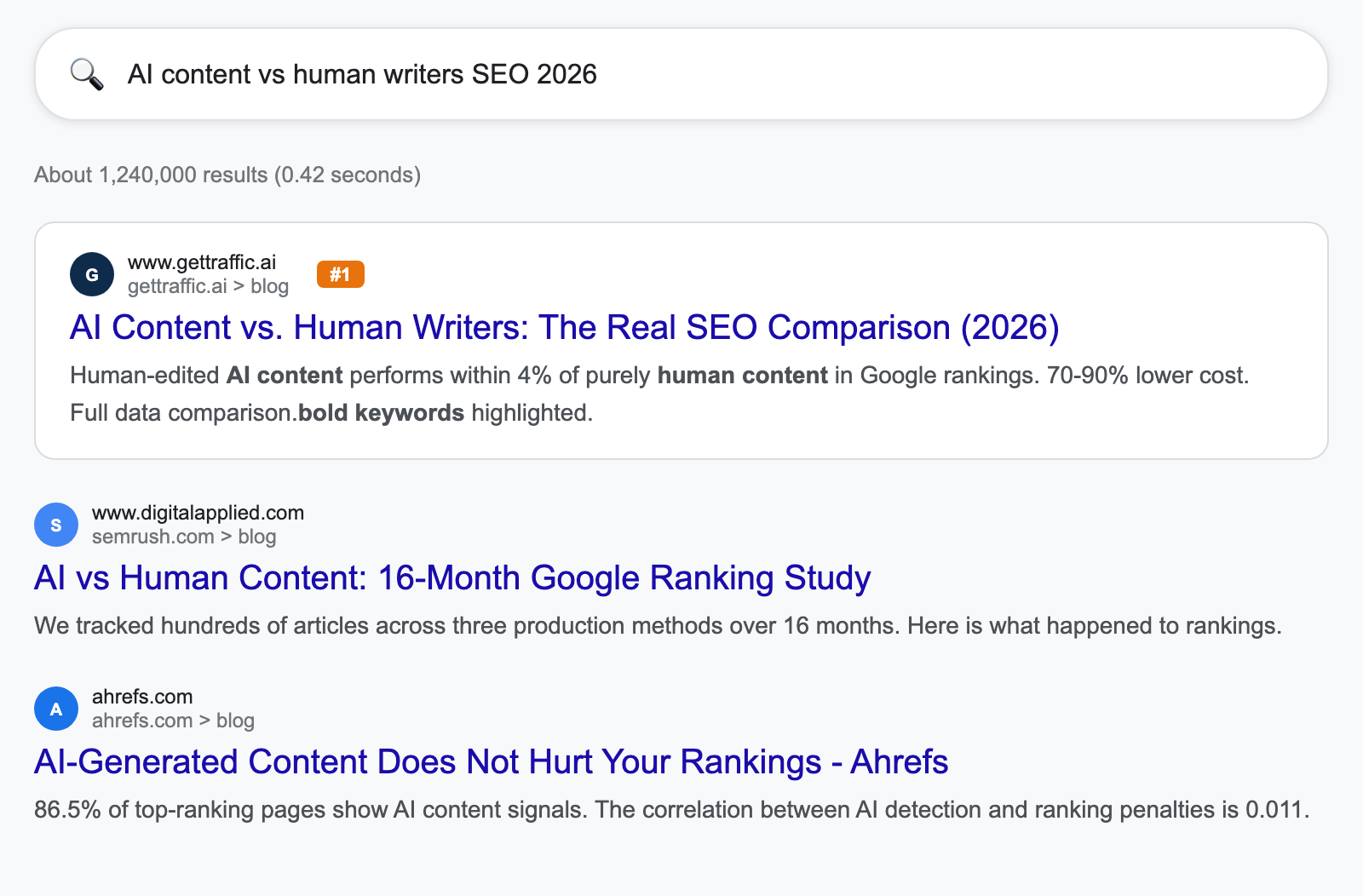
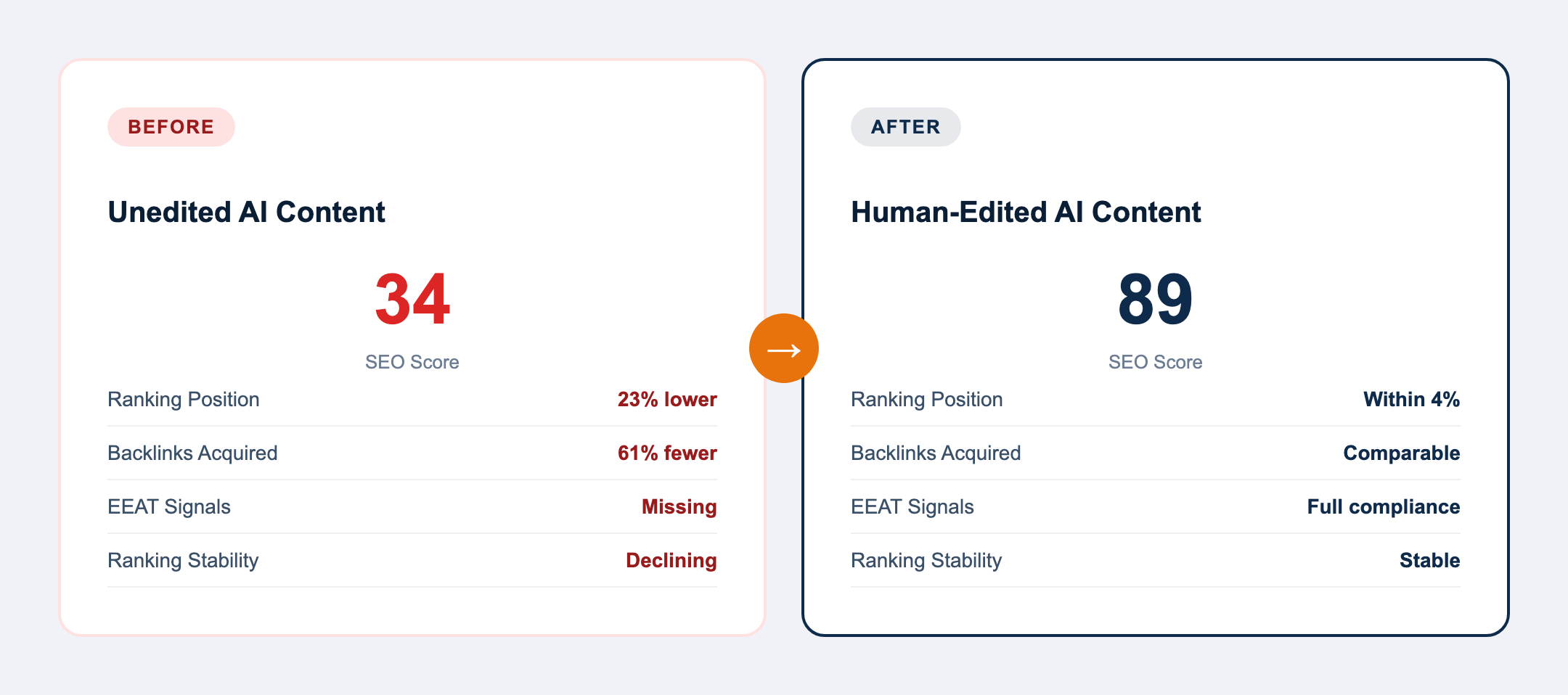
| Metric | Human Content | AI (Edited) | AI (Unedited) |
|---|---|---|---|
| Average ranking position | Baseline | 4% lower | 23% lower |
| Backlinks acquired | Baseline | Comparable | 61% fewer |
| Ranking stability (16 months) | Stable | Stable | Declining |
The 4% gap between edited AI content and human content is within normal ranking variance[2]. In practical terms, this difference is invisible in traffic and revenue outcomes. The 23% gap for unedited AI content, however, is significant - and it widens over the study period as human content accumulates more backlinks and engagement signals.
For the full data set on AI content ranking performance, see our pillar post: does AI content rank on Google? What 600,000 pages tell us.
GetTraffic writes and publishes SEO content automatically - articles that build authority and drive organic traffic - start your free trial.
What Does Quality Look Like for AI vs. Human Content?
Quality is not a single dimension. Here is how AI and human content compare across the quality factors Google evaluates:
Accuracy and fact-checking
Human writers with domain expertise produce more accurate first drafts. AI generates plausible-sounding content that sometimes contains errors, outdated information, or fabricated citations. The editing step for AI content is primarily about accuracy verification.
Depth and expertise
Human experts bring original insights, real-world experience, and nuanced understanding that AI cannot replicate. AI excels at synthesizing existing information comprehensively. The best content combines both: AI for breadth, human expertise for depth.
EEAT signals
Google's quality framework - Experience, Expertise, Authoritativeness, Trustworthiness - inherently favors content with human expertise signals. AI content requires intentional EEAT engineering: author attribution, source citations, expert quotes, and demonstrated methodology. Without these additions, AI content scores lower on trust signals.
Readability and engagement
AI produces grammatically correct, well-structured content consistently. Human writers produce more varied, engaging, and emotionally resonant copy. For informational SEO content, AI's consistency is often sufficient. For brand storytelling and thought leadership, human voice remains essential.
The quality verdict: AI content reaches "good enough for SEO" quickly and cheaply. Reaching "great" requires human involvement regardless of the starting point.
How Do Costs Compare Between AI Content and Human Writers?
Cost is where AI content delivers its clearest advantage. SEO delivers a median ROI of 748% - $22 for every $1 invested[3]. The less you spend on content production, the higher your return.
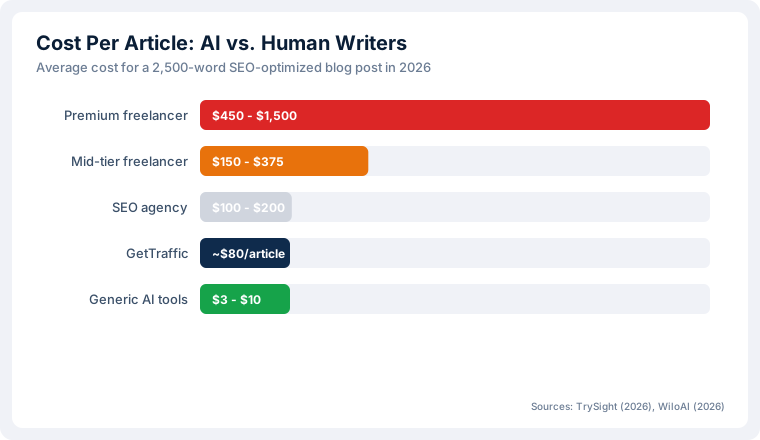
| Production Method | Cost per Article | Monthly Cost (10 articles) | Time to Publish |
|---|---|---|---|
| In-house writer (salary) | $300-800 | $3,000-8,000 | 3-5 days per article |
| Freelance SEO writer | $200-500 | $2,000-5,000 | 5-7 days per article |
| SEO agency | $500-1,500 | $5,000-15,000 | 2-4 weeks per batch |
| AI platform (with editing) | $30-150 | $300-1,500 | Same day |
| Raw AI (no editing) | $5-15 | $50-150 | Minutes |
The cost difference is 70-95% depending on the comparison. On the GetTraffic single plan (€249/month for 10 articles), the cost per article with full EEAT compliance and quality gates comes to roughly €25 (~$27) - compared to $300-1,500 for equivalent human-produced content.
The hidden cost many businesses miss: inconsistency. Human writers take vacations, miss deadlines, and produce variable quality. AI platforms deliver consistent output on a predictable schedule. For SEO, where consistency of publishing matters as much as individual article quality, this reliability carries real value.
What About Speed and Scale?
Content velocity matters for SEO. Content clusters drive 30% more traffic and hold rankings 2.5x longer than standalone articles[4]. Building a complete cluster of 10-15 articles requires significant production capacity.
Human timeline: A skilled writer produces 1-2 quality SEO articles per week. Building a 10-article cluster takes 5-10 weeks. During that time, competitors publish and index their own content.
AI timeline: An AI platform generates 10 articles in hours. With editing, the complete cluster is ready in 1-2 weeks. Faster indexing means faster ranking signals and earlier traffic.
This speed advantage compounds. A business using AI can build topical authority across 3-4 clusters in the time it takes a human-only operation to complete one. Since Google rewards topical depth[4], the business with more complete clusters ranks better across all related keywords.
The counterargument is valid: speed without quality is waste. Raw AI content published at scale performs 23% worse[2]. The solution is not choosing between speed and quality - it is building a workflow that delivers both.
How Does the Backlink Gap Affect Long-Term SEO Performance?
Backlinks remain a primary ranking factor. The 16-month study revealed AI content's biggest weakness: a 61% backlink acquisition gap compared to human content[2].
Why does AI content attract fewer links? Three reasons:
- Lack of original insights: AI synthesizes existing information. Journalists and bloggers link to original research, unique data, and novel perspectives.
- Generic voice: AI content sounds similar across platforms. Content that reads like everything else does not earn "I need to share this" reactions.
- No relationship network: Human writers have professional networks. They share content with peers who link back. AI has no social graph.
The solution is not abandoning AI - it is engineering linkability into AI content:
- Add original data, surveys, or case studies
- Include expert quotes from named sources
- Create unique visual assets (charts, infographics, comparison tables)
- Build content clusters where internal links compensate for fewer external ones
Content clusters mitigate the backlink gap by distributing link authority across connected articles. One strong article with backlinks lifts the entire cluster[4].
When Should You Use AI Content vs. Human Writers?
The data points to a clear decision framework:
Use AI content (with editing) when:
- You need to build topical authority quickly across multiple clusters
- The content is informational or how-to in nature
- Budget constraints prevent hiring enough human writers
- Publishing consistency is more important than individual article brilliance
- You have domain experts available for editing but not writing
Use human writers when:
- Content requires original research, interviews, or firsthand experience
- The topic is YMYL (health, finance, legal) and requires certified expertise
- Brand voice and emotional storytelling are primary goals
- The content strategy relies on thought leadership and personal authority
- Backlink acquisition is the primary objective (outreach-driven content)
Use the hybrid approach when:
- You want 96% of human ranking performance at 70-90% lower cost
- You need scale AND quality
- Your content strategy combines informational and expert-level content
Most businesses in 2026 fall into the hybrid category. The data does not support a purely AI or purely human approach for SEO content.
What Does the Hybrid Workflow Look Like in Practice?
The optimal workflow based on the ranking data:
Phase 1 - Strategy (human): Keyword research, cluster mapping, content briefs. Human strategists define the topical authority plan. This is where platforms like GetTraffic add value - automating the strategy phase with data-driven cluster recommendations while keeping human oversight on targeting decisions.
Phase 2 - First draft (AI): AI generates comprehensive first drafts following the content brief, EEAT requirements, and target structure. Quality gates ensure minimum standards: word count, heading structure, keyword coverage, source citations.
Phase 3 - Expert editing (human): Domain experts review for accuracy, add original insights, verify sources, and enhance with real-world experience. This is the step that closes the 23% ranking gap to 4%[2].
Phase 4 - Technical optimization (AI): Schema markup, internal linking, meta tags, image optimization. AI handles the technical SEO requirements consistently across every article.
Phase 5 - Publishing and monitoring (automated): One-click CMS publishing, indexing monitoring, ranking tracking. Automation ensures nothing falls through the cracks.
This workflow produces content that is 96% as effective as pure human content at a fraction of the cost - and it scales to any volume your strategy requires.
SEO content that ranks, written and published for you
GetTraffic creates authority-building content clusters for your business. No writing, no freelancers, no content calendar. Agency-quality results at 91% less cost.
Start My Free TrialWhat Will AI Content vs. Human Content Look Like in 2027?
Based on current trajectories:
AI content quality will improve. Each generation of language models produces more accurate, nuanced, and expert-sounding content. The editing burden will decrease, further improving the cost advantage.
Human expertise will become more valuable, not less. As AI content floods every niche, the differentiator becomes genuine expertise, original data, and authentic voice. Human experts who can add these signals will command premium rates.
The hybrid approach will become standard. Pure human content operations will be too slow and expensive. Pure AI operations will lack differentiation. The businesses that build efficient hybrid workflows now will have a structural advantage.
Google will continue rewarding quality. Google's March 2024 decision to fold the Helpful Content system into core ranking[5] reinforces their direction: evaluate content quality, not production method. This trend benefits well-executed AI content. For more on how Google's updates affect AI content, read our guide on how Google's Helpful Content Update affects AI content in 2026.
The Bottom Line: AI Content vs. Human Writers for SEO
The comparison data is clear:
| Dimension | Winner | Data Point |
|---|---|---|
| Rankings | Tie (with editing) | 4% gap - within variance[2] |
| Cost | AI | 70-90% lower production cost |
| Speed | AI | 10x faster production |
| Backlinks | Human | 61% more links acquired[2] |
| EEAT signals | Human | Natural expertise signals |
| Scale | AI | Unlimited production capacity |
| Consistency | AI | Uniform quality baseline |
| Originality | Human | Novel insights and data |
AI wins on cost, speed, scale, and consistency. Human wins on backlinks, EEAT, and originality. Rankings are a tie when AI content is properly edited. The answer is not "which is better" - it is "how do you combine both for maximum ROI?"
With SEO delivering $22 for every $1 invested[3], the production method that lets you publish more high-quality content, faster, at lower cost wins. In 2026, that is the hybrid approach.
Can Google Detect AI Content?
Google has AI detection capabilities but does not use them as a ranking factor. The Ahrefs study of 600,000 pages found 86.5% of top-ranking content shows AI signals[6] with a penalty correlation of just 0.011. Google evaluates content quality, not production method. Their official guidelines confirm that AI use is acceptable when the content is helpful and high-quality[5].
Is It Worth Hiring Human Writers for SEO in 2026?
Yes, but not for every piece of content. Human writers are essential for thought leadership, original research, YMYL topics, and content designed to earn backlinks. For informational SEO content at scale, AI with human editing delivers 96% of the ranking performance at 70-90% lower cost[2]. The optimal approach is hybrid: use human writers strategically for high-value content and AI for scalable production.
How Much Does AI Content Cost Compared to Human Writers?
AI content platforms cost $30-150 per article with editing, compared to $200-1,500 for freelance or agency-produced content. At 10 articles per month, AI saves $2,000-13,500 monthly. The ranking performance difference is just 4% when AI content includes human editing[2], making the cost-per-ranking-position dramatically lower with AI.
For where AI content fits into a complete 2026 SEO workflow - including the EEAT signals, schema markup, and topical clustering that close the 4% gap with human-written content - see AI SEO Content in 2026: The Complete Guide.
References
- BrightEdge (2024). How Much Traffic Comes From Organic Search. seoinc.com
- DigitalApplied (2025). AI-Generated vs. Human Content: 16-Month Google Ranking Study. digitalapplied.com
- SEOProfy (2025). SEO ROI Statistics. seoprofy.com
- ClickRank (2025). Topical Authority. clickrank.ai
- Google (2023). Google Search and AI Content. developers.google.com
- Ahrefs (2025). AI-Generated Content Does Not Hurt Your Google Rankings. ahrefs.com
Frequently Asked Questions
Does AI content rank as well as human-written content?
How much cheaper is AI content vs hiring a writer?
Do AI articles get fewer backlinks than human articles?
When should you use AI content vs a human writer?
Will Google detect and penalize AI content?
How does GetTraffic combine AI generation and human editing?
Get your business on page 1 of Google
Get your business found on Google - SEO content written and published automatically.
Start My Free Trial7-day free trial