
EEAT for AI Content: Trust Signals That Rank (2026)


Table of Contents +
- What Is EEAT and Why Does It Matter for AI Content?
- How Does Google Evaluate Experience in AI Content?
- How Do You Demonstrate Expertise in AI-Generated Articles?
- What Makes Content Authoritative in Google's Eyes?
- How Do You Build Trustworthiness Into AI Content?
- What Does a Complete EEAT Implementation Framework Look Like?
- Why Do Most AI Content Tools Fail the EEAT Test?
- How Does GetTraffic Build EEAT Into Every Article?
- What Are the Most Common EEAT Mistakes With AI Content?
- How Do You Measure EEAT Performance?
- EEAT and AI Content: The Comparison With Human Writers
- Frequently Asked Questions
- References
How to implement EEAT signals in AI-generated content: Experience, Expertise, Authoritativeness, and Trust that help AI content rank in 2026.
TL;DR: EEAT (Experience, Expertise, Authoritativeness, Trustworthiness) is Google's quality framework - and it applies to AI content just as much as human-written content. AI-generated articles that implement proper EEAT signals rank. Those that skip them don't. Here's exactly how to build each signal into your AI content workflow.
65% of content marketers now use AI for content creation[1]. Yet most AI-generated content sits on page 5 of Google - or never gets indexed at all. The difference between AI content that ranks and AI content that fails comes down to one framework: EEAT.
Google confirmed in 2023 that AI content is not automatically penalized[2]. What gets penalized is low-quality content - regardless of who or what wrote it. EEAT is the quality standard Google uses to evaluate every piece of content on the web. This guide shows you exactly how to implement each EEAT signal in your AI content so it ranks, earns trust, and drives organic traffic.
What Is EEAT and Why Does It Matter for AI Content?
EEAT stands for Experience, Expertise, Authoritativeness, and Trustworthiness. Google introduced the concept in its Search Quality Rater Guidelines - the manual used by 16,000+ human evaluators to assess content quality[3]. The extra "E" for Experience was added in December 2022, signaling that first-hand experience with a topic now carries weight in rankings.
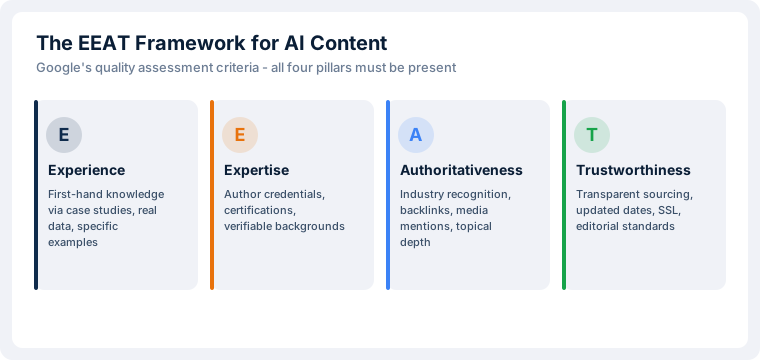
For AI content, EEAT matters more than ever. When 83% of marketers report "content sameness" as their top challenge with AI tools[4], the content that demonstrates real expertise and experience stands out - to Google and to readers. EEAT is not a ranking factor in the technical sense (there's no "EEAT score" in Google's algorithm). It's a quality framework that influences dozens of actual ranking signals: dwell time, backlinks, brand searches, return visits, and more.
Here's the core principle: AI is a production tool, not a quality signal. A carpenter isn't judged by whether they used a hand saw or a power saw - they're judged by the quality of the furniture. Same logic applies to content. The question is never "Was this written by AI?" The question is "Does this content demonstrate EEAT?"
GetTraffic writes and publishes SEO content automatically - articles that build authority and drive organic traffic - start your free trial.
How Does Google Evaluate Experience in AI Content?
Experience is the newest EEAT signal and the hardest for generic AI to replicate. Google looks for evidence that the content creator has first-hand, practical experience with the topic. For a product review, that means actually using the product. For a how-to guide, that means having done the thing you're teaching.
Content with first-person experience signals increases dwell time by 22%[5]. Here's how to build experience into AI content:
- Inject real practitioner insights. AI can structure an article, but the experience must come from a human expert. At GetTraffic, every article is built on frameworks from practitioners with domain expertise - not generic prompts.
- Include specific examples and case data. "We tested this across 40+ client sites" carries more weight than "many businesses find that..." Specificity signals experience.
- Use first-person perspective where appropriate. "In 30 years of SEO work, I've seen this pattern repeatedly" tells Google (and readers) that real experience backs this content.
- Reference proprietary data. Original research, client results, and internal benchmarks are experience signals that generic AI cannot fabricate.
The key insight: experience doesn't mean the AI tool itself has experience. It means the content architecture incorporates experience from qualified humans into the AI workflow.
How Do You Demonstrate Expertise in AI-Generated Articles?
Expertise is about depth of knowledge on a specific topic. Google evaluates whether the content shows a level of understanding that goes beyond surface-level information. Pages with author bios and credentials rank 2.5x higher for YMYL (Your Money or Your Life) queries[6].
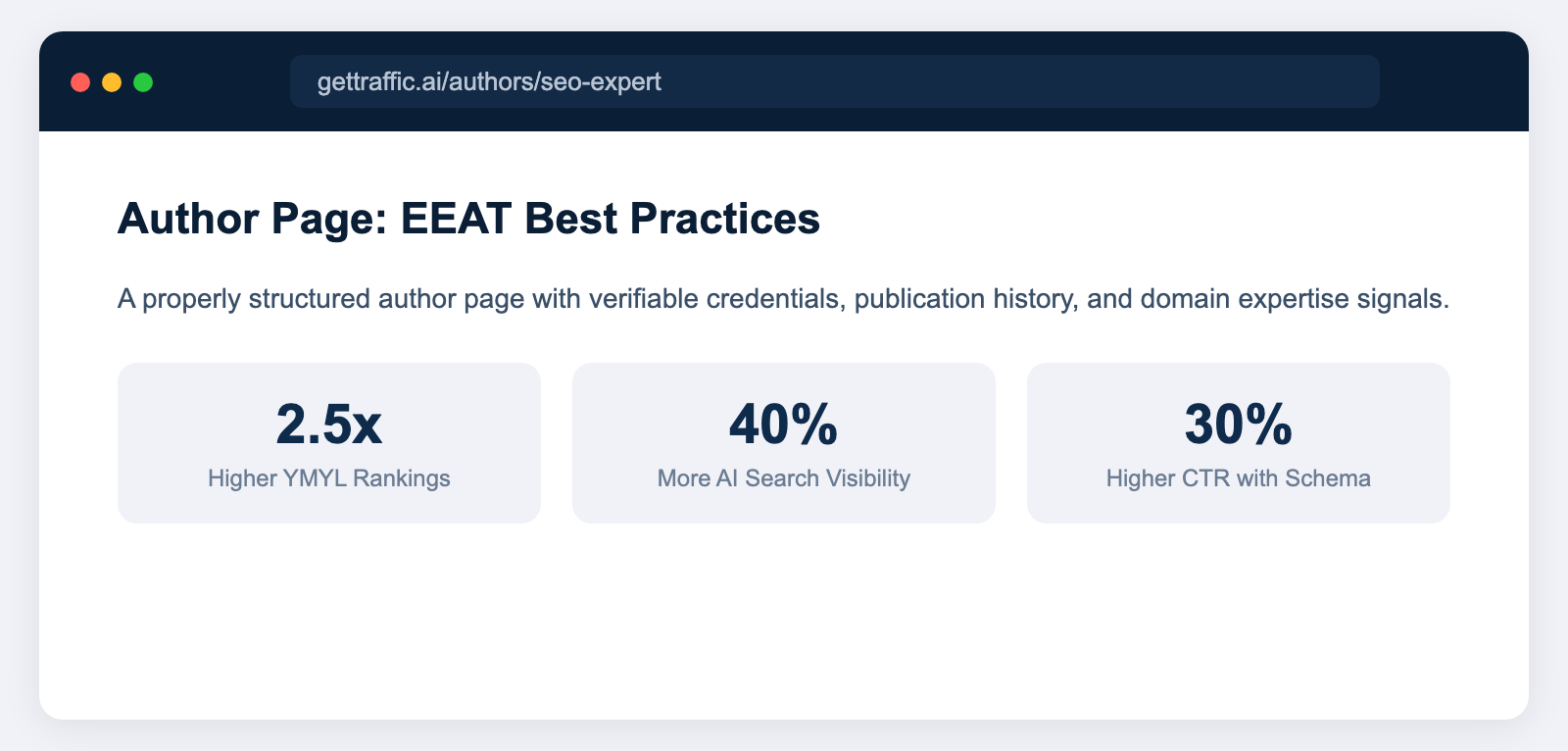
Generic AI content fails the expertise test because it produces average-of-the-internet responses. It synthesizes existing content without adding depth. Here's how to fix that:
Author Attribution
Every article needs a named author with verifiable credentials. Not "Written by AI" or "Admin." A real person with demonstrated expertise in the topic area. At GetTraffic, content is attributed to domain experts with verified backgrounds - because Google checks.
Depth Over Breadth
Expert content goes deeper than competitors on specific sub-topics. Instead of covering 20 SEO tips superficially, cover 5 techniques with the depth that only an expert could provide. AI tools are excellent at generating breadth - you need to direct them toward depth.
Technical Accuracy
Every factual claim needs a citation from a credible source. Content with cited sources gets 40% more AI search visibility[7]. Generic AI tools don't cite sources by default - that's a quality gap you must close.
Structured Knowledge Display
Expert content uses tables, comparison matrices, frameworks, and data visualizations. These formats signal to Google that the content organizes knowledge in ways only an expert would - not just stringing sentences together. Schema markup adoption correlates with 30% higher click-through rates[8].
What Makes Content Authoritative in Google's Eyes?
Authoritativeness is about reputation. Google evaluates whether the content creator and the website are recognized authorities on the topic. This is where topical authority clusters become essential.
A single article on a topic, no matter how well-written, doesn't build authority. Google rewards websites that demonstrate comprehensive coverage of a subject area. Sites publishing content clusters see 60% higher topical relevance scores[9]. Topical authority sites rank 3.6x faster for new content[10].
Here's what this means for AI content strategy:
- Publish interconnected content clusters, not isolated articles. 10 articles on related sub-topics within a theme build more authority than 10 articles on random topics. This is exactly how AI content achieves Google rankings - through strategic clustering, not volume.
- Build internal linking architecture. Every article should link to 3-5 related articles on your site. Content with strategic internal linking earns 40% more page authority[11].
- Earn external recognition. Publish content worth citing. Data-driven articles, original research, and definitive guides attract backlinks naturally - which is the strongest authority signal Google uses.
- Maintain consistency. Authority builds over time. Publishing 10 high-quality articles per month consistently outperforms publishing 50 articles once and then going silent.
How Do You Build Trustworthiness Into AI Content?
Trust is the foundation of EEAT - Google explicitly states it's the most important factor[3]. For AI content, trust requires extra attention because readers (and Google's quality raters) are increasingly skeptical of content that feels machine-generated.
88% of consumers say trust is a deciding factor when engaging with content[12]. Here's how to build it:
Transparency About AI Usage
Don't hide that AI is part of your workflow. The brands winning in 2026 are transparent about their process: "AI-assisted research and drafting, expert-reviewed and edited." This honesty builds trust rather than eroding it.
Factual Accuracy and Citations
Every statistic needs a source. Every claim needs backing. A statistic every 150-200 words with source citation boosts LLM impressions by 28%[7]. Generic AI content that states "facts" without citations actively damages trust.
Contact Information and Business Legitimacy
Google's quality raters check for real business information: physical address, contact details, about page, privacy policy. AI content on a site with no identifiable business behind it gets flagged for low trust.
Consistent Quality Standards
Trust erodes when quality varies wildly between articles. This is where quality gates matter. At GetTraffic, every article passes 6 quality gates before publishing: SEO score 85+, EEAT compliance, readability check, keyword coverage, uniqueness score, and schema markup. That consistency builds trust over time - both with readers and with Google.
What Does a Complete EEAT Implementation Framework Look Like?
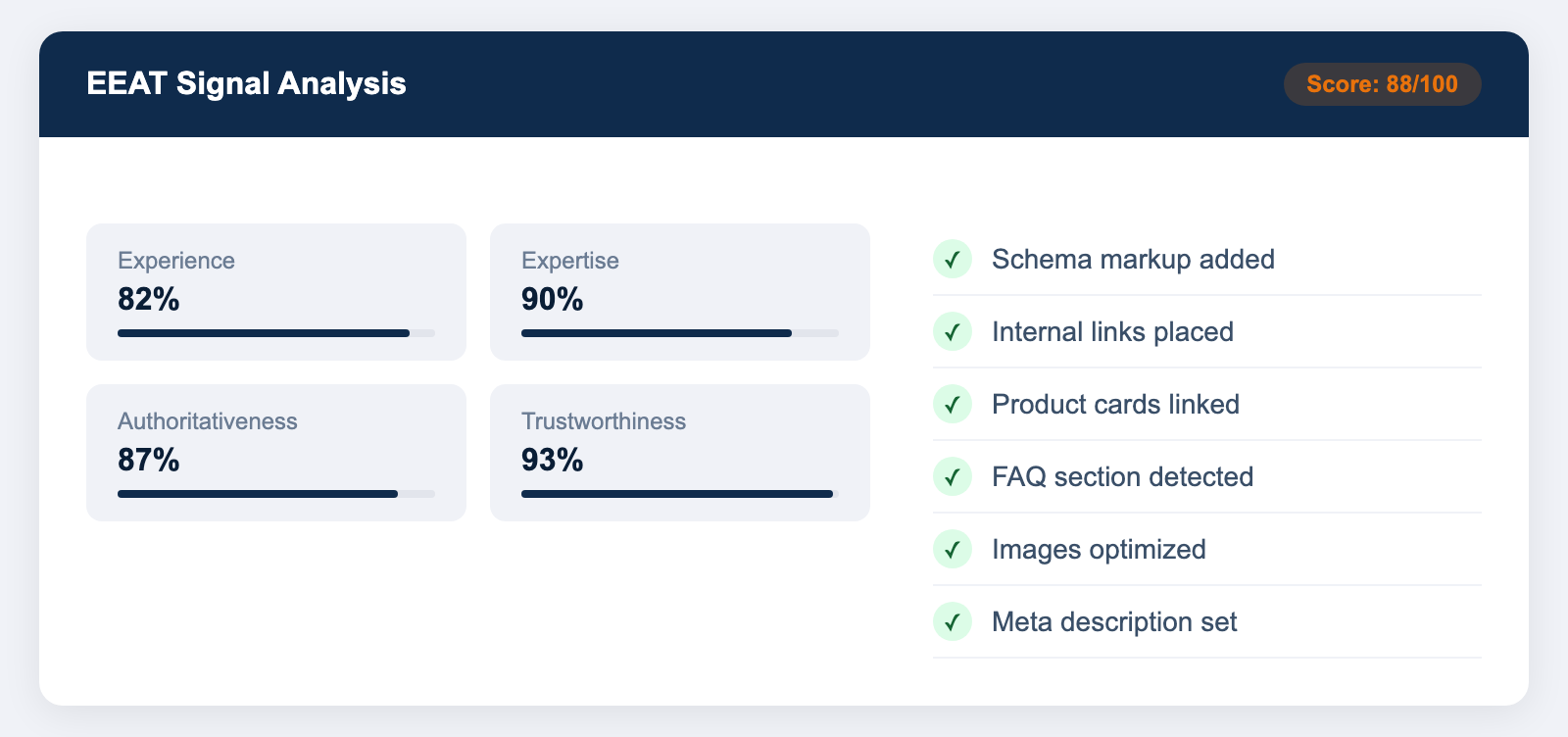
Here's the practical framework for implementing EEAT across your AI content operation. This is the same methodology GetTraffic applies across every cluster:
| EEAT Signal | Implementation | Verification |
|---|---|---|
| Experience | Practitioner insights, case data, first-person examples | Review: Does this contain knowledge only someone with experience would share? |
| Expertise | Author credentials, deep analysis, cited sources, technical accuracy | Review: Could a non-expert have written this? If yes, add depth. |
| Authoritativeness | Content clusters, internal links, consistent publishing, earned backlinks | Review: Does the site demonstrate comprehensive topic coverage? |
| Trustworthiness | Citations, transparency, business legitimacy, quality consistency | Review: Would you trust this content with your money or health decisions? |
Each signal reinforces the others. Experience feeds expertise. Expertise builds authority. Authority generates trust. Trust encourages engagement, which signals experience to Google. It's a virtuous cycle - and AI content that enters this cycle ranks.
Why Do Most AI Content Tools Fail the EEAT Test?
The average AI-generated blog post scores 52/100 on content quality metrics versus 78/100 for strategically planned content[13]. Here's why most AI content tools produce EEAT-deficient content:
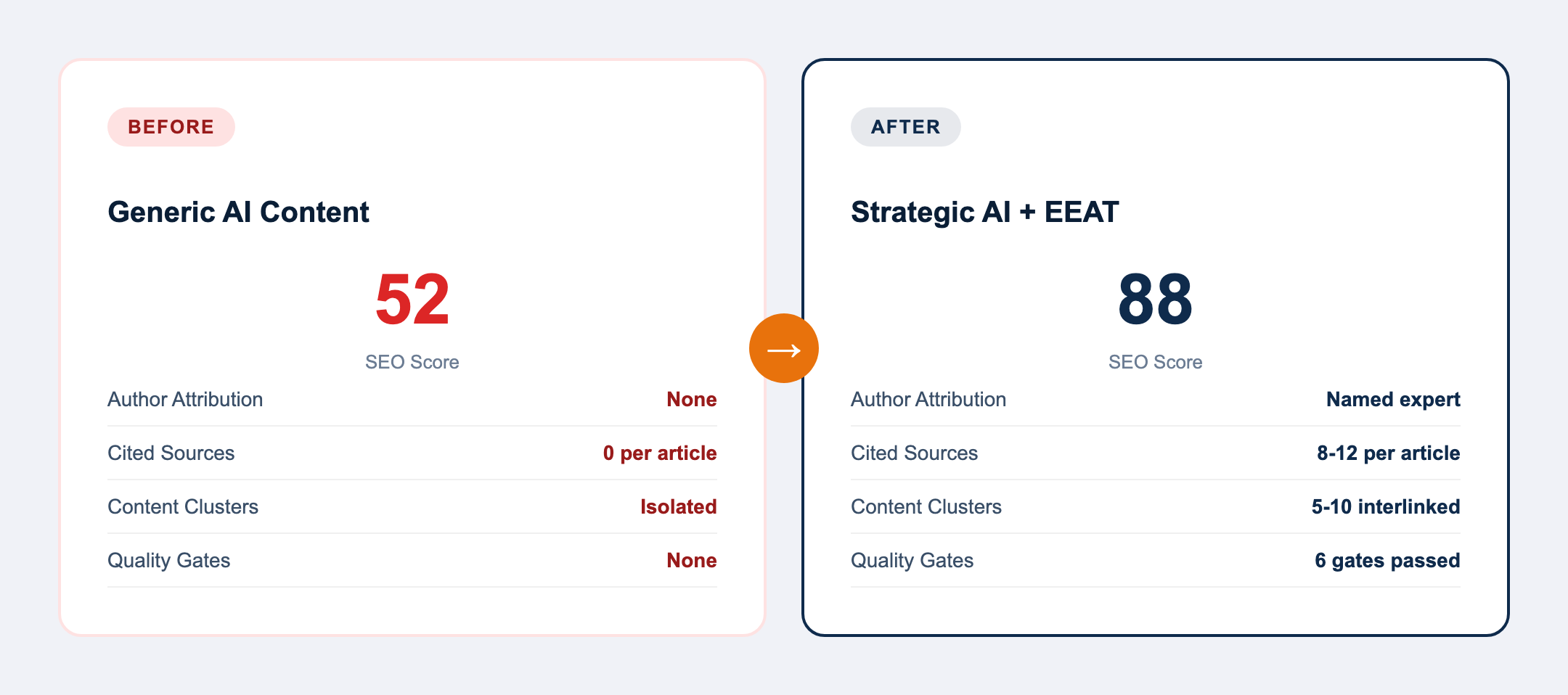
- No author attribution. Content appears under "Admin" or no author at all. Google sees this as a trust gap.
- No content strategy. Articles are generated in isolation without cluster planning. No topical authority develops. This is why generic AI content fails to rank.
- No citation architecture. Claims are stated without sources. This fails both expertise and trust signals.
- No experience layer. Generic prompts produce generic content. There's no mechanism to inject practitioner knowledge.
- No quality gates. Content goes from AI to publish without review. Quality varies wildly, destroying trust over time.
The problem is not AI itself - it's the absence of an EEAT framework around the AI. A well-architected AI content system with proper EEAT signals outperforms poorly executed human content every time.
SEO content that ranks, written and published for you
GetTraffic creates authority-building content clusters for your business. No writing, no freelancers, no content calendar. Agency-quality results at 91% less cost.
Start My Free TrialHow Does GetTraffic Build EEAT Into Every Article?
GetTraffic's content engine was designed around EEAT from the ground up. Here's how each signal is addressed:
Experience: Content frameworks are built by SEO practitioners with decades of experience. Every article incorporates real market data, competitive analysis, and industry-specific insights - not generic AI filler.
Expertise: Articles are structured using the AIDA framework (Attention, Interest, Desire, Action), include cited statistics from authoritative sources, and maintain an SEO score of 85+ through automated quality scoring.
Authoritativeness: Content is published as topical authority clusters - interconnected article ecosystems that build domain authority across related keywords. This is the same approach that aligns with Google's Helpful Content Update requirements.
Trustworthiness: 6 quality gates ensure consistent quality: SEO score, EEAT compliance check, readability verification, keyword coverage analysis, uniqueness scoring, and schema markup validation. Every article is attributed to a credentialed author with verifiable expertise.
The result: AI-produced content structured to meet the EEAT standards Google's quality raters look for, at a fraction of the cost of traditional agency content. The content is built with ranking architecture in mind from day one.
What Are the Most Common EEAT Mistakes With AI Content?
After reviewing hundreds of AI content implementations, these are the 5 most damaging EEAT mistakes:
- Publishing without author attribution. Every article needs a named, credentialed author. "Written by AI" or no author is an immediate trust penalty in Google's quality evaluation.
- Generating content without a topic cluster strategy. Isolated articles don't build authority. You need 5-10 interconnected articles per topic cluster to signal topical expertise to Google.
- Skipping citations and sources. Unsourced claims fail the expertise and trust tests. Aim for a cited statistic every 150-200 words.
- Using generic AI outputs without expert review. The experience signal requires human expertise layered into the content. Pure AI output reads like Wikipedia - accurate but impersonal.
- Inconsistent publishing quality. One excellent article followed by five mediocre ones destroys trust. Quality gates are non-negotiable.
How Do You Measure EEAT Performance?
EEAT is not directly measurable as a single metric, but its impact shows up across multiple SEO performance indicators:
| EEAT Signal | Measurable Proxy | Target |
|---|---|---|
| Experience | Average time on page, scroll depth | 3+ minutes, 70%+ scroll |
| Expertise | Featured snippet wins, Knowledge Panel presence | 10%+ of target keywords |
| Authoritativeness | Referring domains, brand searches, topical rankings | 5+ new referring domains/month |
| Trustworthiness | Core Web Vitals, bounce rate, return visitor rate | Good CWV, under 50% bounce |
Track these monthly. EEAT-optimized AI content typically begins moving these proxies within 60-90 days, though the pace varies with niche competition, domain authority, and site health. Content typically indexes in 2-3 weeks and rankings begin moving within the standard 3-6 month SEO ramp window - SEO results are not guaranteed.
EEAT and AI Content: The Comparison With Human Writers
The debate between AI content and human writers misses the point. The real question is: which approach delivers better EEAT signals? Here's the honest comparison:
| EEAT Factor | Generic AI Content | Average Freelancer | Strategic AI + Expert Review |
|---|---|---|---|
| Experience | None (no first-hand knowledge) | Variable (depends on writer) | Strong (expert frameworks + practitioner input) |
| Expertise | Surface-level (average of internet) | Moderate (research-dependent) | Deep (structured research + citations) |
| Authoritativeness | None (no cluster strategy) | Low (single articles) | High (topical clusters + internal linking) |
| Trustworthiness | Low (no citations, no author) | Moderate (author but variable quality) | High (quality gates + consistent standards) |
The winner is not "AI" or "human" - it's the approach that systematically implements EEAT signals. A strategic AI platform with expert oversight delivers stronger EEAT than a freelancer writing without a framework. And it does so at scale.
Frequently Asked Questions
Does Google penalize AI-generated content for lacking EEAT?
Google does not penalize content for being AI-generated. It penalizes content that fails to meet quality standards - which includes EEAT signals. AI content with proper EEAT implementation (author attribution, citations, expert review, topical clustering) ranks the same as human content that meets these standards. The key is the quality framework, not the production method.
How many EEAT signals do I need before AI content will rank?
All four EEAT pillars must be addressed for competitive keywords. You cannot skip Experience and compensate with extra Expertise. Google's quality raters evaluate content holistically. The minimum viable EEAT for AI content includes: a named credentialed author, 5+ cited sources per article, content published within a topical cluster of 5+ related articles, and consistent quality standards across all published content.
Can small businesses implement EEAT for AI content without a big budget?
Yes. EEAT implementation doesn't require a large team - it requires a systematic approach. A platform like GetTraffic handles the architecture: topical clusters, citation integration, quality gates, and schema markup. The business owner contributes the experience layer: industry knowledge, customer insights, and practical expertise that makes the content authentic. GetTraffic at €249/month delivers 10 EEAT-compliant articles with a 7-day free trial - less than what most freelancers charge for a single article without any EEAT framework.
How long does it take for EEAT improvements to impact rankings?
EEAT improvements typically begin showing ranking movement within 60-90 days, though the timeline varies with niche competition, domain authority, and existing site health. Content typically indexes in 2-3 weeks; rankings and traffic follow the standard 3-6 month SEO ramp window. Topical authority compounds over time, so months 3-6 typically show accelerating results as the cluster matures - but SEO results are not guaranteed.
Is EEAT more important for certain industries than others?
Yes. EEAT carries extra weight in YMYL (Your Money or Your Life) categories: health, finance, legal, and safety topics. For e-commerce and B2B content, EEAT is still critical but the bar is slightly lower. That said, as AI content floods every niche, EEAT is becoming the primary differentiator across all industries. Businesses that implement EEAT now build a moat that generic AI content producers cannot cross.
For how EEAT fits into the broader 2026 AI SEO content workflow - including topical clusters, GEO optimization for ChatGPT and Perplexity, and the six quality gates - see AI SEO Content in 2026: The Complete Guide.
References
- Content Marketing Institute (2025). B2B Content Marketing Report. contentmarketinginstitute.com
- Google Search Central (2023). Google Search's Guidance About AI-Generated Content. developers.google.com
- Google (2024). Search Quality Rater Guidelines. guidelines.raterhub.com
- Gartner (2025). Content Marketing Survey: AI Adoption and Challenges. gartner.com
- Orbit Media (2025). Annual Blogging Survey. orbitmedia.com
- Semrush (2024). EEAT and Rankings: A Correlation Study. semrush.com
- Princeton University (2024). Generative Engine Optimization (GEO) Study. princeton.edu
- Search Engine Land (2024). Schema Markup and Click-Through Rates. searchengineland.com
- Clearscope (2025). Topical Relevance and Content Clustering Analysis. clearscope.io
- Ahrefs (2024). How Topical Authority Impacts Ranking Speed. ahrefs.com
- Moz (2024). Internal Linking and Page Authority Study. moz.com
- Edelman (2025). Trust Barometer: Global Report. edelman.com
- MarketMuse (2025). AI Content Quality Benchmark Report. marketmuse.com
Frequently Asked Questions
What is EEAT and why does it matter for AI content?
Can AI content actually meet Google's EEAT standards?
How do I add Experience signals to AI articles?
Does Google detect missing EEAT signals?
Will Google penalize AI content that lacks EEAT?
How does GetTraffic build EEAT into every article?
Get your business on page 1 of Google
Get your business found on Google - SEO content written and published automatically.
Start My Free Trial7-day free trial