
Topical Authority: 10 Strategic Articles vs. 50 Random

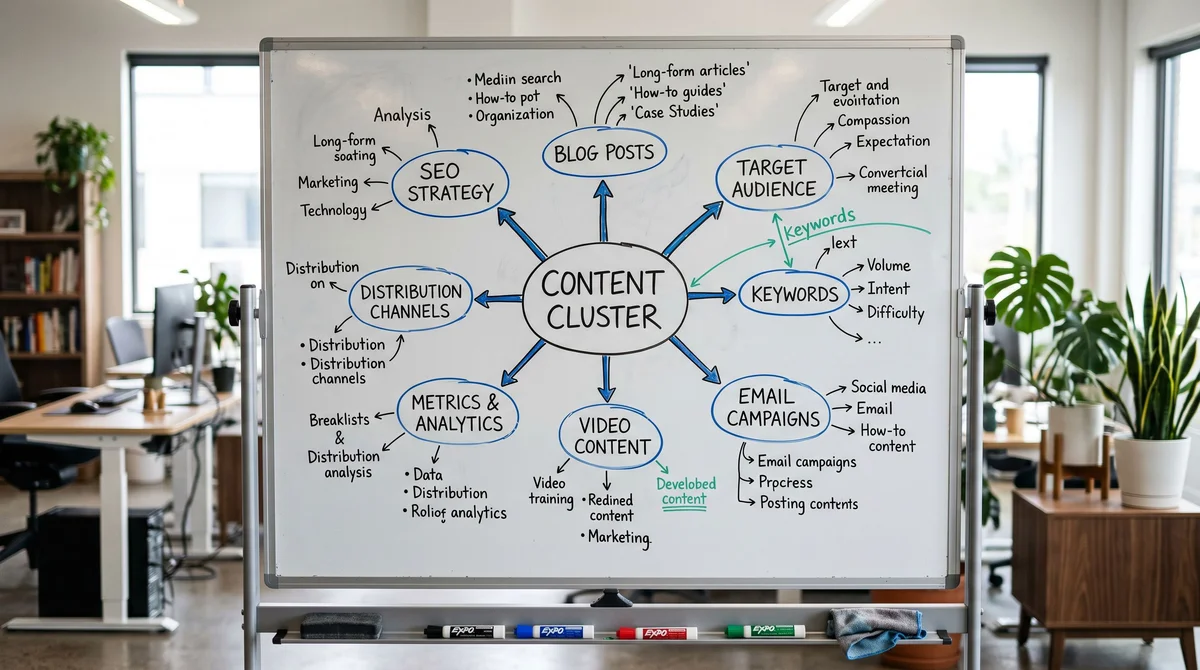
Table of Contents +
- What Is Topical Authority and Why Does Google Care?
- Why Do Content Clusters Beat Random Blog Posts?
- How Many Articles Do You Need for Topical Authority?
- What Does a Topical Authority Cluster Look Like in Practice?
- How Do You Build a Content Cluster Step by Step?
- What Are the Most Common Topical Authority Mistakes?
- How Does AI Content Fit Into a Topical Authority Strategy?
- How Do You Measure Topical Authority Results?
- How Do You Plan Your First Content Cluster?
- Topical Authority vs. Domain Authority: What Is the Difference?
- How GetTraffic Builds Topical Authority Clusters
- Frequently Asked Questions
- References
Content clusters drive 30% more traffic and hold rankings 2.5x longer. Learn why 25-30 strategic articles beat 50 random posts for topical authority SEO.
TL;DR: Topical authority means covering a subject so thoroughly that Google treats your site as the go-to source. Content clusters - groups of interlinked articles around a core topic - drive 30% more traffic than standalone posts and hold rankings 2.5x longer. You need 25-30 strategic articles, not 50 random ones, to cross the authority threshold.
Here is a number that should change how you think about blogging: businesses using a pillar-cluster content strategy see a 55% increase in organic traffic within 6 months[1]. Meanwhile, companies publishing random, disconnected blog posts see traffic plateau - or decline - no matter how much they publish.
The difference is topical authority. Google does not reward volume. It rewards depth, structure, and relevance. This guide breaks down exactly what topical authority SEO means, why clusters beat random publishing, and how to build them step by step.
What Is Topical Authority and Why Does Google Care?
Topical authority is Google's measure of how comprehensively your website covers a specific subject. When your site addresses a topic from every relevant angle - with well-structured, interlinked content - Google recognizes you as an authoritative source and ranks your pages higher across that entire topic.
Think of it this way: a site with 30 interconnected articles about e-commerce SEO (product page optimization, category page strategy, technical foundations, content marketing, link building) signals far more expertise than a site with one generic "SEO Tips" post. Google's systems evaluate topical depth at the domain level, not just page by page[2].
This matters because 53% of all website traffic comes from organic search[3]. If your site lacks topical authority, you are leaving the majority of potential traffic on the table. Random articles compete individually. Clustered articles compete as a network - and the network wins.
GetTraffic writes and publishes SEO content automatically - articles that build authority and drive organic traffic - start your free trial.
Why Do Content Clusters Beat Random Blog Posts?
The data is clear. Clustered content outperforms isolated posts across every metric that matters:
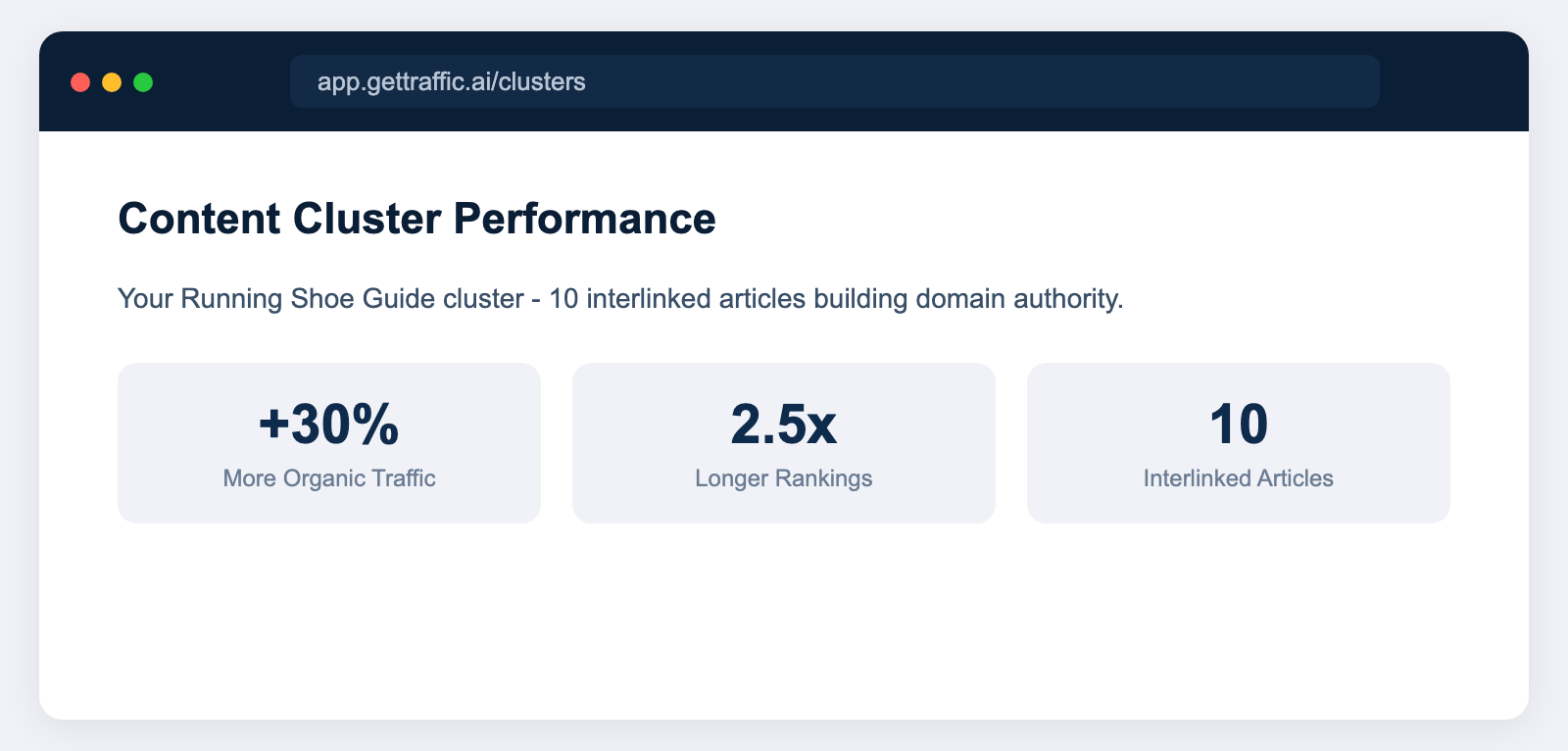
- 30% more organic traffic than standalone articles[4]
- 2.5x longer ranking retention - clusters resist algorithm fluctuations because topical depth is a stable ranking signal[4]
- 3x faster indexing - sites with structured topic clusters see 3x more pages indexed within 60 days[5]
- 55% traffic increase in 6 months with a pillar-cluster strategy[1]
Why does this happen? Three reasons:
1. Internal links pass authority. When 10 articles about e-commerce SEO link to each other, they pass PageRank and topical signals between them. Every article strengthens every other article. Random posts with no interlinking pass nothing[2].
2. Google understands topic completeness. Google's algorithms evaluate whether a site covers the sub-topics that users expect. A cluster on "e-commerce SEO" that includes product page optimization, category SEO, site speed, and content strategy signals comprehensive coverage. A single article can only scratch the surface.
3. Users stay longer and engage more. Clustered content gives readers a clear path: finish one article, click to the next related one. This increases time on site, reduces bounce rate, and sends strong engagement signals to Google.
How Many Articles Do You Need for Topical Authority?
Research from Siege Media shows that 25-30 interlinked articles is the threshold for establishing topical authority on a subject[6]. Below that number, Google sees your coverage as incomplete. Above it, you start seeing compounding returns.
But here is the critical distinction: 25-30 strategic articles, not 25-30 random ones. A cluster needs structure:
| Component | Purpose | Typical Count |
|---|---|---|
| Pillar page | Comprehensive overview of the core topic (3,000-4,500 words) | 1 |
| Cluster articles | Deep dives into sub-topics (2,000-3,000 words each) | 8-15 |
| Supporting content | FAQ pages, glossary entries, case studies | 5-10 |
| Bridge articles | Content connecting to adjacent topic clusters | 2-4 |
A well-planned cluster of 25 articles covers a topic more thoroughly than 50 random posts ever will. The structure is what matters - not the volume.
What Does a Topical Authority Cluster Look Like in Practice?
Here is a real-world example: an e-commerce SEO cluster. The pillar page is "The Complete Guide to E-Commerce SEO." The cluster articles branch into every sub-topic a store owner would search for:
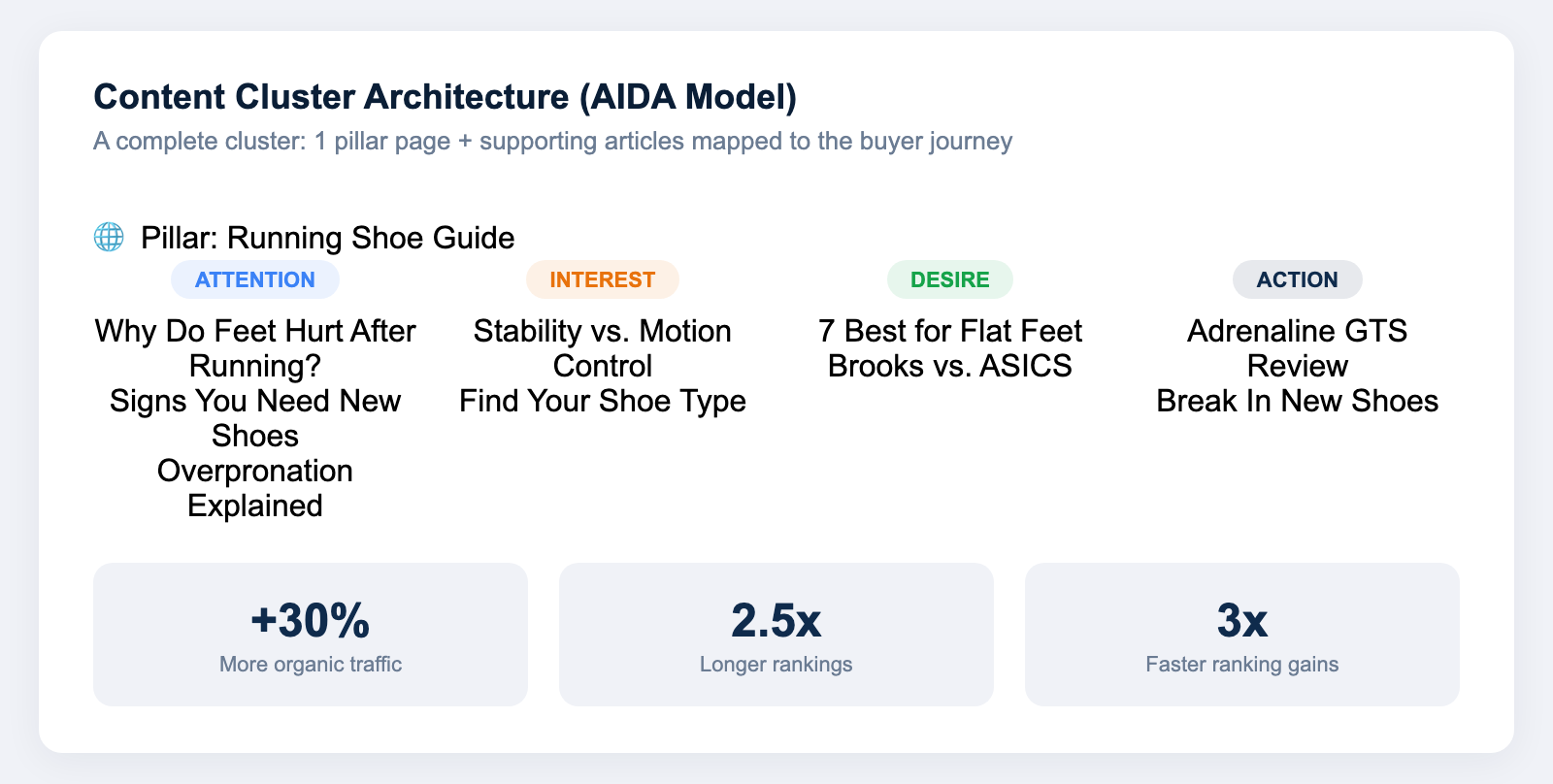
- Product page SEO - how to optimize product descriptions, images, and schema
- Category page optimization - the overlooked pages that drive 30-40% of organic traffic[7]
- Technical SEO for stores - site speed, crawl budget, duplicate content
- Content marketing for e-commerce - blog strategy that drives product sales
- Link building for online stores - earning backlinks to commercial pages
- Local SEO for retail - Google Business Profile optimization
- Shopify SEO - platform-specific optimization
- WooCommerce SEO - platform-specific optimization
Every article links to the pillar page and to 2-3 related cluster articles. The pillar links back to every sub-topic. This creates a web of relevance that Google can crawl, understand, and reward.
At GetTraffic, this is exactly how we structure content: 5 clusters of 10 interlinked articles each, every article tied to the pillar and to 2-3 cluster siblings. Ranking outcomes vary by niche competition, domain age, and existing site authority - SEO results are not guaranteed.
How Do You Build a Content Cluster Step by Step?
Building a topical authority cluster follows a clear process. Here is how to do it:
Step 1: Choose Your Core Topic
Pick a topic that is broad enough to support 15-25 sub-topics but specific enough to match your business. "SEO" is too broad. "E-commerce SEO for Shopify stores" is the right scope.
The topic should directly relate to what you sell. If you run a pet food store, your cluster is "pet nutrition" - not "pet care" (too broad) or "grain-free dog food ingredients" (too narrow).
Step 2: Map Sub-Topics with Keyword Research
Identify every question, problem, and comparison your target audience searches for within your core topic. Tools help, but the best sources are:
- Google's "People Also Ask" boxes for your primary keyword
- Google Search Console data showing queries you already get impressions for
- Reddit and forum threads where your audience asks questions
- Competitor sites - what topics are they covering?
Group these into 8-15 distinct sub-topics. Each becomes a cluster article.
Step 3: Create the Pillar Page First
Your pillar page is the hub. It covers the entire topic at a high level (3,000-4,500 words) and links to each cluster article for deeper coverage. Write this first because it defines the structure of everything else.
Step 4: Write Cluster Articles in Priority Order
Start with the sub-topics that have the highest search volume and closest purchase intent. Each cluster article should be 2,000-3,000 words, target a specific long-tail keyword, and link to the pillar page plus 2-3 sibling articles.
Step 5: Interlink Everything
Internal linking is the engine of topical authority. Every cluster article links to the pillar. The pillar links to every cluster article. Cluster articles link to 2-3 related siblings. This creates a structure Google can follow to understand the relationships between your content[2].
Step 6: Publish Consistently and Expand
Publishing 3-5 articles per week within a cluster is more effective than publishing 1 article per week across random topics. Businesses that publish 16+ articles per month see 3.5x more traffic than those publishing 0-4[8]. Concentrate your output on one cluster until the authority threshold is met, then expand to the next.
What Are the Most Common Topical Authority Mistakes?
Most businesses fail at topical authority not because the concept is hard, but because they skip the structure:
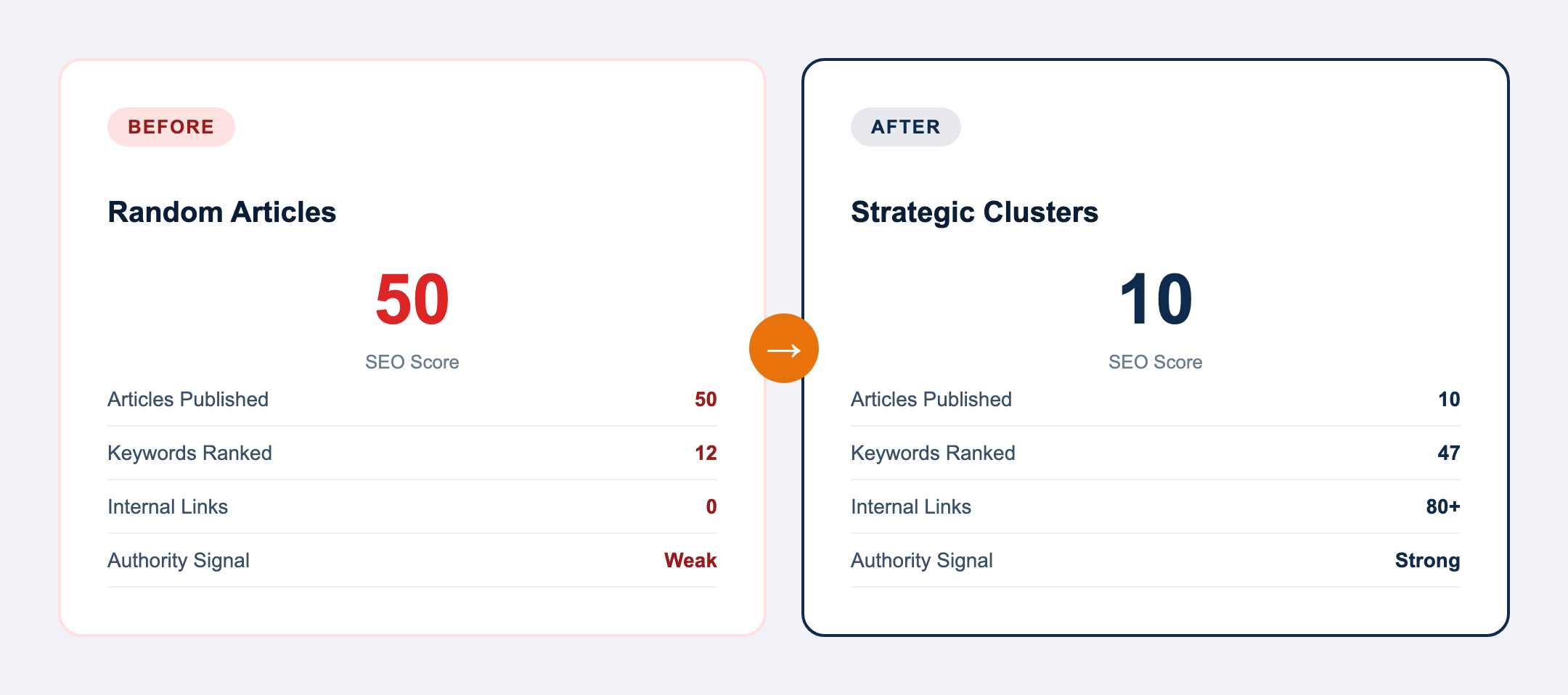
Mistake 1: Publishing random topics. A fitness equipment store publishing articles about "best workout playlists" and "how to stay motivated" builds no topical authority. These posts do not interlink meaningfully and do not support product page rankings.
Mistake 2: Skipping internal links. Writing 20 articles in the same topic area is useless if they do not link to each other. Without internal links, Google cannot see the topical relationship. Each article competes alone instead of as a network.
Mistake 3: Writing too thin. 500-word posts do not establish authority. Each article in the cluster needs 2,000-3,000 words of substantive, original content. Depth is a quality signal - and AI-edited content with proper structure performs within 4% of purely human content[9].
Mistake 4: No pillar page. Without a central hub, your cluster articles lack a structural anchor. The pillar page is what ties everything together and distributes authority across the entire cluster.
Mistake 5: Giving up too early. Topical authority compounds over time. Most clusters need 3-6 months to reach full ranking potential. If you stop at 10 articles when the threshold is 25, you never trigger the authority signal.
How Does AI Content Fit Into a Topical Authority Strategy?
AI content generation has changed the economics of building topical authority. What used to require a team of writers and months of production can now happen in weeks - if done correctly.
The key finding from a study of 600,000 pages: 86.5% of top-ranking content shows AI-detection signals[10]. Google does not penalize AI content. It penalizes low-quality content, regardless of how it was produced.
For topical authority, AI content works when:
- Each article follows EEAT guidelines (Experience, Expertise, Authority, Trust)
- Content is edited and enhanced by subject matter experts
- Articles are structured as a proper cluster with strategic interlinking
- Every piece targets a specific keyword with original analysis, not just rewritten competitor content
AI content fails at topical authority when businesses use it to mass-produce thin, disconnected articles without strategy. 50 AI-generated random posts will never outperform 10 strategic, well-structured cluster articles. The production method does not matter - the structure and quality do.
SEO content that ranks, written and published for you
GetTraffic creates authority-building content clusters for your business. No writing, no freelancers, no content calendar. Agency-quality results at 91% less cost.
Start My Free TrialHow Do You Measure Topical Authority Results?
Topical authority is not a vanity metric. You can track it with concrete numbers:
| Metric | What to Track | Target |
|---|---|---|
| Cluster keyword rankings | Number of cluster articles ranking in top 10 | 60%+ of cluster articles |
| Organic traffic per cluster | Total traffic to all articles in the cluster | 500+ visits/month within 90 days |
| Pillar page position | Ranking of your main pillar page for the core keyword | Top 10 within 6 months |
| Internal link clicks | How often users navigate between cluster articles | 15%+ click-through rate |
| Time on site | Average session duration for cluster visitors | 3+ minutes |
| Indexing speed | Time from publish to Google index | Under 7 days for new cluster articles |
SEO delivers a 748% median ROI - $22 returned for every $1 invested[11]. Topical authority clusters amplify that ROI because every new article strengthens the entire cluster, not just itself.
How Do You Plan Your First Content Cluster?
Planning a cluster before writing prevents wasted effort. Here is a practical planning framework:
Define Your Cluster Map
Start with a mind map. Put your core topic in the center. Branch into 8-15 sub-topics. For each sub-topic, identify the primary keyword, search intent (informational, commercial, or transactional), and where it fits in the buyer journey.
A pet food store's cluster map for "dog nutrition" looks like this:
- Pillar: Complete Guide to Dog Nutrition (informational, top of funnel)
- Cluster: Best food for puppies (commercial, mid-funnel)
- Cluster: Grain-free vs. grain-inclusive dog food (comparison, mid-funnel)
- Cluster: Raw food diet for dogs (informational, top of funnel)
- Cluster: How much should I feed my dog (informational, top of funnel)
- Cluster: Dog food for sensitive stomachs (commercial, mid-funnel)
- Cluster: Homemade dog food recipes (informational, top of funnel)
- Cluster: Dog food ingredients to avoid (problem-aware, top of funnel)
- Supporting: Dog nutrition FAQ page
- Supporting: Dog food glossary (kibble, freeze-dried, dehydrated)
- Bridge: Best supplements for dogs (connects to supplements cluster)
Prioritize by Business Impact
Not all sub-topics are equal. Prioritize based on three factors:
- Search volume - higher volume means more traffic potential
- Purchase intent - commercial queries drive revenue faster
- Competition - lower difficulty keywords rank faster
Write commercial-intent cluster articles first. They drive revenue sooner. Fill in informational articles next to build the authority that lifts your commercial pages. This sequencing means you see ROI before the entire cluster is complete.
Create a Publishing Calendar
Map your articles to a timeline. At 3-5 articles per week, a 25-article cluster takes 5-8 weeks. At 1 article per week (common for manual production), the same cluster takes 6 months. This timeline difference is why automation matters for topical authority - the faster you reach the 25-article threshold, the sooner the compounding effect kicks in.
Topical Authority vs. Domain Authority: What Is the Difference?
These terms are often confused, but they measure different things:
Domain Authority (DA) is a third-party metric (created by Moz) that estimates overall site strength based primarily on backlinks. It is a single number (1-100) applied to your entire domain. Google does not use DA as a ranking factor.
Topical Authority is Google's assessment of your expertise on a specific subject. A site can have high topical authority on "e-commerce SEO" and zero authority on "cryptocurrency" - even with a high DA score.
The practical difference: you build domain authority by earning backlinks (slow, expensive, hard to control). You build topical authority by publishing comprehensive, interlinked content on your core topics (faster, within your control, compounding returns). Both matter for rankings, but topical authority is the lever most businesses underutilize.
How GetTraffic Builds Topical Authority Clusters
Building 25-30 interlinked articles manually takes months and thousands of euros in writer costs. This is exactly the problem GetTraffic solves.
The platform analyzes your products, competitors, and keyword landscape, then generates complete topical authority clusters - with pillar pages, cluster articles, internal linking, EEAT structure, and e-commerce-specific optimization - published directly to your CMS.
The method is straightforward: 5 clusters of 10 interlinked articles built on EEAT and cluster architecture, structured to compete across a niche keyword set over months. The total cost is a fraction of an equivalent agency engagement.
The math is simple: if topical authority requires 25-30 articles per cluster, and a freelance writer charges €200-400 per article, one cluster costs €5,000-12,000 in content alone - before strategy, optimization, or publishing. Automation changes that equation entirely.
Frequently Asked Questions
How long does it take to build topical authority?
Most clusters need 3-6 months to reach full ranking potential. Content indexes within 2-3 weeks, rankings begin moving at 30-60 days, and compounding effects kick in after 25+ articles are published and interlinked. Consistency matters more than speed - publishing 3-5 articles per week within one cluster is more effective than spreading them across unrelated topics.
Can a small website compete with large sites for topical authority?
Yes. Topical authority is topic-specific, not site-wide. A 50-page site with 30 deeply interlinked articles about "organic dog food" can outrank a 10,000-page site that only has 3 articles on that topic. Focus beats scale. This is why niche e-commerce stores regularly outrank Amazon for specific product category searches.
Do I need to write all cluster articles myself?
No. AI-generated content that follows EEAT guidelines and is edited by subject matter experts performs within 4% of purely human content in rankings[9]. The key is strategic structure and quality - not who or what produces the words. Platforms like GetTraffic automate the entire cluster creation process while maintaining quality standards.
What happens if I stop publishing after building one cluster?
A well-built cluster holds rankings 2.5x longer than standalone posts[4]. However, topical authority grows strongest when you keep expanding - adding new sub-topics, updating existing articles, and building adjacent clusters. SEO is a compounding investment; the returns accelerate over time.
How many content clusters does a typical business need?
Start with one cluster focused on your core product or service category. Once that cluster reaches the 25-30 article threshold and ranks well, expand to a second cluster on an adjacent topic. Most businesses see strong results with 3-5 clusters covering their key product categories. GetTraffic clients typically build 2-4 clusters in their first year.
For how topical clusters fit into the complete 2026 AI SEO content workflow - including EEAT architecture, schema markup, GEO optimization, and the six quality gates that ship every article - see AI SEO Content in 2026: The Complete Guide.
References
- HubSpot (2024). Topic Clusters: The Next Evolution of SEO. blog.hubspot.com
- Google Search Central (2025). Links Crawlable. developers.google.com
- BrightEdge (2024). How Much Traffic Comes from Organic Search. seoinc.com
- ClickRank (2025). Topical Authority Research. clickrank.ai
- Orbit Media (2024). Content Hubs: How to Build Them. orbitmedia.com
- Siege Media (2025). Building Topical Authority. siegemedia.com
- Ahrefs (2025). E-Commerce SEO Guide. ahrefs.com
- HubSpot (2024). How Often Should You Blog. blog.hubspot.com
- DigitalApplied (2025). AI-Generated vs. Human Content: 16-Month Google Ranking Study. digitalapplied.com
- Ahrefs (2025). AI-Generated Content Does Not Hurt Your Google Rankings. ahrefs.com
- SEOProfy (2025). SEO ROI Statistics. seoprofy.com
Frequently Asked Questions
What is topical authority in SEO?
How many articles do I need to build topical authority?
What is the difference between pillar and cluster content?
How long does topical authority take to build?
Will random AI articles ever build topical authority?
How does GetTraffic build topical authority clusters automatically?
Get your business on page 1 of Google
Get your business found on Google - SEO content written and published automatically.
Start My Free Trial7-day free trial