How to Get Your Online Store on Page 1 of Google (2026)

Table of Contents +
- Why Does Ecommerce SEO Matter More Than Ever in 2026?
- How Do You Optimize Product Pages for Google?
- How Do You Optimize Category Pages for SEO?
- How Does Content Marketing Drive Ecommerce SEO?
- What Technical SEO Foundations Does Your Store Need?
- How Do You Handle Duplicate Content in E-Commerce?
- What About SEO for Shopify and WooCommerce Specifically?
- How Do You Measure Ecommerce SEO Results?
- How Do You Build Links for an E-Commerce Site?
- What Are the Most Common Ecommerce SEO Mistakes?
- How Long Does Ecommerce SEO Take to Show Results?
- How Can GetTraffic Help Your Store Rank?
- Frequently Asked Questions
- References
Learn how to rank your online store on Google. Covers product page SEO, category optimization, content clusters, and technical SEO for Shopify and WooCommerce.
TL;DR: Ecommerce SEO is the process of optimizing your online store so Google ranks your product pages, category pages, and blog content on page 1. With 53% of website traffic coming from organic search and SEO delivering 748% median ROI, it is the highest-leverage marketing channel for online stores. This guide covers everything from product page optimization to content clusters.
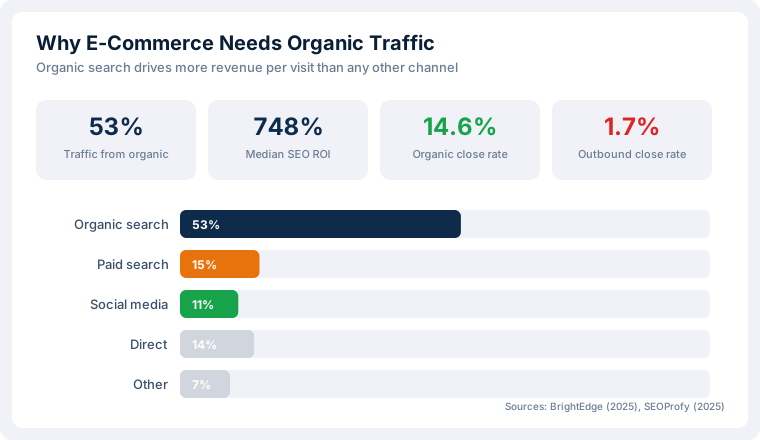
53% of all website traffic comes from organic search[1]. For e-commerce businesses competing in a $6.3 trillion global market[2], that means the majority of your potential customers start their buying journey on Google - not on Instagram, not on TikTok, not through paid ads.
Yet most online stores treat SEO as an afterthought. They copy manufacturer product descriptions, publish a blog post when they have time, and wonder why their store is invisible on Google. Meanwhile, their competitors rank for the exact keywords their customers search for - and capture the traffic, the sales, and the market share.
This guide changes that. It covers every aspect of ecommerce SEO - product pages, category pages, content marketing, technical foundations, and measuring results - specifically for online store owners who know SEO matters but need a clear path to page 1.
Why Does Ecommerce SEO Matter More Than Ever in 2026?
Three shifts make ecommerce SEO more critical - and more competitive - than any previous year:
1. Zero-click searches are rising. 70% of mobile searches result in zero clicks[3] - users get answers from featured snippets, AI Overviews, and knowledge panels without clicking through. For e-commerce, this means your product information needs to be structured (schema markup) so Google displays it directly in search results.
2. Page speed directly impacts sales. A 1-second delay in page load time reduces conversions by 20%[4]. Google uses Core Web Vitals as a ranking factor. If your store is slow, you lose rankings AND sales simultaneously.
3. Content is the new competitive moat. Online stores that build topical authority through content clusters drive 30% more organic traffic and hold rankings 2.5x longer[5]. Product pages alone are not enough. The stores winning in 2026 combine product optimization with strategic blog content.
SEO delivers a 748% median ROI - $22 returned for every $1 invested[6]. No other marketing channel comes close for long-term, compounding returns.
GetTraffic writes and publishes SEO content automatically - articles that build authority and drive organic traffic - start your free trial.
How Do You Optimize Product Pages for Google?
Product pages are the revenue-generating core of your store. Here is how to optimize them:
Write Unique Product Descriptions (300+ Words)
Product pages with 300+ words of unique content rank 2x better than pages using manufacturer descriptions[7]. This is the single highest-impact change most stores can make. Manufacturer descriptions are duplicate content - every retailer uses the same text, and Google has no reason to rank your version over anyone else's.
Write descriptions that answer the questions your customers actually ask:
- What problem does this product solve?
- How is it different from alternatives?
- What are the specifications that matter for buying decisions?
- Who is this product best suited for?
Optimize Title Tags and Meta Descriptions
Your product page title tag should follow this formula:
[Product Name] - [Key Benefit or Feature] | [Your Store Name]
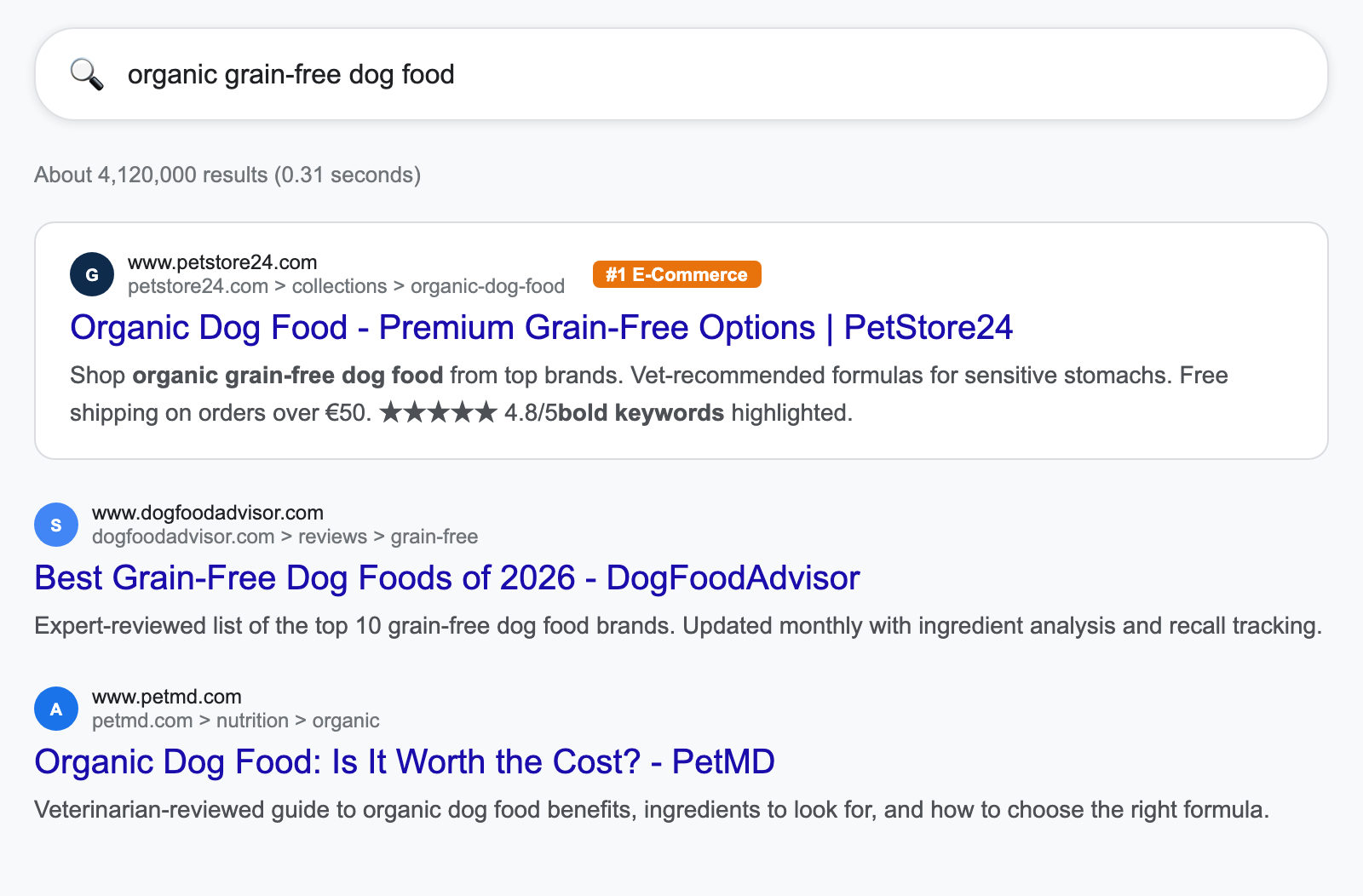
Example: "Organic Dog Food - Grain-Free Formula for Sensitive Stomachs | PetStore24"
Meta descriptions should include the primary keyword, a benefit statement, and a call-to-action. Keep them under 160 characters. These do not directly affect rankings, but they affect click-through rates - which do.
Add Product Schema Markup
Product schema (structured data) tells Google the price, availability, rating, and review count of your products. This increases click-through rate by 30% in search results[8] by enabling rich snippets with star ratings, pricing, and stock status.
Every product page should include Product schema with these properties: name, description, image, price, currency, availability, aggregateRating, and review.
Optimize Product Images
Product images need:
- Descriptive filenames: "organic-grain-free-dog-food-chicken.webp" not "IMG_4582.jpg"
- Alt text describing the product: "Organic grain-free dog food with chicken, 2kg bag"
- WebP format for smaller file sizes and faster loading
- Multiple angles - more images increase time on page and reduce bounce rate
How Do You Optimize Category Pages for SEO?
Category pages are the unsung heroes of ecommerce SEO. They drive 30-40% of organic traffic for e-commerce sites[9] - often more than individual product pages.
Add Unique Category Descriptions
Most stores leave category pages as bare product grids with zero text content. Google cannot rank what it cannot read. Add 200-400 words of unique content to each category page:
- What products are in this category and who are they for
- How to choose between products (buying guide preview)
- Key features or benefits to look for
- Link to a detailed buying guide blog post (bridges to your content cluster)
Optimize Category Page Titles
Category title tags should target the broader keyword your customers search for:
[Category Name] - [Qualifier] | [Store Name]
Example: "Organic Dog Food - Premium Grain-Free Options | PetStore24"
Category keywords typically have higher search volume than individual product keywords. Ranking a category page for "organic dog food" captures more traffic than ranking one product page.
Use Faceted Navigation Carefully
Filters (by price, size, color, brand) create URL variations that can cause duplicate content issues. Use canonical tags to point filtered URLs to the main category page. Block filter URLs from indexing in your robots.txt or use noindex tags. Crawl budget is real - do not waste it on thousands of filtered URL variations.
How Does Content Marketing Drive Ecommerce SEO?
Product and category pages cover commercial keywords ("buy organic dog food"). Content marketing covers informational keywords ("best food for dogs with allergies") - which represent a much larger search volume and capture customers earlier in their buying journey.
Build Topical Authority Clusters
A topical authority cluster is a group of 15-25 interlinked articles covering a topic comprehensively. For an e-commerce store, clusters map to your product categories:
| Product Category | Content Cluster Topic | Example Articles |
|---|---|---|
| Organic dog food | Dog nutrition | "Best food for puppies," "grain-free vs. grain-inclusive," "raw diet guide" |
| Running shoes | Running foot health | "Best shoes for flat feet," "how to prevent blisters," "pronation guide" |
| Skincare products | Skincare routines | "Morning routine for oily skin," "retinol guide," "SPF myths" |
Each article targets a specific long-tail keyword, links to related articles in the cluster, and includes strategic links to relevant product and category pages. This structure drives 30% more traffic than standalone blog posts[5] and creates a natural path from informational content to purchase.
Link Blog Content to Products Strategically
Every blog article should link to 2-3 relevant products or category pages. But do this naturally - within the context of helpful information, not as a sales pitch. A post about "best food for dogs with allergies" naturally references specific hypoallergenic products you sell. This passes authority from your blog content to your commercial pages.
Publish Consistently
Businesses publishing 16+ articles per month see 3.5x more traffic than those publishing 0-4[10]. For most e-commerce teams, this volume requires content automation - which is why platforms like GetTraffic exist.
What Technical SEO Foundations Does Your Store Need?
Technical SEO ensures Google can crawl, index, and rank your store effectively. Here are the non-negotiable foundations:
Site Speed and Core Web Vitals
A 1-second delay costs you 20% of conversions[4]. Prioritize:
- Image compression: Convert all images to WebP format. Use lazy loading for below-fold images.
- Minimize JavaScript: Remove unused apps and scripts. Each Shopify app adds load time.
- Use a CDN: Serve assets from servers closest to your customers.
- Target scores: Largest Contentful Paint under 2.5s, First Input Delay under 100ms, Cumulative Layout Shift under 0.1.
Mobile Optimization
Google uses mobile-first indexing - your mobile site is the version Google ranks. With 70% of searches happening on mobile[3], a poor mobile experience means poor rankings. Test every page on mobile: buttons should be tappable, text should be readable without zooming, and checkout should work seamlessly.
Site Architecture and Internal Linking
Your site structure should follow a clear hierarchy:
Homepage → Category Pages → Subcategory Pages → Product Pages
Every page should be reachable within 3 clicks from the homepage. Use breadcrumb navigation (with BreadcrumbList schema) to help Google understand your site hierarchy. Internal links from blog content to product and category pages pass authority and improve rankings for commercial keywords.
XML Sitemap and Robots.txt
Submit an XML sitemap to Google Search Console that includes all indexable pages: products, categories, and blog posts. Use robots.txt to block pages that should not be indexed: filtered URLs, admin pages, cart pages, and checkout pages. Check for crawl errors monthly in Search Console.
HTTPS and Security
HTTPS is a confirmed ranking factor. Every e-commerce store must use SSL certificates across all pages - not just checkout. Mixed content (HTTP images on HTTPS pages) triggers browser warnings and erodes trust.
How Do You Handle Duplicate Content in E-Commerce?
Duplicate content is the most common technical SEO issue for online stores. It comes from:
- Manufacturer descriptions used across multiple retailers
- Product variants (same product in different sizes/colors creating separate URLs)
- Filtered navigation generating unique URLs for every filter combination
- HTTP/HTTPS and www/non-www versions of the same pages
Solutions:
- Write unique product descriptions for your top 50-100 products (focus on revenue-generating pages first)
- Use canonical tags to point variant URLs to the primary product page
- Set up 301 redirects from HTTP to HTTPS and from www to non-www (or vice versa)
- Block filter parameter URLs from indexing
What About SEO for Shopify and WooCommerce Specifically?
Shopify SEO Considerations
Shopify handles many technical SEO basics automatically (SSL, mobile responsiveness, sitemap). But it has limitations:
- URL structure is fixed: Products always live under /products/, collections under /collections/. You cannot customize this.
- Robots.txt has limited customization: Use Shopify's built-in robots.txt editor (available since 2024) to block filtered URLs.
- Page speed depends on theme and apps: Every app adds JavaScript. Audit and remove unused apps quarterly.
- Blog functionality is basic: Shopify's native blog lacks SEO features. GetTraffic publishes directly to Shopify blogs with proper optimization.
WooCommerce SEO Considerations
WooCommerce offers more control but requires more setup:
- Install an SEO plugin (Yoast or RankMath) for meta tags, schema, and sitemap management
- Optimize your hosting: WooCommerce on shared hosting is slow. Use managed WordPress hosting with built-in caching.
- Manage plugin bloat: Each plugin adds database queries and load time. Keep active plugins under 20.
- Configure permalink structure: Use /%category%/%postname%/ for clean, keyword-rich URLs.
How Do You Measure Ecommerce SEO Results?
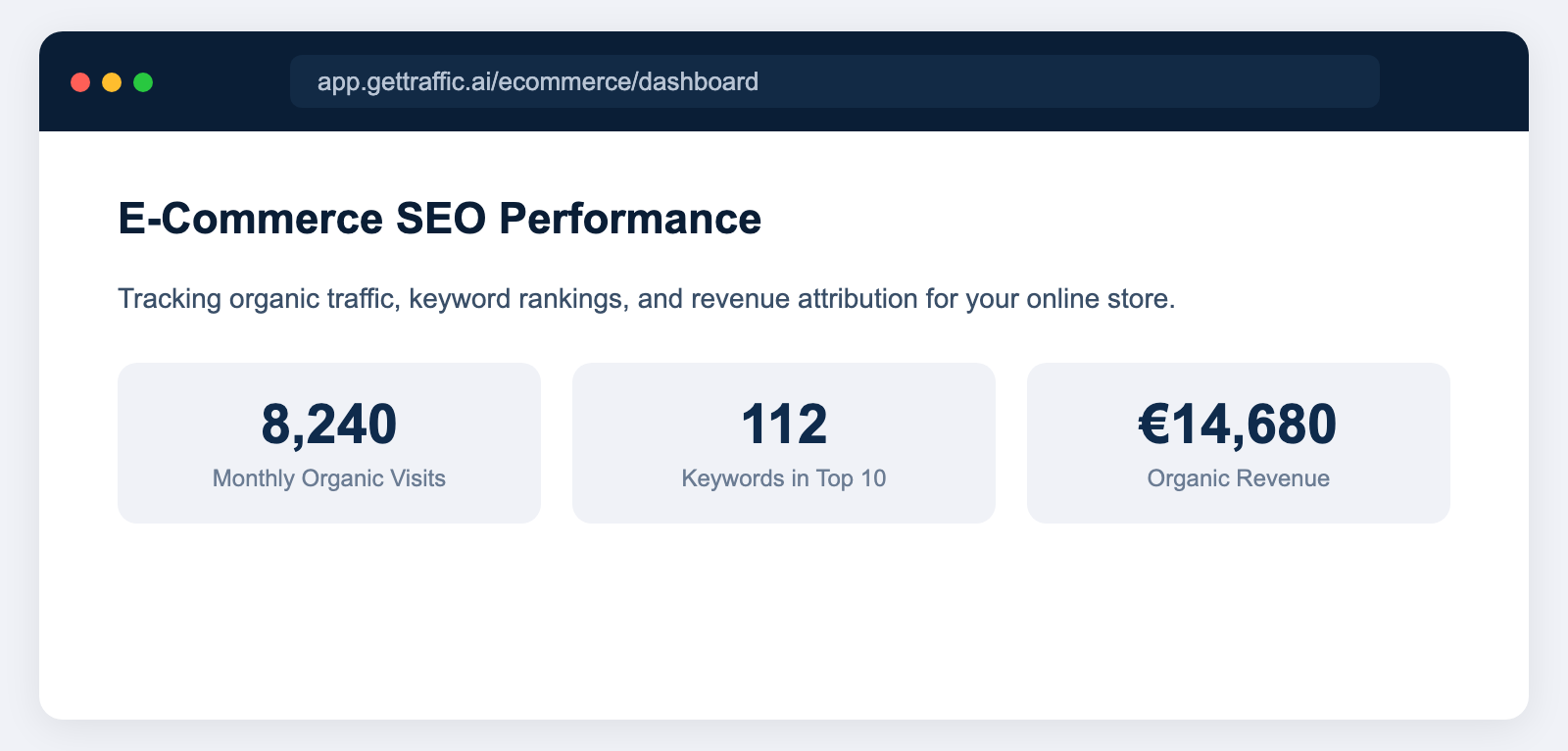
Track these metrics monthly to measure your SEO progress:
| Metric | Tool | Target |
|---|---|---|
| Organic traffic | Google Analytics / Plausible | Month-over-month growth for 6+ months |
| Keyword rankings | Google Search Console / Ahrefs | Top 10 for 5+ category keywords within 6 months |
| Organic revenue | Google Analytics (enhanced ecommerce) | Track revenue attributed to organic search |
| Click-through rate | Google Search Console | 3%+ average CTR from search results |
| Pages indexed | Google Search Console | All product, category, and blog pages indexed |
| Core Web Vitals | PageSpeed Insights | All metrics in "Good" range |
| Conversion rate from organic | Google Analytics | Track separately from paid traffic |
The most important metric is organic revenue - not just traffic. A page ranking #1 for a keyword nobody buys from is vanity. Connect your SEO efforts to actual sales by setting up enhanced ecommerce tracking in Google Analytics.
SEO content that ranks, written and published for you
GetTraffic creates authority-building content clusters for your business. No writing, no freelancers, no content calendar. Agency-quality results at 91% less cost.
Start My Free TrialHow Do You Build Links for an E-Commerce Site?
Backlinks remain one of the strongest ranking signals. E-commerce sites face a unique challenge: people rarely link to product pages. Here is how to earn links strategically:
Create linkable content assets. Buying guides, industry data, comparison charts, and original research attract links naturally. A "Complete Guide to Running Shoe Types" earns links that pass authority to your running shoe category and product pages through internal linking.
Supplier and manufacturer relationships. If you are an authorized retailer, request inclusion on manufacturer "Where to Buy" pages. These are relevant, authoritative links that competitors cannot easily replicate.
Digital PR and data-driven content. Publish original data about your industry - customer surveys, pricing trends, product usage statistics. Journalists and bloggers link to primary data sources. A pet food retailer publishing "Average Pet Food Spending by Breed Size (2026 Data)" attracts links from pet publications, veterinary blogs, and news outlets.
Resource page link building. Find industry resource pages ("Best Online Stores for Organic Dog Food") and request inclusion. These curated lists drive both referral traffic and link authority.
Avoid: buying links, participating in link schemes, or submitting to low-quality directories. Google's spam policies penalize manipulative link building. Focus on earning links through genuinely useful content and real business relationships.
What Are the Most Common Ecommerce SEO Mistakes?
After working with 40+ e-commerce businesses, these are the mistakes we see most often:
Mistake 1: Ignoring category pages. Category pages drive 30-40% of organic traffic[9] but most stores leave them as bare product grids. Add unique descriptions, optimize title tags, and include internal links to blog content.
Mistake 2: Using manufacturer descriptions. Duplicate content across hundreds of retailers. Google has no reason to rank your version. Write unique descriptions for at least your top 50 products.
Mistake 3: No content strategy. Publishing random blog posts without a cluster strategy wastes time and money. Build interlinked content clusters around your product categories. 25-30 articles per cluster is the authority threshold[11].
Mistake 4: Ignoring site speed. Every second of delay costs conversions[4]. Run PageSpeed Insights monthly. Remove unused apps. Compress images. Use a CDN.
Mistake 5: No schema markup. Product schema increases CTR by 30%[8]. BreadcrumbList schema helps Google understand site structure. FAQ schema gets your content into featured snippets. These are free ranking advantages most stores skip.
Mistake 6: Treating SEO as a one-time project. SEO is a compounding investment. The stores that win are those that publish consistently for 6-12+ months, building topical authority that competitors cannot easily replicate.
How Long Does Ecommerce SEO Take to Show Results?
Set realistic expectations:
| Timeline | What Happens |
|---|---|
| Weeks 1-2 | Technical fixes implemented (site speed, schema, canonical tags) |
| Weeks 2-4 | New content indexed by Google, appearing in Search Console |
| Months 1-2 | Rankings begin moving for long-tail keywords |
| Months 2-4 | Measurable traffic increases, first content cluster gaining traction |
| Months 4-6 | Category and product page rankings improve as content authority builds |
| Months 6-12 | Compounding returns - topical authority established, rankings stable, organic revenue growing |
Most SEO programs see content indexed within 2-3 weeks of publication, with ranking movement and traffic growth typically materializing over the 3-6 month SEO ramp window. The compounding effect accelerates from there - each new article strengthens the entire cluster.
How Can GetTraffic Help Your Store Rank?
Most e-commerce owners face the same problem: they know SEO matters, but they do not have the time, team, or expertise to execute it. GetTraffic solves this by automating the entire content workflow:
- Connect and Analyze (10 minutes) - Link your store. AI scans your products, competitors, and keyword landscape.
- Generate and Publish (under 3 hours) - Monthly SEO content clusters auto-created with EEAT structure, product links, and branded images. Published directly to your CMS.
- Rank and Grow - Content indexed in 2-3 weeks; ranking movement and traffic growth follow the typical 3-6 month SEO ramp for new content.
The cost: €249/month for 10 articles in 1 authority cluster with a 7-day free trial - vs. €4,500+/month for an agency delivering 4-8 articles. That is a 94% cost reduction with more output.
The method is straightforward: 5 clusters of 10 interlinked, EEAT-compliant articles published directly to your Shopify blog, structured to compete for niche keyword visibility over months.
Frequently Asked Questions
How much does ecommerce SEO cost?
DIY with tools: €50-150/month. AI automation platform like GetTraffic: €249/month. SEO agency: €3,500-€5,000+/month. The right choice depends on your budget, team size, and how much you want to manage yourself. For most stores with 5-50 employees, an AI automation platform delivers the best ROI - more content at lower cost than an agency, with less effort than DIY.
Do I need a blog for my online store?
Yes. Product and category pages target commercial keywords ("buy running shoes"). Blog content targets informational keywords ("best running shoes for flat feet") that capture customers earlier in their journey. Stores with active blogs see 55% more traffic within 6 months of implementing a pillar-cluster strategy[12]. The blog is how you build topical authority that lifts rankings for every page on your site.
Is Shopify or WooCommerce better for SEO?
Both can rank well. WooCommerce offers more technical control (custom URL structures, server-side optimization, unlimited plugin options). Shopify offers simpler setup and handles many technical basics automatically. The content you publish matters far more than the platform. Choose the platform that fits your business - then invest in content and optimization regardless.
Can AI content work for ecommerce SEO?
Yes. Human-edited AI content performs within 4% of purely human content in Google rankings. The key is quality control: EEAT structure, expert editing, strategic clustering, and proper internal linking. Generic, unedited AI content ranks 23% lower. The production method does not matter - the quality and strategy do.
What is the most important ecommerce SEO action I can take today?
Write unique product descriptions for your top 20 products. If every competing retailer uses the same manufacturer description, your unique 300+ word descriptions immediately differentiate your pages. This single action has delivered measurable ranking improvements for every e-commerce client we have worked with.
References
- BrightEdge (2024). How Much Traffic Comes from Organic Search. seoinc.com
- Statista (2025). Worldwide Retail E-Commerce Sales. statista.com
- SparkToro (2024). Google CTR Study. sparktoro.com
- Google/Portent (2024). Mobile Page Speed and Conversion Data. thinkwithgoogle.com
- ClickRank (2025). Topical Authority Research. clickrank.ai
- SEOProfy (2025). SEO ROI Statistics. seoprofy.com
- Backlinko (2025). E-Commerce SEO Guide. backlinko.com
- Google Search Central (2025). Product Structured Data. developers.google.com
- Ahrefs (2025). E-Commerce SEO Guide. ahrefs.com
- HubSpot (2024). How Often Should You Blog. blog.hubspot.com
- Siege Media (2025). Building Topical Authority. siegemedia.com
- HubSpot (2024). Topic Clusters: The Next Evolution of SEO. blog.hubspot.com
Frequently Asked Questions
How do I get my Shopify store on page 1 of Google?
How long does e-commerce SEO take to show results?
Should I optimize product pages or category pages first?
Do I really need a blog for e-commerce SEO?
Will AI content hurt my e-commerce SEO?
What is the cheapest way to scale e-commerce SEO content?
Get your business on page 1 of Google
Get your business found on Google - SEO content written and published automatically.
Start My Free Trial7-day free trial