
GEO vs SEO: What's the Difference (and Do You Need Both)?


Table of Contents +
GEO vs SEO compared: GEO layers on SEO using the same signals. ~50% of AI-cited sources rank top 10. Do both with one content effort.
TL;DR: GEO (generative engine optimization) and SEO are not rivals. GEO layers on top of SEO and runs on the same authority signals: relevant content, clear structure, and links. About half of the sources AI engines cite already rank in Google's top 10. Strong SEO is the foundation. Do both with one content effort.
You keep seeing two acronyms. SEO, the discipline you know, and GEO, the new one built for ChatGPT, Perplexity, and Google AI Overviews. The pitch is usually that GEO is replacing SEO and you need a separate strategy, a separate budget, and a separate team. That framing sells software. It does not match how AI search actually works.
Here is the honest version. AI engines do not invent their answers from nothing. They read the web, weigh sources, and cite the ones they trust. The signals that earn that trust are the same signals that earn Google rankings. So the real question is not GEO or SEO. It is how to build content once so it works in both places. This post breaks down the difference, the data, and what changes in your workflow.
What is the difference between GEO and SEO?
SEO optimizes for ranked links: you want to appear high in a list of blue links a person clicks. GEO optimizes for citations: you want an AI engine to quote your page inside a generated answer. The goal differs (a click versus a mention), but the inputs overlap almost entirely. Both reward topical relevance, clear structure, and authority.
Think of GEO as a new surface, not a new discipline. When someone asks Perplexity a question, the engine retrieves candidate sources, reads them, and synthesizes an answer with citations. To be one of those sources, your page has to be findable, readable by a machine, and credible enough to trust. SEO already does the findable and credible parts. GEO adds attention to how cleanly a machine can extract a self-contained answer from your page.
It helps to see where the two terms come from. SEO has had 25 years to mature into a defined practice with clear metrics: impressions, clicks, positions, and backlinks. GEO is barely two years old and still settling its vocabulary, which is why you also see it called AEO (answer engine optimization) or LLMO. The names differ, the underlying idea does not: make your content the thing an engine reaches for when it builds an answer. Treating GEO as a wholly separate function is what leads teams to duplicate effort and budget for no extra return.
GetTraffic writes and publishes SEO content automatically - articles that build authority and drive organic traffic - start your free trial.
Is GEO replacing SEO?
No. GEO layers on SEO and depends on it. BrightEdge analysis found that roughly half of the sources AI engines cite already rank in the top 10 of traditional search, and pages with a domain rating under 30 are rarely cited at all.[1] Strong SEO is the prerequisite, not the casualty.
The mechanism is simple. AI Overviews now appear in around 45% of searches, and a page's top-10 ranking strongly correlates with whether it gets cited in that overview.[2] Engines pull from what they can already find and rank. If you abandon SEO fundamentals, you remove yourself from the pool AI draws from. The skills transfer directly: keyword research becomes question and entity research, on-page structure becomes answer-block structure, and link building still builds the authority both systems read. For the full playbook, see our generative engine optimization guide.
This is the part the replacement narrative gets wrong. A site with no SEO foundation has nothing for an AI engine to cite. Domain rating under 30 means you are effectively invisible to the model, no matter how you format your pages. So the order of operations matters: you earn rankings and authority first, then refine for extractability second. GEO without SEO is a roof with no walls under it.
GEO vs SEO at a glance
The two approaches share most of their machinery and diverge mostly at the edges: where the user sees you and how you measure success. The table below maps the differences row by row. Notice that the primary signals column is nearly identical, which is the whole point.
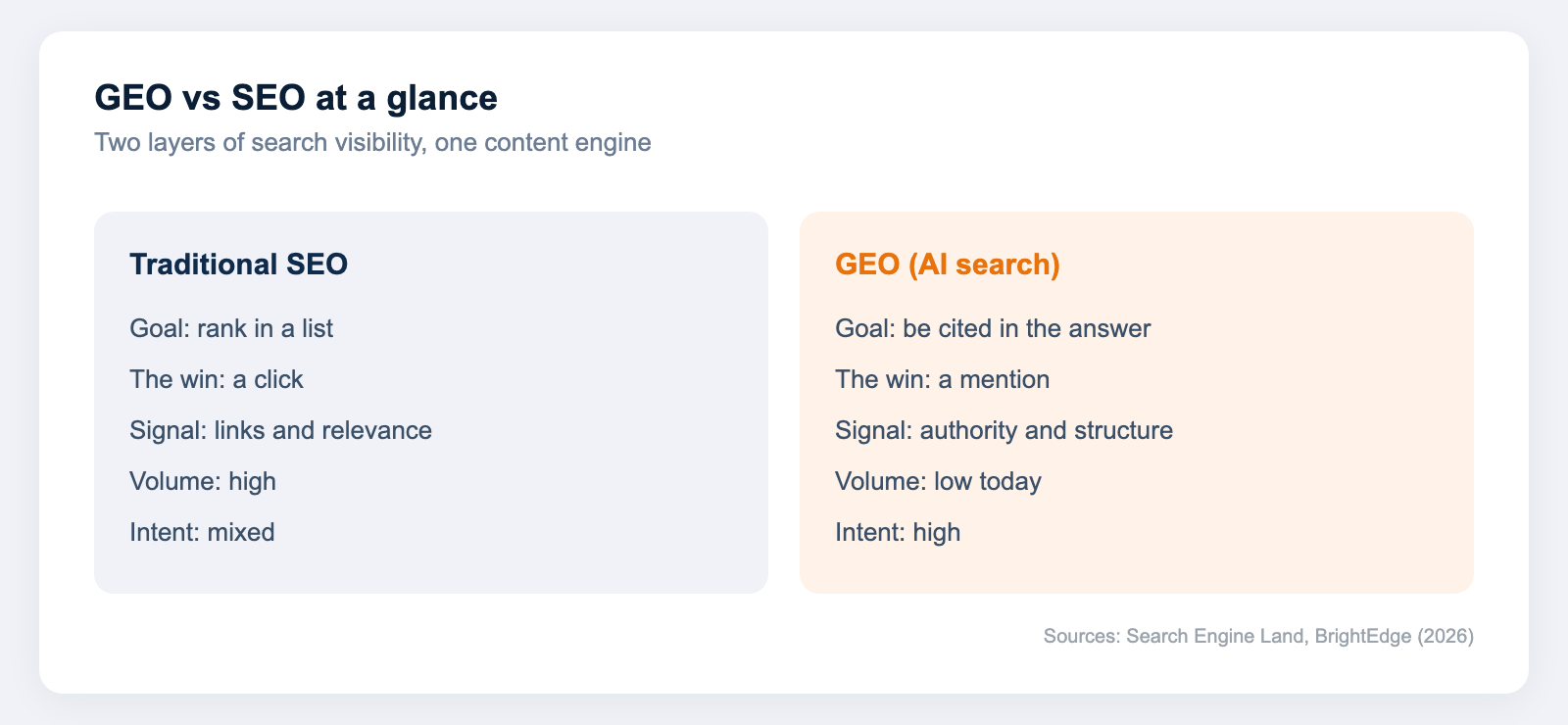
| Dimension | SEO | GEO |
|---|---|---|
| Goal | Rank high in a list of links | Get cited inside an AI-generated answer |
| Unit of success | Ranking position and click | Citation and mention |
| Where users see you | Search results page | ChatGPT, Perplexity, Google AI Overviews and AI Mode |
| Primary signals | Relevance, structure, authority, links | Relevance, structure, authority, links, extractable answers |
| Traffic volume | High | Low today, under 1% of referrals for most sites |
| Conversion rate | Baseline (around 1.2%) | Higher (around 3.8%) |
| Time horizon | Established, slowly shifting | Emerging, growing fast |
Does AI search traffic actually convert better?
Yes, and the gap is large. Amsive's analysis found AI search traffic converts at 3.76% versus 1.19% for traditional organic, a 216% improvement.[3] The Washington Post reported AI referrals subscribe at four to five times the rate of other channels.[3] The visitor already got context from the AI answer and arrives closer to a decision.
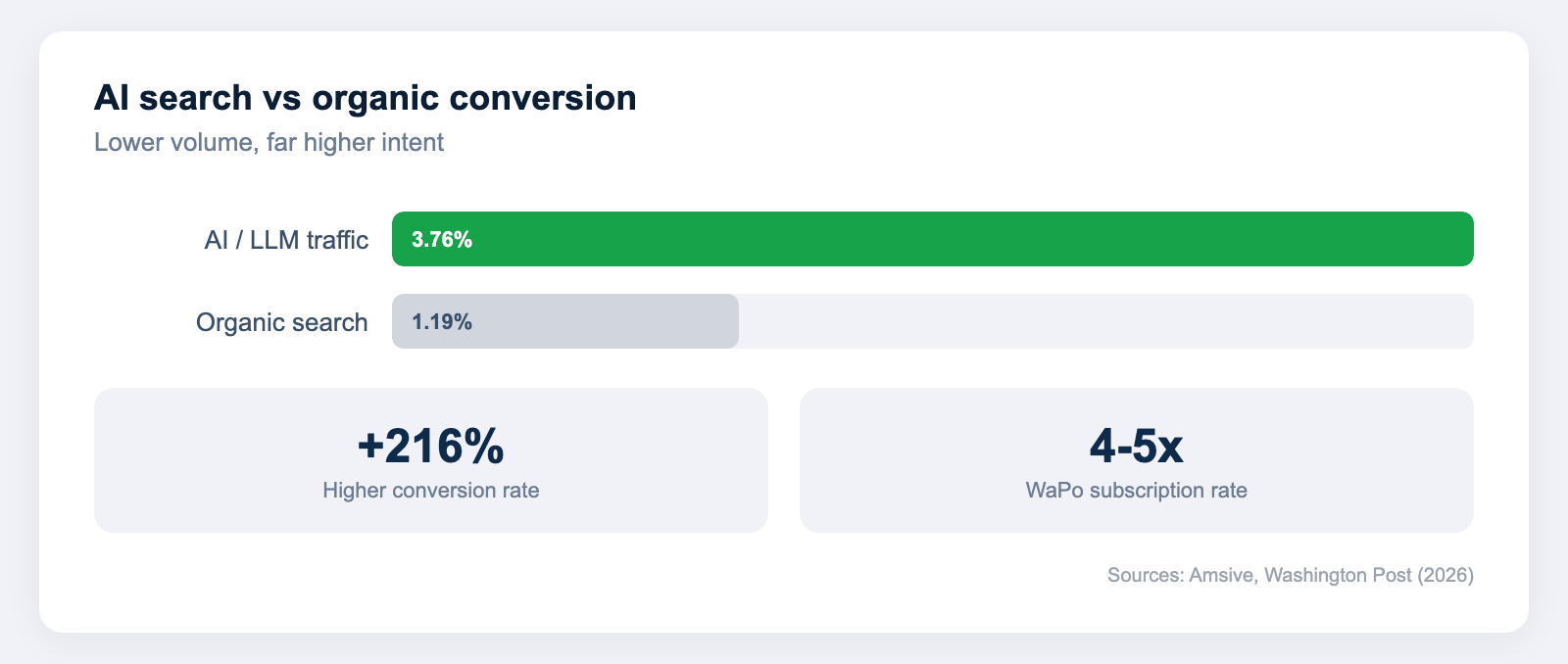
The reason is pre-qualification. A person who clicks through from an AI answer has read a synthesized summary, seen your brand framed as a credible source, and chosen to learn more. That is warmer intent than a cold blue-link click. The traffic is smaller but it is denser. We break the numbers down further in does AI search traffic convert.
For an e-commerce founder, that changes the math on what a citation is worth. If AI traffic is roughly a third of the volume but converts at triple the rate, the revenue per visit can match or beat traditional organic even while the absolute numbers stay small. You are not chasing pageviews. You are chasing buyers who arrive already informed about what you sell and why it fits their problem.
If the volume is tiny, why bother with GEO?
Because the trend line points one direction and the intent is high. AI referral volume is still under 1% of total referrals even for large publishers like Reuters and The Guardian, so the value today is intent, not volume.[3] Gartner projects a 25% drop in traditional search volume by 2026 as AI absorbs queries.[4]
The shift is also structural. Roughly 93% of Google AI Mode sessions end without a click to any external site.[4] That zero-click reality means the clicks that do happen are more selective and more valuable. Getting cited also builds brand presence inside the answer itself, even when no one clicks. You are positioning for where attention is moving, not where it sits today. The good news: the work that earns citations is the work you should already be doing for ranking in Google AI Overviews.
SEO content that ranks, written and published for you
GetTraffic creates authority-building content clusters for your business. No writing, no freelancers, no content calendar. Agency-quality results at 91% less cost.
Start My Free TrialDo I need to choose between GEO and SEO?
No. Choosing is the wrong frame. Because both run on the same signals, one well-built content cluster serves both at once. A page that ranks in Google's top 10 is already a strong citation candidate for AI engines, and a page structured for clean AI extraction tends to read clearly for human searchers too. The overlap means you optimize once and benefit twice.
The budget question answers itself once you see the overlap. Splitting spend into a GEO line and an SEO line implies two production pipelines, two content calendars, and two reporting dashboards for what is essentially one body of work. Most teams cannot staff that, and they do not need to. The smarter move is one pipeline tuned for both: research the questions, build the clusters, structure the answers, and earn the links. Measure rankings and citations from the same content. That keeps cost flat while doubling the surfaces you appear on.
What earns both is consistent. Comparison content earns the largest share of AI citations at around 33%, ahead of guides at 15%, original research at 12%, and listicles at 10%.[5] Those same formats rank well in traditional search. So the priority list looks like this:
- Build topical depth, not scattered one-off posts. Clusters signal authority to both systems. See topical authority clusters.
- Lead with direct, self-contained answers near the top of each section so machines and people can extract them.
- Earn links and references to lift domain authority above the threshold where AI engines start citing you.
- Favor comparison and guide formats, which earn the most citations and rank reliably.
What changes in your workflow?
Less than the hype suggests. You keep doing keyword and topic research, you keep writing structured authoritative content, and you keep building links. The additions are small: write tighter answer blocks at the top of sections, cover questions as questions, and track AI citations alongside rankings. The core engine of good content does not change.
Concretely, three habits cover most of the GEO gap on top of solid SEO. First, open each section with a direct 40-to-75-word answer before you elaborate, because that is the chunk an engine extracts. Second, phrase headings as the questions your buyers actually type, since AI engines map queries to question-shaped content. Third, add measurement: tools that monitor whether ChatGPT, Perplexity, and AI Overviews mention you, so citations become a metric you can manage rather than a mystery. None of this replaces your SEO work; it sharpens the same content for a second audience of machines.
The practical constraint is capacity. Building deep clusters that satisfy both systems takes consistent output, and most DACH e-commerce teams do not have hours per week for it. This is where an AI SEO engine helps: GetTraffic builds industry-specific topical-authority clusters and publishes them to your CMS, so one effort produces content that ranks in search and gets cited in AI answers. You can compare the approach against point tools on our AI tools comparison, or see what 10 articles a month costs on pricing.
The takeaway: stop treating GEO and SEO as a fork in the road. They are the same road with a new lane. Build authoritative, well-structured clusters and you compete in both.
References
- WordStream (2025). How to Get Cited by AI Search. wordstream.com
- Search Engine Land (2025). How to Optimize for AI Overviews. searchengineland.com
- Search Engine Land (2025). The SEO-GEO Gap: AI Search Traffic vs Organic Traffic. searchengineland.com
- Omnia (2025). AI Search Monitoring Tools. useomnia.com
- Aggarwal et al. (2023). GEO: Generative Engine Optimization. arxiv.org
Frequently Asked Questions
What is the difference between GEO and SEO?
Is GEO replacing SEO?
Does AI search traffic convert better than organic?
If AI search volume is tiny, why optimize for it?
Do I need separate strategies for GEO and SEO?
What content format gets cited most by AI engines?
Get your business on page 1 of Google
Get your business found on Google - SEO content written and published automatically.
Start My Free Trial7-day free trial