SEO Content Automation: What It Is and Who It Is For


Table of Contents +
- What Is SEO Content Automation (and What It Is Not)?
- Why Does SEO Content Automation Matter in 2026?
- Who Benefits Most from SEO Content Automation?
- What Should You Automate vs. Keep Manual?
- What Does the Full Automation Workflow Look Like?
- What Does SEO Content Automation Look Like for E-Commerce Specifically?
- What Are the Risks of SEO Content Automation?
- How Do You Choose the Right Automation Platform?
- How Does SEO Content Automation Compare to DIY and Agency Approaches?
- What Real-World Results Does Automation Deliver?
- What Results Should You Expect from Content Automation?
- Is SEO Content Automation Right for Your Business?
- Frequently Asked Questions
- References
SEO content automation goes beyond AI writing. Learn what it covers, who benefits most, and which parts of the SEO workflow to automate vs. keep manual in 2026.
TL;DR: SEO content automation is the use of AI and software to handle the full content workflow - from keyword research and strategy to writing, optimization, and publishing. It is not just AI writing. Businesses publishing 16+ articles per month see 3.5x more traffic, and automation is the only way most teams can hit that volume without hiring an army of writers.
Content marketing costs 62% less than outbound marketing and generates 3x more leads per dollar spent[1]. But there is a problem: producing enough content to actually move the needle takes an enormous amount of time. The average SEO article requires 4-6 hours of research and 3-4 hours of writing[2]. At 10 articles per month, that is 80-100 hours of skilled labor.
This is where SEO content automation enters the picture. Not as a shortcut that replaces quality - but as a system that handles the repetitive, time-intensive steps so your content actually gets published. This guide explains what automation means in 2026, who benefits from it, and which parts of the SEO workflow to automate vs. keep manual.
What Is SEO Content Automation (and What It Is Not)?
SEO content automation is the use of AI and software to execute some or all of the content marketing workflow: keyword research, content strategy, article creation, on-page optimization, publishing, and performance tracking.
What it is not: pressing a button and getting a finished blog post. That is AI writing - one component of a much larger system. The distinction matters because most businesses that fail with "AI content" actually failed at strategy, not writing.
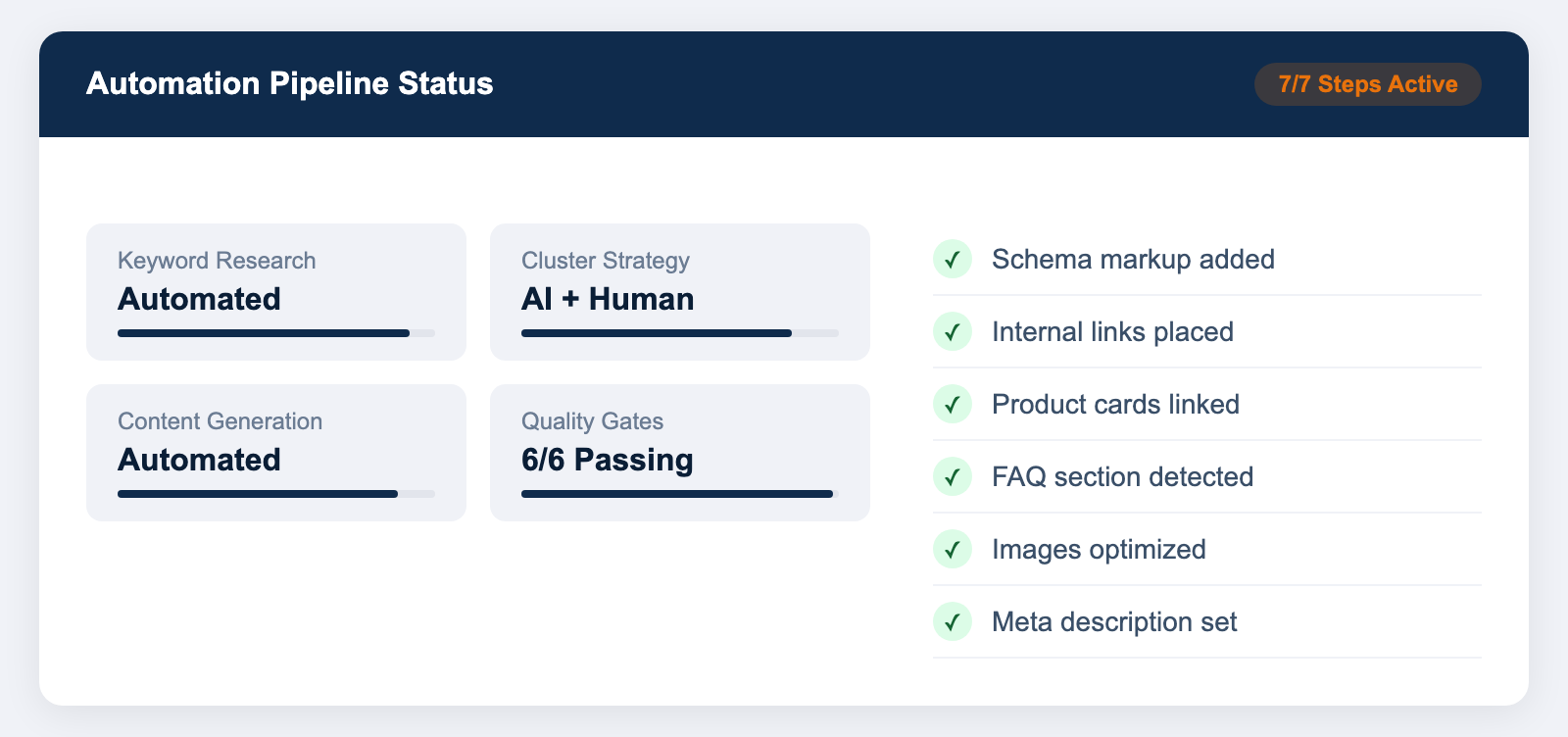
A complete SEO content automation stack covers 7 steps:
- Keyword research and gap analysis - identifying what your audience searches for and where your competitors rank
- Content strategy - planning topical authority clusters, not random articles
- Brief creation - defining target keyword, outline, internal links, and word count
- Content generation - drafting the article with AI assistance
- Quality and SEO optimization - EEAT compliance, readability, keyword coverage, schema markup
- Publishing and distribution - direct CMS integration, formatting, image placement
- Performance measurement - tracking rankings, traffic, and conversions per article
Most "AI content tools" handle only step 4. Full-stack automation handles all 7. That is the difference between a writing tool and a content engine.
GetTraffic writes and publishes SEO content automatically - articles that build authority and drive organic traffic - start your free trial.
Why Does SEO Content Automation Matter in 2026?
Three forces are pushing businesses toward automation:
1. Volume requirements have increased. Businesses publishing 16+ articles per month see 3.5x more traffic than those publishing 0-4[3]. Building topical authority requires 25-30 interlinked articles per topic cluster[4]. Manual production simply cannot keep up at this pace for most teams.
2. Competition has intensified. 53% of website traffic comes from organic search[5], and every competitor is investing in content. The window for building topical authority narrows every month. Speed matters - not just quality.
3. AI quality has reached a threshold. Human-edited AI content now performs within 4% of purely human content in Google rankings[6]. The technology has moved from "experiment" to "production-ready" - when used with proper quality controls.
The result: 83% of marketers report measurable gains from AI-powered SEO[7]. Automation is no longer a competitive advantage. It is becoming the baseline.
Who Benefits Most from SEO Content Automation?
Not every business needs full automation. Here is who gets the most value:
E-Commerce Businesses (5-50 Employees)
Online stores need content for product pages, category pages, and blog articles. They compete in a $6.3 trillion global market[8] where organic visibility directly drives revenue. Most e-commerce teams have zero dedicated SEO staff. Automation fills the gap between "knowing SEO matters" and actually publishing the content.
Marketing Managers Without a Content Team
61% of marketers say generating traffic and leads is their top challenge[9]. If you are the one-person marketing department responsible for SEO, social media, email, and paid ads, content automation lets you maintain a publishing cadence that would otherwise require 2-3 dedicated writers.
Agencies Scaling Content Delivery
Digital marketing agencies managing 10+ client accounts face a content bottleneck. Each client needs 5-20 articles per month. Automation platforms with white-label capabilities let agencies scale output without scaling headcount.
Businesses Currently Spending on Agencies
If you are paying an SEO agency $3,500-$5,000+ per month and receiving 4-8 articles, automation can deliver more content at a fraction of the cost. The question is not whether automation works - it is whether the cost-quality trade-off makes sense for your situation.
What Should You Automate vs. Keep Manual?
Not every step in the content workflow benefits equally from automation. Here is the breakdown:
| Workflow Step | Automate? | Why |
|---|---|---|
| Keyword research | Yes | AI processes thousands of keywords faster and finds gaps human analysts miss |
| Content strategy | Partially | AI maps cluster structures; humans validate business alignment and brand priorities |
| Brief creation | Yes | Structured briefs with target keywords, outlines, and internal links are formulaic and well-suited for automation |
| Article writing | Yes (with editing) | AI generates drafts; human editors add expertise, examples, and brand voice |
| SEO optimization | Yes | Technical on-page factors (meta tags, schema, keyword density) are rule-based and ideal for automation |
| Publishing | Yes | CMS integration, formatting, and image placement are pure process - no creativity needed |
| Performance tracking | Yes | Data collection and reporting are automation's strongest use case |
The pattern is clear: automate the process-heavy, data-driven steps. Keep human judgment for strategic decisions and brand-specific expertise. This hybrid approach delivers the speed of automation with the quality of human oversight.
What Does the Full Automation Workflow Look Like?
Here is how a full-stack content automation platform works in practice:
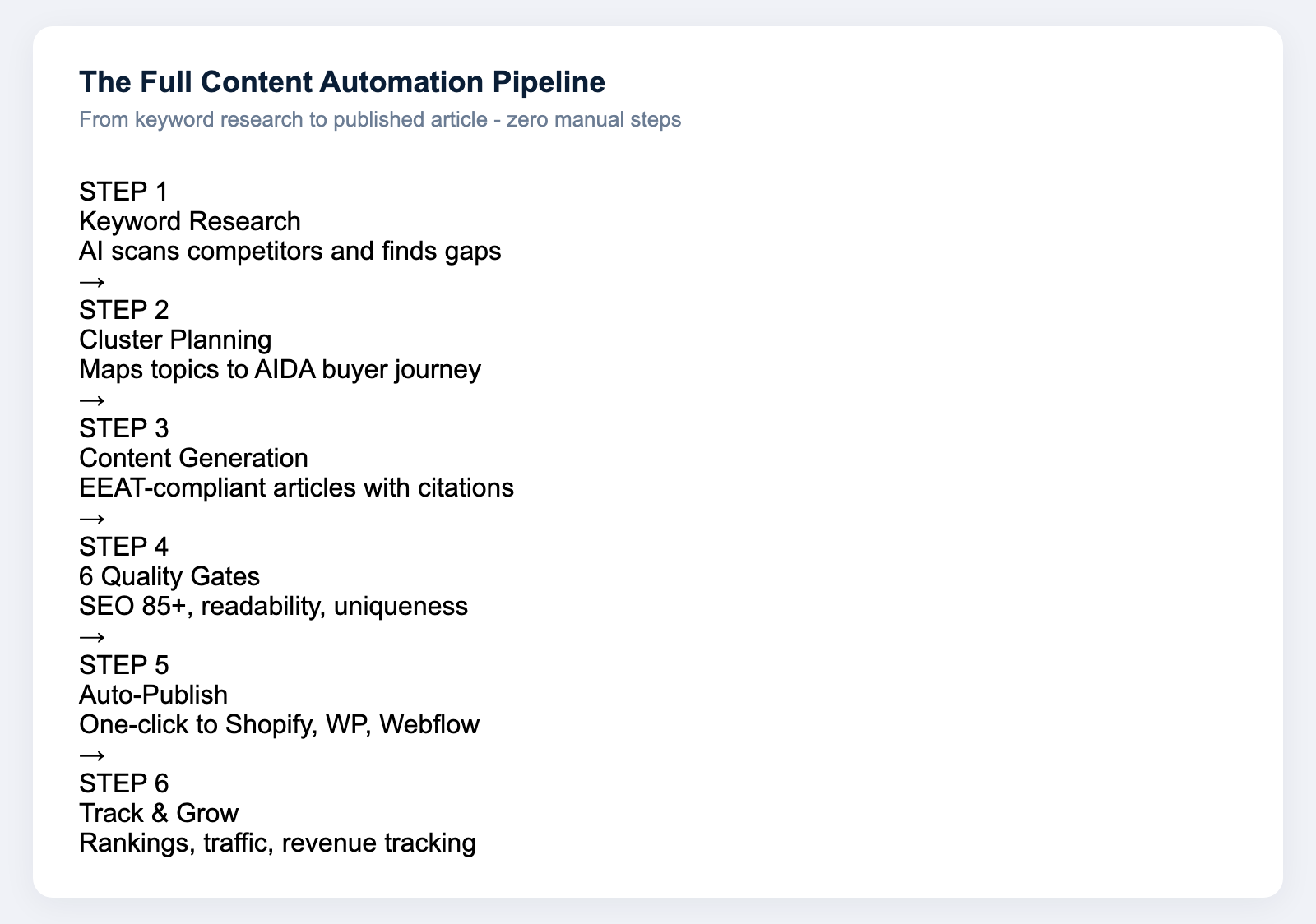
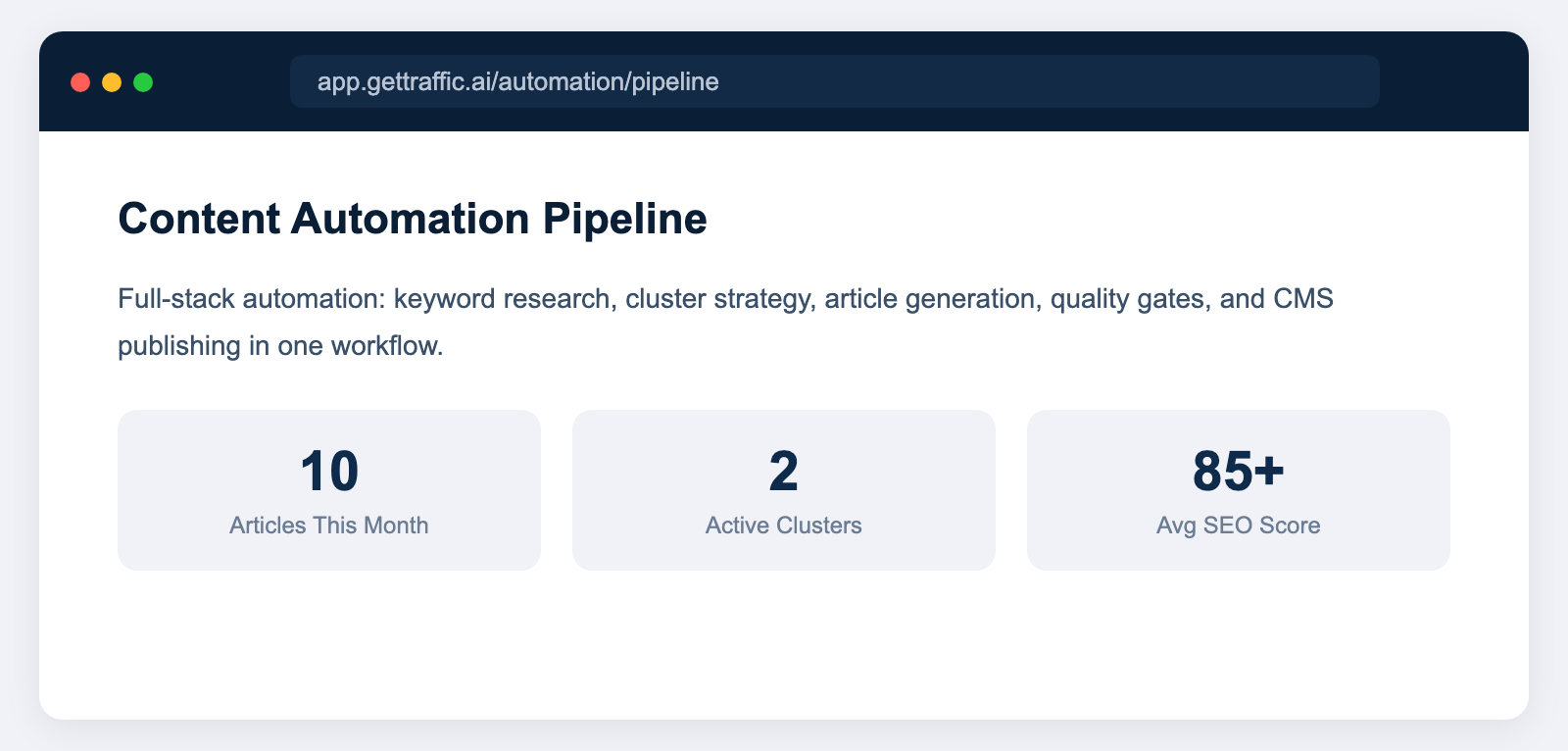
Week 1: Analysis. The platform scans your website, products, and competitors. It identifies keyword gaps, maps topical authority clusters, and creates a 3-6 month content calendar. This step replaces the strategy consulting an agency charges $1,500/month for.
Week 2-4: Production. Articles are generated following the content strategy - each one targeting a specific keyword, following EEAT structure, with proper internal linking and schema markup. Quality gates check SEO score (85+ target), readability, uniqueness, and keyword coverage.
Ongoing: Publishing. Articles publish directly to your CMS (Shopify, WooCommerce, WordPress, Webflow, or others) with proper formatting, meta tags, and images. No copy-pasting, no manual formatting.
Monthly: Measurement. Performance reports show which articles are ranking, driving traffic, and generating conversions. The strategy adapts based on data - doubling down on topics that perform and adjusting those that do not.
This entire workflow used to require a strategist ($1,500/month), a content writer team ($3,000/month for 10 articles), and an SEO specialist ($2,000/month). Full-stack automation delivers comparable output starting at €249/month.
What Does SEO Content Automation Look Like for E-Commerce Specifically?
E-commerce stores have unique automation opportunities that go beyond blog content:
Product description generation. If your store has 200+ products with manufacturer descriptions (duplicate content that Google ignores), automation can generate unique, SEO-optimized descriptions for each product. A 300+ word unique description ranks 2x better than a copied manufacturer spec sheet[14]. Doing this manually for 200 products would take 400+ hours. Automation handles it in a fraction of the time.
Category page content. Category pages drive 30-40% of organic traffic for e-commerce sites[15], but most stores leave them as bare product grids. Automated category descriptions - 200-400 words explaining the category, key product features, and buying guidance - turn these high-traffic pages from ranking dead zones into conversion assets.
Blog content clusters mapped to product categories. The most effective e-commerce content strategy maps blog clusters directly to product categories. A pet food store builds a cluster on "dog nutrition" that links strategically to dog food products. An outdoor gear store builds a cluster on "hiking equipment" that links to boots, backpacks, and apparel. Automation platforms that understand your product catalog build these connections automatically.
Seasonal and promotional content. Pre-holiday buying guides, seasonal product roundups, and sale-event content follow predictable patterns that automation handles efficiently. Instead of scrambling to write "Black Friday Gift Guide" content in October, automation generates it from your existing product data with proper keyword targeting and internal links.
What Are the Risks of SEO Content Automation?
Automation is not risk-free. Here are the real concerns and how to address them:
Risk 1: Generic, commodity content. The biggest risk is not Google penalties - it is publishing content that sounds like every other AI-generated article on the topic. The fix: choose platforms that build topical authority clusters with original analysis, not platforms that rewrite the top 10 search results.
Risk 2: Factual errors. AI models can generate plausible-sounding but incorrect information. The fix: quality gates that include fact-checking, source citation, and expert review. At GetTraffic, every article passes through 6 quality gates before publishing.
Risk 3: Brand voice misalignment. Generic AI content does not sound like your brand. The fix: platforms that learn your brand voice, product catalog, and audience language during onboarding - not generic one-size-fits-all generators.
Risk 4: Over-automation. Automating strategic decisions (which topics to cover, how to position your brand) leads to undifferentiated content. Keep strategy human-guided. Automate execution.
The correlation between AI content and Google penalties is 0.011 - essentially zero[10]. Quality-controlled automation does not hurt rankings. Low-quality content does, regardless of production method.
How Do You Choose the Right Automation Platform?
Not all automation platforms are equal. Here is what to evaluate:
- Full-stack vs. single-step: Does it handle the entire workflow (research through publishing) or just writing? Full-stack platforms like GetTraffic deliver complete content operations. Single-step tools handle one piece and leave you to manage the rest.
- Content strategy: Does it build topical authority clusters, or does it generate random standalone articles? Clusters drive 30% more traffic and hold rankings 2.5x longer.
- Quality controls: What quality gates exist? Look for SEO scoring, EEAT compliance checks, readability analysis, uniqueness verification, and schema markup.
- CMS integration: Can it publish directly to your platform? Manual copy-paste creates a bottleneck that defeats the purpose of automation.
- Reporting: Does it track content performance and attribute revenue to specific articles?
The market ranges from $50/month AI writing tools (step 4 only) to $249+/month full-stack platforms (steps 1-7). The right choice depends on your team, budget, and how much of the workflow you want to hand off.
SEO content that ranks, written and published for you
GetTraffic creates authority-building content clusters for your business. No writing, no freelancers, no content calendar. Agency-quality results at 91% less cost.
Start My Free TrialHow Does SEO Content Automation Compare to DIY and Agency Approaches?
Understanding the trade-offs helps you make the right investment decision:
| Factor | DIY with Tools | Full-Stack Automation | SEO Agency |
|---|---|---|---|
| Monthly cost | €50-150 (tools only) | €249 | €3,500-€5,000+ |
| Articles per month | 2-4 (limited by your time) | 10 | 4-8 |
| Time investment | 40-80 hours | 2-5 hours (review and approval) | 2-4 hours (meetings and feedback) |
| Strategy included | No (you figure it out) | Yes (automated cluster planning) | Yes (human strategist) |
| Quality consistency | Depends on your skill | Consistent (quality gates) | Varies by writer assigned |
| Time to first article | 1-2 weeks | Under 3 hours | 2-4 weeks |
For a marketing manager spending 60 hours per month on content creation, the time cost alone exceeds €3,000 in opportunity cost (assuming €50/hour effective rate). Automation reclaims that time for higher-value activities - campaign strategy, conversion optimization, customer research - while maintaining or increasing content output.
The AI tools vs. agencies comparison goes deeper into this decision framework if you are actively evaluating options.
What Real-World Results Does Automation Deliver?
Data from GetTraffic clients shows consistent patterns across industries:
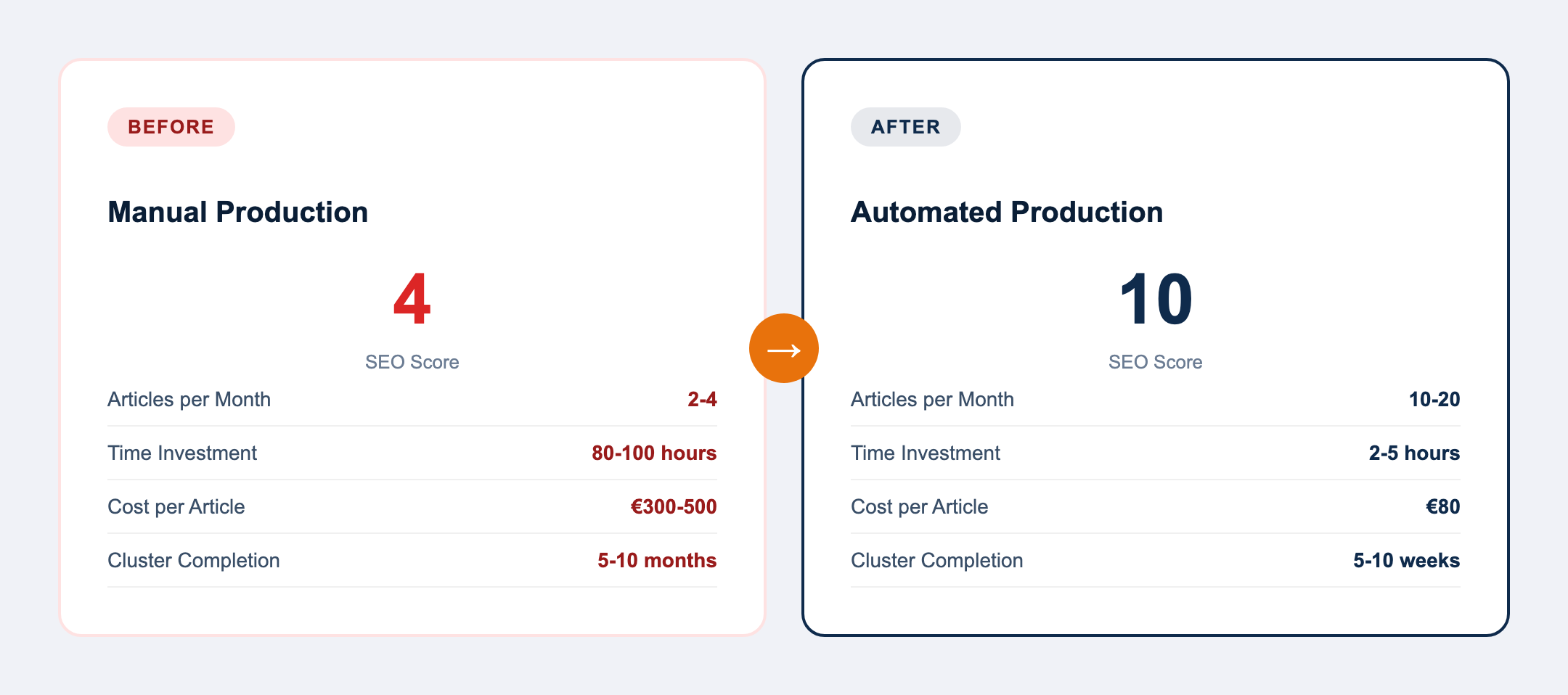
How the model is designed to work: 50 articles published across 5 topical clusters over 5 months, structured to compete for niche keyword visibility and to position organic traffic as a primary revenue channel over time.
Typical industry benchmarks for structured cluster publishing:
- Time from publication to Google index: 2-3 weeks is common
- Time to measurable ranking movement: 30-60 days is typical
- Traffic growth window: follows the standard 3-6 month SEO ramp
- SEO score per article: 85+ is achievable when measured across 6 quality gates
- Content cost per article: €24.90 with a platform vs. €300-500 from a freelance writer
These benchmarks reflect what the industry typically sees when content follows a structured cluster strategy with a consistent publishing cadence. The automation removes the execution bottleneck that prevents most businesses from reaching the 25-30 article authority threshold.
What Results Should You Expect from Content Automation?
Set realistic expectations based on data:
| Timeframe | Expected Result |
|---|---|
| Weeks 1-3 | Content indexed by Google, appearing in search console |
| Days 30-60 | Rankings begin moving for long-tail keywords |
| Months 2-3 | Measurable traffic increases for cluster topics |
| Months 3-6 | Significant organic traffic growth common for sites starting from a low base |
| Months 6-12 | Compounding returns - existing content strengthens new content |
SEO delivers a 748% median ROI[11]. AI-driven SEO achieves a 14.6% close rate compared to 1.7% for traditional outbound marketing[12]. The returns are real - but they compound over time, not overnight.
Is SEO Content Automation Right for Your Business?
Here is a simple decision framework:
Automation is a strong fit if:
- You need 5+ articles per month but do not have dedicated writers
- You are spending $3,500+ per month on an agency and want more output at lower cost
- You have a CMS (Shopify, WooCommerce, WordPress) but underutilize the blog
- You understand SEO is a 3-6 month investment, not an instant fix
- You want to build topical authority but lack the time to manage the process
Automation is not the right fit if:
- You need 1-2 highly specialized thought leadership pieces per month (hire a writer)
- You have an in-house SEO team that already produces at volume (you need tools, not a platform)
- You expect instant rankings and are not willing to wait 3-6 months
- Your product or industry requires regulatory compliance review for every piece of content
For the e-commerce owner or marketing manager who knows SEO matters but does not have the time, team, or expertise to execute - automation turns content from a constant source of stress into a system that runs on its own.
Frequently Asked Questions
Is automated SEO content the same as AI-generated content?
No. AI content generation is one step in a larger workflow. SEO content automation covers the entire process: keyword research, strategy, writing, optimization, publishing, and measurement. A platform like GetTraffic automates all 7 steps, not just the writing.
Will Google penalize automated content?
Google's official position is that content quality matters, not production method[13]. A study of 600,000 pages found the correlation between AI content and penalties is 0.011 - essentially zero[10]. Quality-controlled automation with proper EEAT signals performs as well as human-written content.
How much does SEO content automation cost?
GetTraffic costs €249/month for 10 articles with free onboarding and a 7-day free trial. Compared to agency costs of €3,500-€5,000+/month for similar output, automation typically represents a 70-91% cost reduction. Single-step AI writing tools start at $50/month but require you to manage every other step manually.
How long before I see results from automated content?
Content typically indexes in 2-3 weeks. Rankings begin moving within the standard 3-6 month SEO ramp window. Building topical authority - where a site competes consistently on a topic - takes 3-6+ months of consistent publishing. Outcomes vary by niche competition and site health.
Can I use automation alongside my existing content team?
Yes. Many businesses use automation for high-volume cluster content (product-related articles, FAQ content, long-tail keyword targeting) while keeping their human writers for thought leadership, case studies, and brand storytelling. The hybrid model often delivers the best results.
References
- Content Marketing Institute (2024). Content Marketing Statistics. contentmarketinginstitute.com
- Orbit Media (2025). Annual Blogger Survey. orbitmedia.com
- HubSpot (2024). How Often Should You Blog. blog.hubspot.com
- Siege Media (2025). Building Topical Authority. siegemedia.com
- BrightEdge (2024). How Much Traffic Comes from Organic Search. seoinc.com
- DigitalApplied (2025). AI-Generated vs. Human Content: 16-Month Ranking Study. digitalapplied.com
- Conductor (2025). AI SEO Guide. conductor.com
- Statista (2025). Worldwide Retail E-Commerce Sales. statista.com
- HubSpot (2025). State of Marketing Report. blog.hubspot.com
- Ahrefs (2025). AI-Generated Content Does Not Hurt Your Google Rankings. ahrefs.com
- SEOProfy (2025). SEO ROI Statistics. seoprofy.com
- Search Engine Journal (2025). SEO Statistics. searchenginejournal.com
- Google Search Central (2023). Google Search and AI Content. developers.google.com
- Backlinko (2025). E-Commerce SEO Guide. backlinko.com
- Ahrefs (2025). E-Commerce SEO Guide. ahrefs.com
Frequently Asked Questions
What is SEO content automation?
What parts of the SEO workflow can be automated?
Is SEO content automation worth it for SMBs?
Does automated SEO content rank as well as manual?
Will automation replace my SEO team?
How does GetTraffic automate the full SEO content workflow?
Get your business on page 1 of Google
Get your business found on Google - SEO content written and published automatically.
Start My Free Trial7-day free trial