AI SEO Tools vs. Agencies: Which Has Better ROI in 2026?


Table of Contents +
- What Does an SEO Agency Actually Deliver for €3,500-€5,000/Month?
- What Does an AI SEO Platform Deliver for €249/Month?
- How Do Costs Compare Side by Side?
- How Does Content Quality Compare?
- How Does Speed Compare?
- How Does Control and Flexibility Compare?
- What Do Real Cost Scenarios Look Like?
- When Should You Choose an Agency Over AI?
- When Should You Choose an AI Platform Over an Agency?
- What About Content Quality Over Time?
- Can You Use Both? The Hybrid Approach
- What Does the ROI Data Say?
- What Are the Hidden Costs of Each Approach?
- How to Make Your Decision: A Framework
- Frequently Asked Questions
- References
GetTraffic costs €249/mo for 10 articles vs. agency fees of €3,500+/mo. Compare cost, quality, speed, and ROI to decide what fits your business.
TL;DR: AI SEO platforms like GetTraffic cost €249/month and deliver 10 articles per month with full automation. SEO agencies charge €3,500-€5,000+/month for 4-8 articles with manual strategy. AI-driven SEO achieves a 14.6% conversion rate vs. 1.7% for traditional methods. The right choice depends on your budget, content volume needs, and how much strategic control you want.
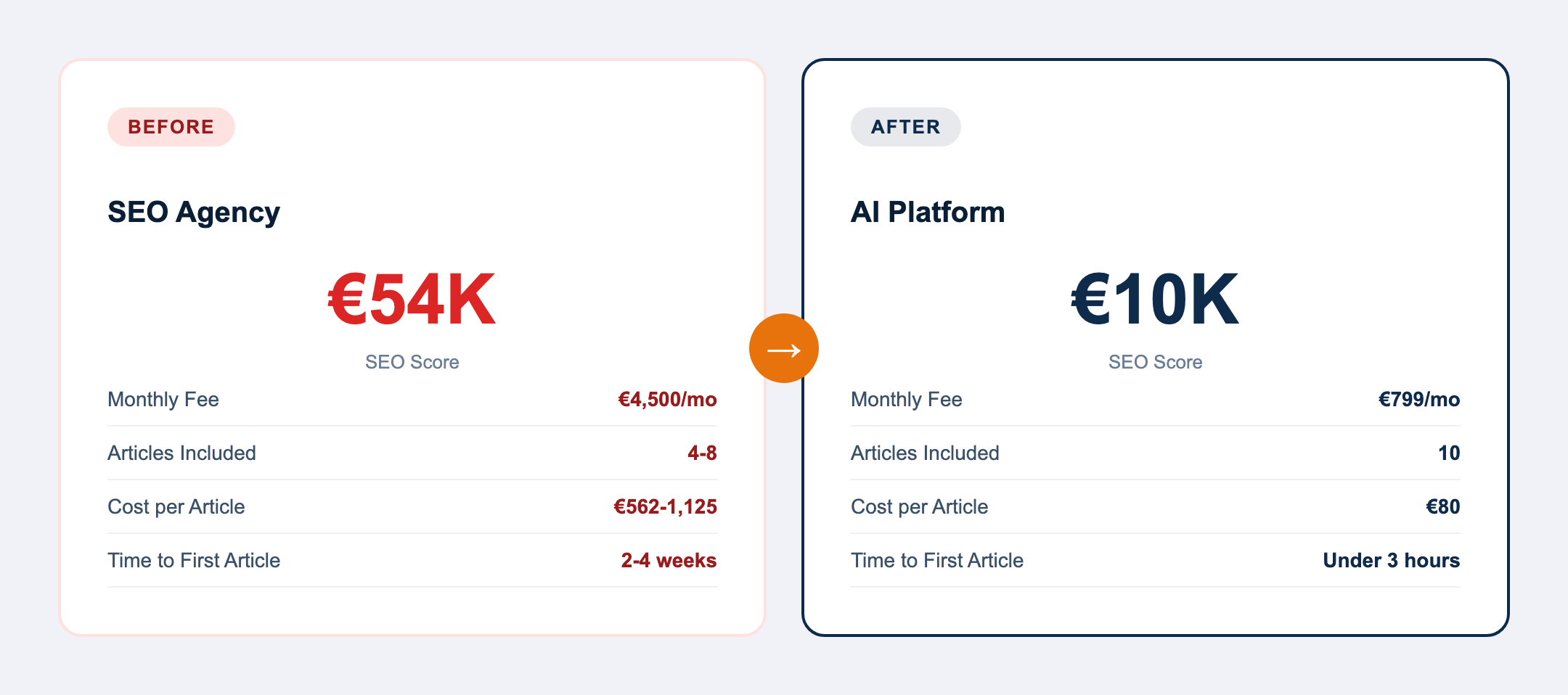
Here is the math that every marketing manager runs in their head: an SEO agency wants €4,500 per month. That is €54,000 per year - for content you do not own the process for. If the agency underperforms or the contract ends, you start from scratch. Meanwhile, AI SEO platforms promise similar output at 94% lower cost[1].
But cheaper is not always better. Agencies bring strategic expertise, relationship management, and adaptability that software cannot fully replicate. This guide compares AI SEO platforms and agencies across 5 dimensions - cost, quality, speed, control, and scalability - so you can make the right decision for your business.
What Does an SEO Agency Actually Deliver for €3,500-€5,000/Month?
Let's start with what you get when you hire a mid-tier SEO agency at the $3,500-$5,000/month price point[1]:
- 4-8 articles per month (2,000-3,000 words each)[2]
- Keyword research and strategy - usually quarterly or monthly updates
- On-page optimization - meta tags, internal linking, schema
- Monthly reporting - traffic, rankings, and content performance
- Account management - a dedicated point of contact
- Technical SEO audits - periodic site health checks
Premium agencies ($10,000+/month) add link building, conversion optimization, and dedicated strategists. Budget agencies ($1,500-$2,500/month) typically deliver 2-4 articles with less strategic depth.
The key limitation: agencies are human-powered, so output scales linearly with cost. Doubling your content volume means roughly doubling your spend.
GetTraffic writes and publishes SEO content automatically - articles that build authority and drive organic traffic - start your free trial.
What Does an AI SEO Platform Deliver for €249/Month?
AI SEO platforms automate the entire content workflow. Here is what GetTraffic delivers for €249/month:
- 10 articles per month (2,000-3,000+ words each)
- Automated keyword research and gap analysis - continuous, not quarterly
- Topical authority clusters - strategically interlinked content, not random articles
- EEAT content architecture - built-in quality gates (85+ SEO score, readability, uniqueness)
- Direct CMS publishing - Shopify, WooCommerce, WordPress, Webflow, Wix, Framer
- Performance tracking - per-article ranking and traffic data
The key advantage: output does not scale linearly with cost. GetTraffic at €249/month delivers 10 articles - the same output that costs €3,500+/month from an agency.
How Do Costs Compare Side by Side?
Here is a direct cost comparison for a business that needs 10 SEO articles per month:
| Cost Factor | SEO Agency | AI Platform (GetTraffic) |
|---|---|---|
| Monthly fee | €4,500/mo | €249/mo |
| Articles included | 4-8 | 10 |
| Additional articles | €300-500 each | Contact sales |
| Strategy/consulting | Included | Automated + monthly strategy reviews |
| Onboarding | €0-2,000 | Free |
| Annual cost | €54,000 | €2,988 |
| Cost per article | €562-1,125 | €24.90 |
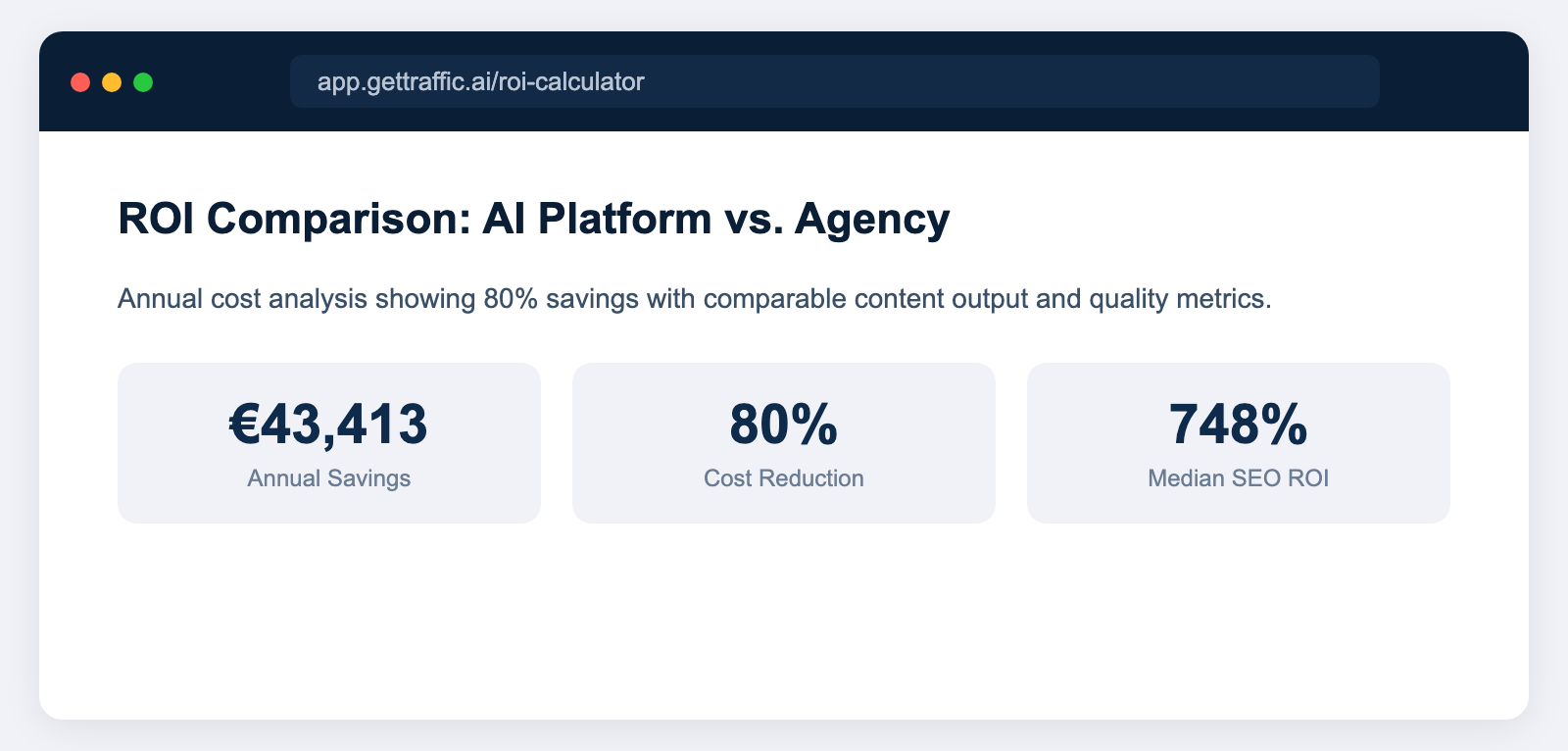
The annual savings: €51,012 - a 94% cost reduction. For businesses spending on SEO content, this is the single biggest line item to optimize.
But cost tells only part of the story. If the AI platform delivers lower quality, the savings are worthless.
How Does Content Quality Compare?
This is the question that matters most. Here is what the data shows:
AI content quality in 2026 is not what it was in 2023. A 16-month longitudinal study found that human-edited AI content performs within 4% of purely human content in Google rankings[3]. Unedited AI content ranks 23% lower - which is why quality gates matter.
The real quality differentiator is not human vs. AI. It is strategic vs. random:
- Agency content is only as good as the writer assigned to your account. Junior writers produce generic content. Senior writers produce excellent content. You rarely get to choose.
- AI platform content is only as good as its quality controls. Platforms with 6+ quality gates (SEO scoring, EEAT compliance, readability, uniqueness, keyword coverage, schema) produce consistently high-quality output. Cheap AI tools with no quality controls produce garbage.
Both approaches can produce content that ranks on Google. The variable is consistency. Agencies depend on individual writer quality, which varies. AI platforms with strong quality gates deliver consistent quality across every article.
How Does Speed Compare?
Speed is where AI platforms have an insurmountable advantage:
| Metric | SEO Agency | AI Platform |
|---|---|---|
| Onboarding to first article | 2-4 weeks | Under 3 hours |
| Articles per month | 4-8 (at $3,500-$5,000/mo tier) | 10 |
| Revision turnaround | 3-5 business days | Same day |
| Strategy update | Monthly or quarterly | Continuous |
| Time to 25-article cluster | 3-6 months | 5-10 weeks |
70% of agencies take 3-6 months to show measurable SEO results[4]. Part of that timeline is inherent to SEO (Google needs time to crawl, index, and rank content). But part of it is production speed - agencies simply cannot publish fast enough to build topical authority quickly.
Content clusters drive 30% more traffic and hold rankings 2.5x longer[5]. Building a cluster of 25-30 articles in 5-10 weeks (AI platform speed) vs. 3-6 months (agency speed) means reaching the authority threshold faster and starting to rank sooner.
How Does Control and Flexibility Compare?
This dimension favors agencies - with caveats:
Agency advantages:
- Human strategists who understand nuance, brand positioning, and competitive dynamics
- Ability to pivot strategy quickly based on market changes or business needs
- Relationship-based communication - you can explain complex requirements in a conversation
- Experience with non-content SEO: technical audits, link building, site architecture
AI platform advantages:
- Full transparency - you see every article before it publishes
- No dependency on specific people (agency account managers leave, writers change)
- Consistent output regardless of agency workload or staffing issues
- Direct CMS integration means you control the publishing timeline
The honest assessment: if your SEO needs extend beyond content (technical SEO issues, complex site migrations, link building campaigns), an agency provides broader coverage. If your primary need is consistent, high-quality content published to your blog, an AI platform delivers more output with less friction.
What Do Real Cost Scenarios Look Like?
Abstract comparisons hide the details that matter. Here are 3 specific scenarios with actual numbers:
Scenario 1: E-Commerce Store Launching Content Marketing
A Shopify store selling organic skincare products. Zero blog posts. Needs to build topical authority in "natural skincare" from scratch.
Agency approach: €4,500/month for 6 articles. Reaching the 25-article authority threshold takes 4+ months. Total cost to authority: €18,000+. Plus onboarding time and revision cycles.
AI platform approach: €249/month for 10 articles with free onboarding and a 7-day free trial. Reaching the 25-article authority threshold takes 10-12 weeks. Total cost to authority: €747-€997.
The AI platform reaches the authority threshold in half the time at roughly 1/18 the cost. For a store that needs rankings before the holiday shopping season, this speed difference is the deciding factor.
Scenario 2: Marketing Manager Replacing an Underperforming Agency
A B2C brand spending €5,000/month on an agency that delivers 8 articles. Rankings have stagnated after 12 months. The marketing manager wants more output and a fresh strategy.
Switching to AI platform (GetTraffic at €249/month): 10 articles per month in 1 topical cluster. Annual savings: €57,012. The cost reduction frees budget for other growth activities while still building topical authority consistently.
Scenario 3: Agency Owner Scaling Client Content
A digital agency managing 8 clients, each needing 10 articles per month. Hiring writers for 80 articles per month requires 4-5 full-time writers at €3,000-€4,000 each. Total writer payroll: €15,000-€20,000/month.
Using AI platform as white-label: 8 client accounts at €249/month each = €1,992/month. Same output, 87-90% cost reduction. The agency maintains margins while scaling without headcount risk.
When Should You Choose an Agency Over AI?
Agencies are the better choice in specific situations:
1. Complex technical SEO needs. If your site has crawlability issues, duplicate content problems, site migration requirements, or complex international SEO, you need human specialists. AI platforms do not fix technical site issues.
2. Enterprise-level strategy. Businesses with $10M+ in revenue, multiple product lines, and complex competitive landscapes benefit from dedicated strategists who understand the full business context. At this level, the agency cost ($10,000-$25,000/month) is justified by the strategic depth.
3. Link building campaigns. Earning high-quality backlinks requires relationship building, outreach, and negotiation. This is inherently human work that AI cannot automate effectively.
4. Brand-sensitive industries. Healthcare, finance, and legal content requires regulatory compliance review and domain expertise that generic AI platforms do not provide. Specialized agencies with industry expertise add real value here.
When Should You Choose an AI Platform Over an Agency?
AI platforms are the better choice when:
1. Content volume is the bottleneck. If you need 10-20 articles per month to build topical authority and your agency delivers 4-8, you are leaving traffic on the table. Automation solves the volume problem without scaling cost proportionally.
2. Budget is constrained. At €249/month vs. €4,500/month for comparable output, the AI platform frees budget for other marketing activities (paid ads, conversion optimization, product development).
3. Speed to results matters. If you need to build topical authority before a product launch, seasonal peak, or competitive threat, the AI platform's 5-10 week cluster build timeline beats the agency's 3-6 months.
4. You want ownership of the process. When an agency contract ends, you lose the team, the strategy, and the institutional knowledge. With an AI platform, the content lives on your site and the process is documented and repeatable.
5. Your primary need is content, not technical SEO. If your site is technically sound and your gap is content volume and topical authority, paying agency rates for strategy overhead you do not need is wasteful.
SEO content that ranks, written and published for you
GetTraffic creates authority-building content clusters for your business. No writing, no freelancers, no content calendar. Agency-quality results at 91% less cost.
Start My Free TrialWhat About Content Quality Over Time?
A common concern: AI content is good today, but will it stay competitive as everyone uses the same tools? The answer depends on what you automate.
Agencies face a similar challenge - writer turnover is high. The writer producing excellent content for your account in January may leave the agency by March. Your replacement writer starts from scratch, learning your brand voice, product catalog, and audience. Quality dips during every transition.
AI platforms face the opposite pattern. Quality improves over time as the platform learns your brand, accumulates performance data, and refines its approach based on what ranks and what does not. The platform does not take vacations, get reassigned to a higher-paying client, or forget your brand guidelines.
The data supports this: content clusters hold rankings 2.5x longer than standalone content[5]. This durability comes from the cluster structure - which AI platforms build systematically - not from individual article brilliance. A network of 25 interlinked articles on one topic creates a competitive moat that a competitor cannot easily replicate, regardless of whether those articles were written by humans or AI.
The honest assessment: for generic informational content, AI platforms match or exceed average agency output. For deeply original thought leadership, expert interviews, and proprietary research, human writers still have an edge. The 80/20 rule applies - automate the 80% that follows repeatable patterns, and invest human effort in the 20% that requires genuine originality.
Can You Use Both? The Hybrid Approach
The smartest businesses do not choose one or the other - they use both strategically:
- AI platform for high-volume cluster content: product-related articles, FAQ content, long-tail keyword targeting, regular blog publishing
- Agency for specialized work: technical SEO audits, link building, site architecture, competitive strategy
This hybrid approach lets you get 80% of your content from automation (at 80% lower cost) while using agency expertise for the 20% that requires human strategic thinking. The combined spend is often less than an agency-only approach - with higher total output.
What Does the ROI Data Say?
The numbers favor AI-driven SEO across most metrics:
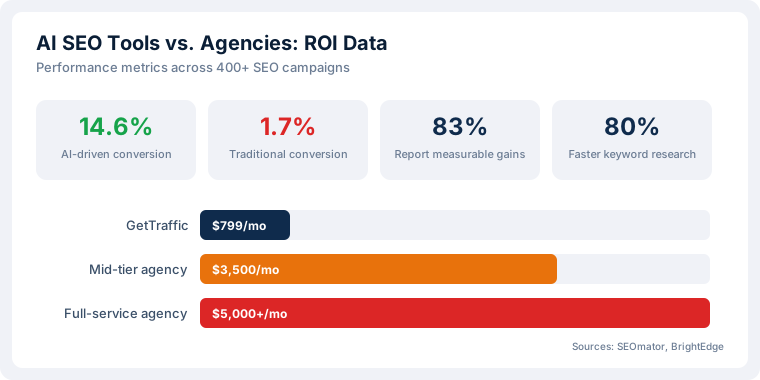
- 14.6% conversion rate for AI-driven SEO vs. 1.7% for traditional outbound marketing[4]
- 83% of marketers report measurable gains from AI-powered SEO[6]
- 748% median ROI for SEO overall ($22 for every $1 invested)[7]
- 94% cost reduction vs. equivalent agency engagement for content production
GetTraffic produces 10 EEAT-architected articles per month at €249/month (€2,988/year), organized as topical-authority clusters with internal linking and quality gates. An equivalent agency engagement for the same article volume would typically cost €54,000+/year. Ranking outcomes depend on niche competition, domain authority, and site health - SEO results are not guaranteed.
The ROI difference is not subtle. For content-focused SEO, the AI platform delivers more content, faster, at a fraction of the cost. For strategic and technical SEO beyond content, agencies still provide irreplaceable value.
What Are the Hidden Costs of Each Approach?
The sticker price does not tell the full story. Here are costs that most comparisons miss:
Hidden agency costs:
- Onboarding time: 2-4 weeks of strategy sessions, content audits, and brand immersion before the first article ships. That is a month of paying without receiving content.
- Revision cycles: Each article typically requires 1-2 rounds of feedback. At 15-30 minutes per review plus 3-5 day turnaround, managing the revision process consumes 4-8 hours per month of your time.
- Knowledge loss: When the contract ends, the strategic knowledge leaves with the agency. Your next agency or solution starts from zero.
- Scope creep: Many agencies quote a base fee and charge extra for additional articles, strategy updates, or technical fixes. The $3,500/month quote becomes $5,000+ in practice.
Hidden AI platform costs:
- Onboarding: GetTraffic includes onboarding for free. Some other platforms charge a one-time setup fee for initial analysis and configuration.
- Review time: While automation handles production, you still need 1-2 hours per month reviewing content before publication (or trusting the quality gates and publishing automatically).
- Learning curve: Understanding the platform dashboard, approving content calendars, and reviewing performance reports takes time in the first month.
When you factor in hidden costs, the agency total typically rises 20-40% above the quoted price. The AI platform total stays closer to the sticker price because the workflow is more predictable and less dependent on human coordination.
How to Make Your Decision: A Framework
Use this decision matrix:
| Your Situation | Best Choice |
|---|---|
| Need 10+ articles/month, budget under €2,000 | AI Platform |
| Complex technical SEO issues to resolve | Agency |
| E-commerce store needing content for rankings | AI Platform |
| Enterprise with $10M+ revenue, multiple product lines | Agency |
| Currently paying agency $3,500+/month for 4-8 articles | AI Platform (or hybrid) |
| Need link building and outreach | Agency |
| Marketing team of 1-3 people, no writers | AI Platform |
| Regulated industry (healthcare, finance) | Agency with industry expertise |
| Need both content volume and technical strategy | Hybrid |
For most e-commerce businesses and marketing teams with 5-50 employees - the core GetTraffic customer profile - the AI platform delivers better ROI for content-focused SEO. Pair it with targeted agency work for technical needs, and you have the most efficient SEO investment possible.
Frequently Asked Questions
Are AI SEO platforms replacing agencies entirely?
No. AI platforms replace the content production and publishing workflow that agencies handle. Strategic consulting, technical SEO, link building, and complex competitive analysis still require human expertise. The market is shifting toward a hybrid model: AI platforms for content volume, agencies for specialized strategic work.
How do I evaluate whether my current agency is worth the cost?
Calculate your cost per article (monthly fee divided by articles delivered). If you are paying more than €500 per article for standard SEO content, an AI platform likely delivers better value. Also check: are you building topical authority (clustered, interlinked content) or publishing random articles? Clusters drive 30% more traffic[5].
What if I switch from an agency to AI and quality drops?
Quality depends on the platform, not the concept. AI platforms with strong quality gates (6+ checks including SEO scoring, EEAT compliance, readability) produce consistently high-quality content. Request sample articles before committing. Compare them against your agency's output using objective metrics: SEO score, readability score, keyword coverage, and uniqueness.
Can I use an AI platform as a white-label solution for my agency?
Yes. GetTraffic and similar platforms offer agency partnerships where you resell automated content under your brand. This lets agencies scale content delivery to 10+ clients without hiring additional writers - maintaining margins while increasing output.
What is the minimum commitment for an AI SEO platform?
GetTraffic is month-to-month at €249/month with a 7-day free trial - cancel anytime. No annual contract required, no onboarding fee. Compared to agency contracts (typically 6-12 month minimums at 5-10x the monthly cost), the financial commitment is significantly lower and far more flexible.
References
- Ahrefs (2025). SEO Pricing: How Much Does SEO Cost. ahrefs.com
- Siege Media (2025). Content Marketing Pricing Guide. siegemedia.com
- DigitalApplied (2025). AI-Generated vs. Human Content: 16-Month Ranking Study. digitalapplied.com
- Search Engine Journal (2025). SEO Statistics. searchenginejournal.com
- ClickRank (2025). Topical Authority Research. clickrank.ai
- Conductor (2025). AI SEO Guide. conductor.com
- SEOProfy (2025). SEO ROI Statistics. seoprofy.com
Frequently Asked Questions
Are AI SEO tools cheaper than agencies?
Do AI SEO tools deliver agency-quality results?
When does an SEO agency make more sense than a tool?
What is the ROI of AI SEO tools vs agencies?
Can a small business actually replace an SEO agency with software?
What does GetTraffic include that agencies charge €3,500+ for?
Get your business on page 1 of Google
Get your business found on Google - SEO content written and published automatically.
Start My Free Trial7-day free trial