How to Get Cited by ChatGPT (2026)


Table of Contents +
- Why doesn't ChatGPT cite my site?
- Is ChatGPT search powered by Bing?
- How does ChatGPT choose which 15% to cite?
- How do I make my content extractable for ChatGPT?
- How does ChatGPT decide which brands to name?
- What is a ChatGPT citation checklist?
- How do I track ChatGPT citations?
- How long does it take to get cited by ChatGPT?
- References
How to get cited by ChatGPT: 7 steps to join the 15% of pages ChatGPT cites, from Bing indexing to entity signals (2026).
TL;DR: ChatGPT cites only about 15% of the pages it retrieves, and it pulls from the Bing index. To get cited, allow OAI-SearchBot and GPTBot in robots.txt, rank in Bing and Google's top 10, add citable statistics and quotations, and build entity strength across Wikipedia, LinkedIn, and Crunchbase. Sites with 32,000+ referring domains are roughly 3.5x more likely to be cited.
ChatGPT now answers product questions, comparison queries, and how-to searches for millions of people who never open a search engine. When it answers, it names sources. If your site is not one of them, you are invisible in a channel that is growing fast.
The good news: ChatGPT citation is not random. It runs on rules you can influence. This post breaks down why ChatGPT ignores most sites, how it decides which pages and brands to name, and the exact steps to make your content citable. For the wider strategy across every answer engine, see our guide to generative engine optimization.
Why doesn't ChatGPT cite my site?
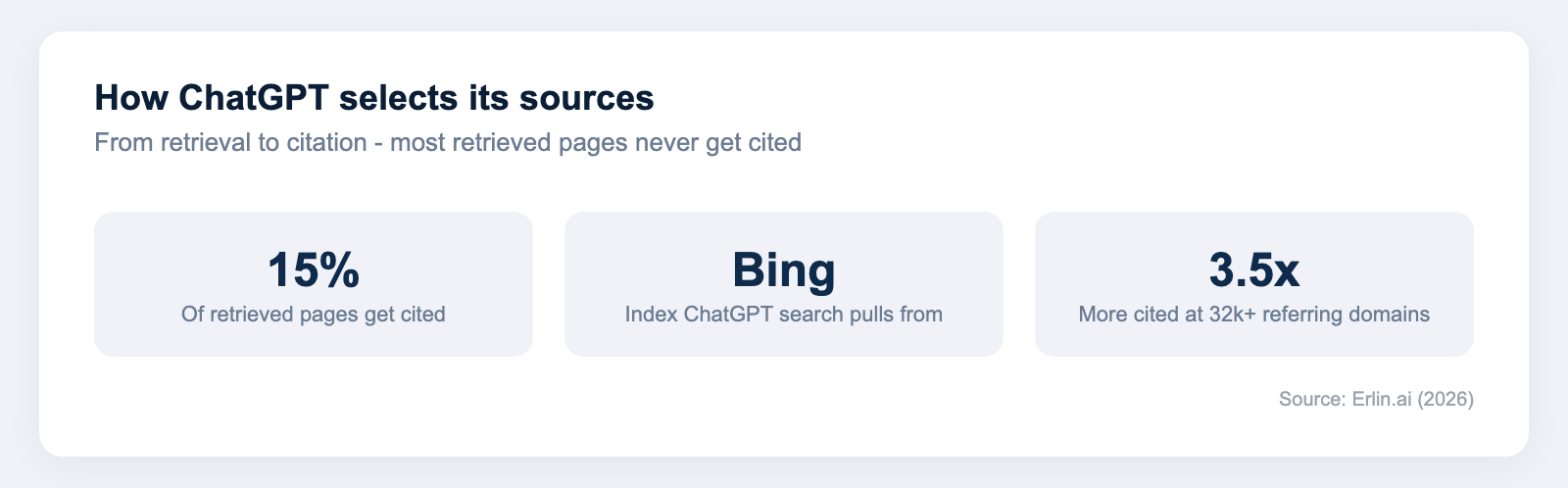
ChatGPT retrieves dozens of pages per query but cites only about 15% of them.[1] If your page is blocked to its crawlers, missing from the Bing index, or weak on authority signals, it never enters that 15%. Most sites fail at the first gate: their robots.txt blocks the bots, or they simply do not rank well enough to be retrieved.
Three common reasons your content gets passed over:
- Crawler blocked. Each AI platform uses its own crawler. Block it and you cannot be cited, full stop.[2]
- Low authority. Pages with a Domain Rating under 30 are rarely cited.[3]
- Nothing extractable. No statistics, no clear answers, no structure the model can lift cleanly.
Notice the order. Access comes before authority, and authority comes before extractability. A page can be beautifully written and full of data, but if the crawler is blocked or the page never ranks in Bing, none of that matters. Diagnose from the top down: confirm access, confirm indexing and ranking, then improve the content itself. We cover the full diagnostic in why AI isn't citing your content.
GetTraffic writes and publishes SEO content automatically - articles that build authority and drive organic traffic - start your free trial.
Is ChatGPT search powered by Bing?
Yes. ChatGPT search retrieves results through the Bing index, so your first job is to get indexed and ranked in Bing.[1] If Bing cannot find or rank your page, ChatGPT cannot retrieve it. This is a practical advantage: Bing is less competitive than Google for many queries, so a strong Bing presence is achievable faster.
Two checks before anything else. Verify your site in Bing Webmaster Tools and confirm your key pages are indexed. Then confirm your robots.txt allows the OpenAI crawlers: OAI-SearchBot for live search retrieval and GPTBot for training and answers.[1] A single disallow line on those user agents removes you from the channel entirely.
This is also why every AI engine has to be handled on its own terms. Each platform runs a separate crawler, and blocking any one of them prevents citation on that platform.[2] Allowing GPTBot helps ChatGPT but does nothing for Perplexity or Google. Audit your robots.txt against the full list of AI user agents, not just one, and keep it open unless you have a specific reason to block.
How does ChatGPT choose which 15% to cite?
ChatGPT favors pages that already rank well in conventional search and carry strong authority signals. Roughly half of AI-cited sources rank in Google's top 10, and pages under a Domain Rating of 30 are rarely chosen.[3] On top of ranking, the model rewards content it can extract and trust: clear answers, cited data, and matching structured markup.
The signals that move you into the cited 15%, and what to do about each:
| Signal | What it means | Action |
|---|---|---|
| Search ranking | ~50% of cited sources rank Google top 10 | Earn rankings in Bing and Google for the query |
| Domain authority | DR under 30 rarely cited | Build referring domains over time |
| Referring domains | 32,000+ domains ~3.5x more likely cited | Earn links through useful, linkable content |
| Extractable data | Statistics and quotations lift citation odds | Add original numbers and direct quotes |
| Schema match | FAQPage schema has high citation rates | Add schema that matches visible content |
The referring-domains effect is large: sites with 32,000+ referring domains are about 3.5x more likely to be cited by ChatGPT.[4] You will not hit that overnight, but the direction is clear: links and authority still decide who gets named.
How do I make my content extractable for ChatGPT?
Write content the model can lift in one clean pass. A Princeton study on generative engine optimization found that adding cited sources raised visibility by 40%, adding statistics by 37%, and adding quotations by 30%, while keyword stuffing cut visibility by 10%.[5] Lead each section with a direct answer, then support it with data.
Concrete moves that make a page extractable:
- Answer first. Open every section with a 40-75 word direct answer to the question in the heading.
- Add statistics. Use specific numbers with dates and sources, not vague claims.
- Add quotations. Direct quotes from named experts give the model something to attribute.
- Use FAQPage schema. It has one of the highest AI citation rates, but the markup must match the visible text. A mismatch reads as manipulation.[6]
- Drop the stuffing. Repeating keywords lowers visibility. Write for clarity.[5]
One nuance on schema. FAQPage markup earns citations because it maps a clear question to a clear answer, which is exactly the shape ChatGPT wants to lift. But the markup must match what a reader sees on the page. If your schema lists questions and answers that do not appear in the visible content, search engines read it as manipulation and may discount the page entirely.[6] Keep schema and visible text identical.
The same extractability rules apply across engines. See our playbooks for Perplexity and Google AI Overviews.
How does ChatGPT decide which brands to name?
ChatGPT cross-references entities. When it considers naming a brand or author, it checks structured sources like Wikipedia, Wikidata, LinkedIn, and Crunchbase to confirm the entity exists and matters.[4] A brand with consistent, verifiable presence across those sources is far easier for the model to name with confidence than one that appears only on its own website.
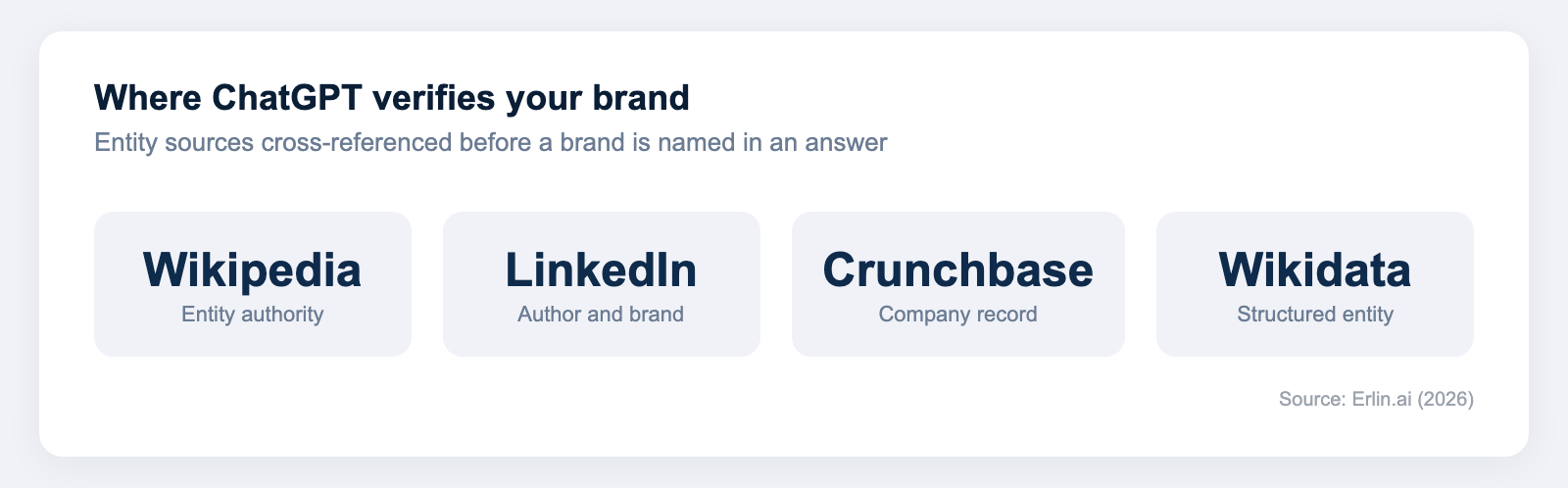
Build entity strength deliberately. Keep your company name, founders, and key authors consistent across LinkedIn, Crunchbase, and any industry directories, because the model trusts what it can corroborate in more than one place. Where you qualify, a Wikipedia or Wikidata entry anchors your entity in the structured web the model already reads. Author expertise feeds the same trust system, which is why E-E-A-T for AI content directly affects whether you get named.
This is the slow part of the work, and it is where most one-off content efforts fall short. A single well-written page rarely builds enough entity weight on its own. The brands ChatGPT names tend to have published consistently across a topic, earned references from other sites, and kept their profiles current. Authority and breadth are what separate a brand the model names from one it skips.
SEO content that ranks, written and published for you
GetTraffic creates authority-building content clusters for your business. No writing, no freelancers, no content calendar. Agency-quality results at 91% less cost.
Start My Free TrialWhat is a ChatGPT citation checklist?
A ChatGPT citation checklist is a short, ordered set of technical and content fixes that move a page into the cited 15%. Work top to bottom: access first, then ranking, then extractability, then entity signals. Skipping the access step makes the rest pointless, because a blocked crawler never reaches your content.
| Step | Check | Why it matters |
|---|---|---|
| 1 | Allow OAI-SearchBot and GPTBot in robots.txt | Blocked crawler = zero citations |
| 2 | Index and rank the page in Bing | ChatGPT search runs on the Bing index |
| 3 | Earn Google top-10 rankings | ~50% of cited sources rank top 10 |
| 4 | Lead each section with a direct answer | Extractable answers get lifted |
| 5 | Add statistics and quotations | +37% and +30% visibility |
| 6 | Add matching FAQPage schema | High citation rate when consistent |
| 7 | Build referring domains and entity profiles | Authority and trust decide who is named |
Most teams stall on steps 3 through 7 because they require consistent publishing and link-worthy depth across a whole topic, not one page. This is where GetTraffic helps: the engine builds industry-specific topical-authority clusters and the entity signals that earn citations, then auto-publishes to your CMS. You get coverage and structure at agency quality without the agency timeline. If you are weighing options, compare the approaches on our AI SEO tools comparison.
How do I track ChatGPT citations?
Track citations by running your target questions through ChatGPT yourself and recording which sources it names, then repeat on a schedule. There is no official analytics dashboard, so a manual log of queries, dates, and cited domains is the practical baseline. Watch for your own pages appearing, and note which competitors keep showing up so you can study what they do well.
Build a simple monitoring routine. List the 20 to 30 questions your buyers actually ask, run them monthly, and log the cited sources in a spreadsheet. Pair this with your Bing and Google rankings for the same queries, because the two move together: when a page climbs into the top 10 and gets cleaner data, it tends to start appearing in answers. Treat any competitor cited repeatedly as a content gap to close.
How long does it take to get cited by ChatGPT?
There is no fixed timeline, and no one can promise a citation. Speed depends on your starting authority, how fast Bing indexes your pages, and how quickly you build topical depth and referring domains. Pages that already rank top 10 and carry decent authority can appear in answers within weeks of adding extractable data and schema. Weak domains take longer because authority compounds slowly.
Treat ChatGPT citation as a byproduct of strong search performance, not a separate game. The pages that get cited are usually the same ones that rank, answer clearly, and come from a recognized entity. Build that foundation and citations follow.
References
- Erlin (2025). ChatGPT Search Optimization. erlin.ai
- Ziptie (2025). How to Optimize Content for Perplexity AI. ziptie.dev
- WordStream (2025). How to Get Cited by AI Search. wordstream.com
- Erlin (2025). ChatGPT Search Optimization (entity and referring-domain signals). erlin.ai
- Aggarwal et al. (2023). GEO: Generative Engine Optimization. arxiv.org
- WordStream (2025). How to Get Cited by AI Search (schema and FAQ). wordstream.com
Frequently Asked Questions
Is ChatGPT search powered by Bing?
What percentage of pages does ChatGPT cite?
How do I let ChatGPT crawl my site?
Do backlinks affect ChatGPT citations?
What content gets cited most by ChatGPT?
How does ChatGPT decide which brands to name?
Get your business on page 1 of Google
Get your business found on Google - SEO content written and published automatically.
Start My Free Trial7-day free trial