How to Get Cited by Perplexity (2026)

Table of Contents +
How to get cited by Perplexity in 2026: 40-80 word answer capsules, schema (about 73% lift), and a 14-day freshness cadence that wins citations.
TL;DR: To get cited by Perplexity, lead with a 40-80 word answer capsule near the top, add FAQPage and Article schema (raises selection odds about 73%), and refresh evergreen pages roughly every 14 days. Cite sources and statistics, build a presence on Reddit and YouTube, and never block PerplexityBot.
Perplexity does not return ten blue links. It reads pages, picks a handful of sources, and writes one answer with citations. If you are not in that short list, you get no visit and no credit. The good news: the signals that earn a Perplexity citation are concrete and measurable, and most of your competitors ignore them.
Perplexity matters because its behavior is spreading. Users increasingly expect a direct, sourced answer instead of a page of links, and Google's AI Overviews work on the same logic. Optimizing for Perplexity is not a niche bet on one product; it is practice for how most search will work. Win here and the same habits earn citations elsewhere.
This guide breaks down how Perplexity chooses sources, what an answer capsule is, whether schema moves the needle, how often to refresh, and why Reddit and YouTube dominate the citation list. For the broader picture across every AI engine, start with our generative engine optimization guide.
How does Perplexity choose sources?
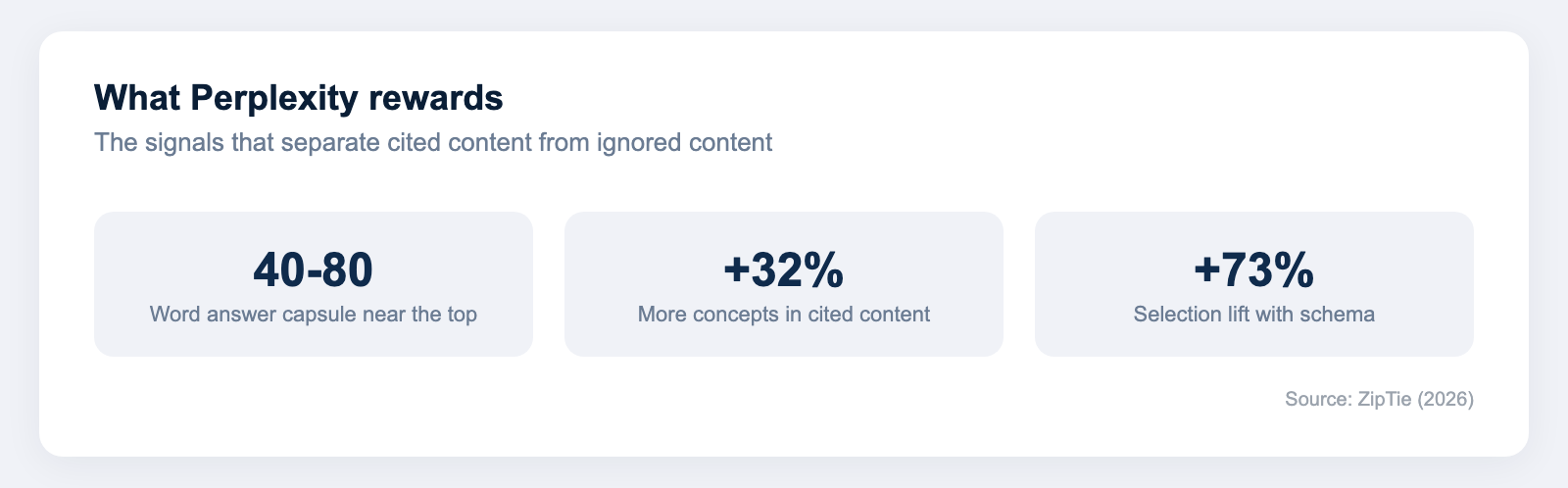
Perplexity runs a live search, ranks pages, then synthesizes an answer from the top results and links each claim to its source. Pages that win cite their own sources, include statistics, and use clear, explicit language. One analysis found cited content carries about 32% more explicit concepts than uncited content.[1] Vague, padded copy gets skipped.
Think of it as a two-stage filter. First, retrieval: Perplexity pulls a set of candidate pages from its live index for the query. Second, synthesis: the model reads those candidates and decides which sentences are worth quoting and attributing. You have to clear both stages. A page can rank well enough to be retrieved yet still get passed over at synthesis because its claims are mushy or unsupported. Specific, sourced, scannable writing wins the second stage.
A Princeton study of generative engines confirms the pattern. Adding citations to sources lifted visibility by 40%, adding statistics by 37%, and adding direct quotations by 30%. Keyword stuffing cut visibility by 10%.[2] Write for a reader who wants evidence, not for a 2015-era keyword density tool. In practice that means swapping a sentence like "organic search drives a lot of traffic" for "organic search drives 53% of trackable website traffic," with a source. The numbers and citations are what the engine reaches for. The same fundamentals carry over to getting cited by ChatGPT and ranking in Google AI Overviews.
GetTraffic writes and publishes SEO content automatically - articles that build authority and drive organic traffic - start your free trial.
What is an answer capsule and how long should it be?
An answer capsule is a short, self-contained paragraph that answers the question directly, placed near the top of the page right after the heading. Perplexity favors a capsule of roughly 40 to 80 words.[1] It should state the answer in the first sentence, then add one or two sentences of qualification. No preamble, no "in this article we will explore." The model can lift it almost verbatim, which is exactly what you want.
Format every major section this way. Lead with the capsule, then expand with detail, examples, and data below it. This is the single highest-leverage change most pages can make, and it costs nothing but discipline.
A strong capsule follows a simple shape. Sentence one restates the question as a statement and answers it. Sentence two adds the most important caveat or number. Sentence three points to what comes next or names an edge case. Avoid hedging openers, marketing throat-clearing, and pronouns with no clear referent. The model rewards capsules it can quote without having to read the rest of the page to make sense of them, so each one must stand alone.
Does schema markup help on Perplexity?
Yes. Structured data accounts for roughly 10% of Perplexity's ranking signals, and adding it can raise your odds of being selected as a source by about 73%.[1] The opportunity is wide open: only about 12.4% of sites use structured data at all.[1] FAQPage schema in particular shows some of the highest AI citation rates, though the markup must match the visible content or it reads as manipulation.[3]
Prioritize these schema types:
- Article - author, publish date, and last-updated date so freshness is machine-readable.
- FAQPage - each question paired with a concise answer capsule.
- Organization - to establish the publishing entity.
- HowTo - for step-by-step content where it genuinely applies.
One rule sits above the rest: the markup must mirror what a human sees on the page. If your FAQPage schema lists ten questions but only three appear in the visible content, that gap reads as manipulation and can cost you the citation rather than earn it.[3] Treat schema as a faithful description of the page, never as a place to stuff extra claims the reader never gets to see.
How often must I refresh content?
Perplexity weights freshness heavily and revisits pages on a cadence that depends on content type. Evergreen reference pages should be reviewed roughly every 14 days, and how-to or fast-moving content closer to weekly.[1] A "refresh" means real change: updated numbers, a new example, a corrected claim, and a bumped last-modified date in your schema. Cosmetic date changes do not fool the model.
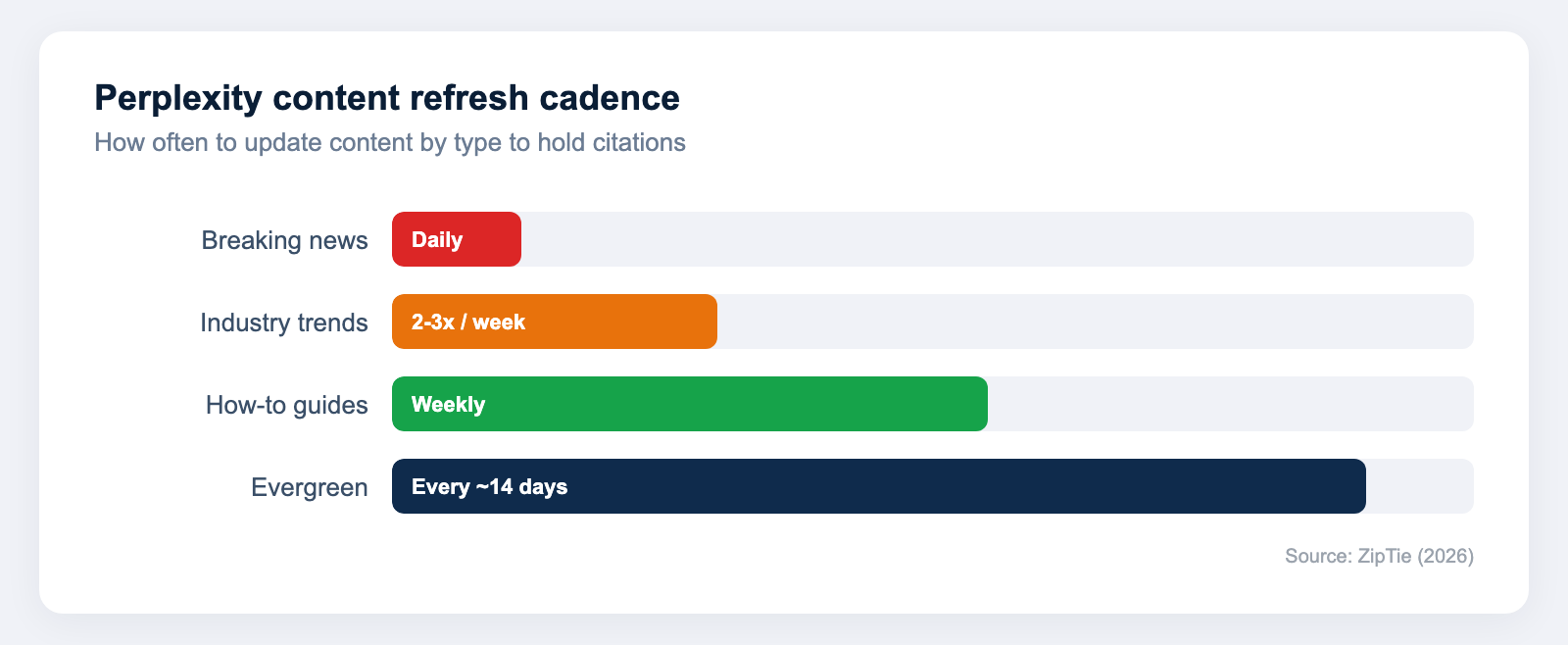
Use this cadence as a baseline:
| Content type | Review cadence | What to update |
|---|---|---|
| How-to and tutorials | Weekly | Steps, screenshots, tool versions |
| Evergreen guides | Every ~14 days | Stats, examples, internal links |
| Reference and definitions | Monthly | Terminology, edge cases |
| News and trends | As events break | Facts, dates, sources |
Maintaining this rhythm by hand across a content cluster is the part most teams quietly drop. GetTraffic handles it automatically: it injects matching Article and FAQPage schema, keeps the last-updated signal honest, and runs a freshness cadence across every article in a topical-authority cluster, so the whole set stays eligible instead of one hero page.
Why do Reddit and YouTube get cited so much?
Reddit is the most-cited domain in Perplexity answers, and YouTube earns far more video citations than any other platform.[1] The reason is third-party signal. Reddit threads carry real, unpolished human opinion the model treats as trustworthy, and YouTube supplies indexed transcripts that answer practical questions. Both represent your entity existing in places the model already trusts, not just on your own domain.
You will not outrank Reddit on its own turf, but you can earn presence: answer questions in relevant subreddits, publish a YouTube video with a clean transcript for your key topics, and make sure your brand and product are described consistently wherever they appear. When the model sees the same entity across multiple trusted sources, your own pages gain credibility too. If your content is invisible despite good writing, weak entity presence is often why - see why AI isn't citing your content.
Practical moves that build third-party signal:
- Be genuinely useful on Reddit. Answer real questions in the subreddits your buyers read. Drop links sparingly and only when they add value, or the community removes them.
- Add a transcript to every video. Perplexity reads transcripts, not pixels. A clean, accurate transcript turns a YouTube video into citable text.
- Keep your entity description consistent. Use the same product name, category, and one-line description on your site, your profiles, and any listing. Conflicting descriptions confuse the model about who you are.
- Earn mentions, not just links. A clear mention of your brand and what it does, even without a link, helps the model associate your entity with the topic.
SEO content that ranks, written and published for you
GetTraffic creates authority-building content clusters for your business. No writing, no freelancers, no content calendar. Agency-quality results at 91% less cost.
Start My Free TrialIs PerplexityBot allowed to crawl me?
Check now, because if PerplexityBot is blocked you cannot be cited at all. Each AI platform uses its own crawler, and blocking one specific bot quietly removes you from that engine's answers while leaving Google intact.[1] Many sites block AI bots by default through a CDN setting or an aggressive robots.txt rule and never notice the lost visibility.
Open your robots.txt and confirm PerplexityBot is not disallowed. Also check WAF and CDN bot-management rules at Cloudflare or similar, since those can block crawlers before robots.txt is ever read. Allowing the crawler is a prerequisite, not an optimization - everything else in this guide depends on it.
Two checks take five minutes. First, request your own page using the PerplexityBot user agent and confirm you get a 200 response, not a 403 or a challenge page. Second, search Perplexity for a query your page should answer and see whether you appear in the sources. If you are crawlable but still absent, the problem is content, not access, and the rest of this guide is where to focus.
What is the Perplexity citation checklist?
Getting cited comes down to a repeatable set of signals. Work through this checklist on any page you want surfaced, then maintain it on the cadence above. None of these steps require new tooling, only consistency.
- Answer capsule: 40-80 words directly after each heading, answer-first.
- Evidence: cite sources, add statistics, use direct quotes. No keyword stuffing.
- Schema: Article, FAQPage, Organization, with matching visible content.
- Freshness: review evergreen pages every ~14 days, how-tos weekly, and update the real content plus the modified date.
- Entity presence: earn mentions on Reddit, YouTube, and other trusted third-party sources.
- Crawl access: confirm PerplexityBot is allowed in robots.txt and your CDN.
- Clusters: build topical depth so the engine sees breadth, not a single page.
None of these signals is hard in isolation. The difficulty is doing all seven, on every page, on schedule, while you also run a business. A single well-optimized article can win a citation; sustained visibility comes from a maintained cluster. If you would rather not run this loop by hand across dozens of articles, that is the gap GetTraffic fills, by building the cluster, applying the schema, and holding the freshness cadence for you. Compare the approaches on our AI tools comparison.
References
- ZipTie (2026). How to Optimize Content for Perplexity AI. ziptie.dev
- Aggarwal et al. (2023). GEO: Generative Engine Optimization. arxiv.org
- WordStream (2026). How to Get Cited by AI Search. wordstream.com
Frequently Asked Questions
How long should a Perplexity answer capsule be?
Does schema markup help you get cited by Perplexity?
How often should I refresh content for Perplexity?
Why does Perplexity cite Reddit and YouTube so often?
Can blocking PerplexityBot stop me from being cited?
What signals make content more likely to be cited?
Get your business on page 1 of Google
Get your business found on Google - SEO content written and published automatically.
Start My Free Trial7-day free trial