
FAQPage Schema and AI Citations: How FAQ Markup Increases Your Chances of Being Cited by ChatGPT, Perplexity, and Google AI Overviews


Table of Contents +
- Why does FAQPage schema correlate with higher AI citations?
- What changed in May 2026 for FAQ rich results?
- How do AI systems evaluate and extract FAQ content?
- How should you structure FAQ content for AI extraction?
- Why won't schema markup alone get you cited?
- Where does FAQPage schema fit in your answer engine optimization strategy?
- Frequently asked questions
- Sources and research
FAQPage schema and AI citations: why FAQ markup earns more picks from ChatGPT, Perplexity, and Google AI Overviews-but only on real authority.
There's a tidy story going around: Google stopped showing FAQ rich results in May 2026, so FAQPage schema is dead weight - strip it out and move on. It's a clean narrative, and it's wrong in a way that quietly costs you visibility. The story that actually matters for faqpage schema and AI citations was never about the expandable snippet under a blue link.
Here's the tension. As search shifts from ten blue links to answers generated by ChatGPT, Perplexity, and Google AI Overviews, the pages ripping out their FAQ markup aren't cleaning up dead code - they're forfeiting citation lift in exactly the surfaces that are eating their organic traffic. The feature you lost was cosmetic. The value you're about to lose is the one that decides whether an AI engine names you as a source at all.
Why does FAQPage schema correlate with higher AI citations?
FAQPage schema correlates with about 45% more AI citations across ChatGPT, Perplexity, and Google AI Overviews, according to a 2026 analysis of AI-cited pages. The markup works because it hands these engines an unambiguous question-answer structure they can extract and attribute with confidence.
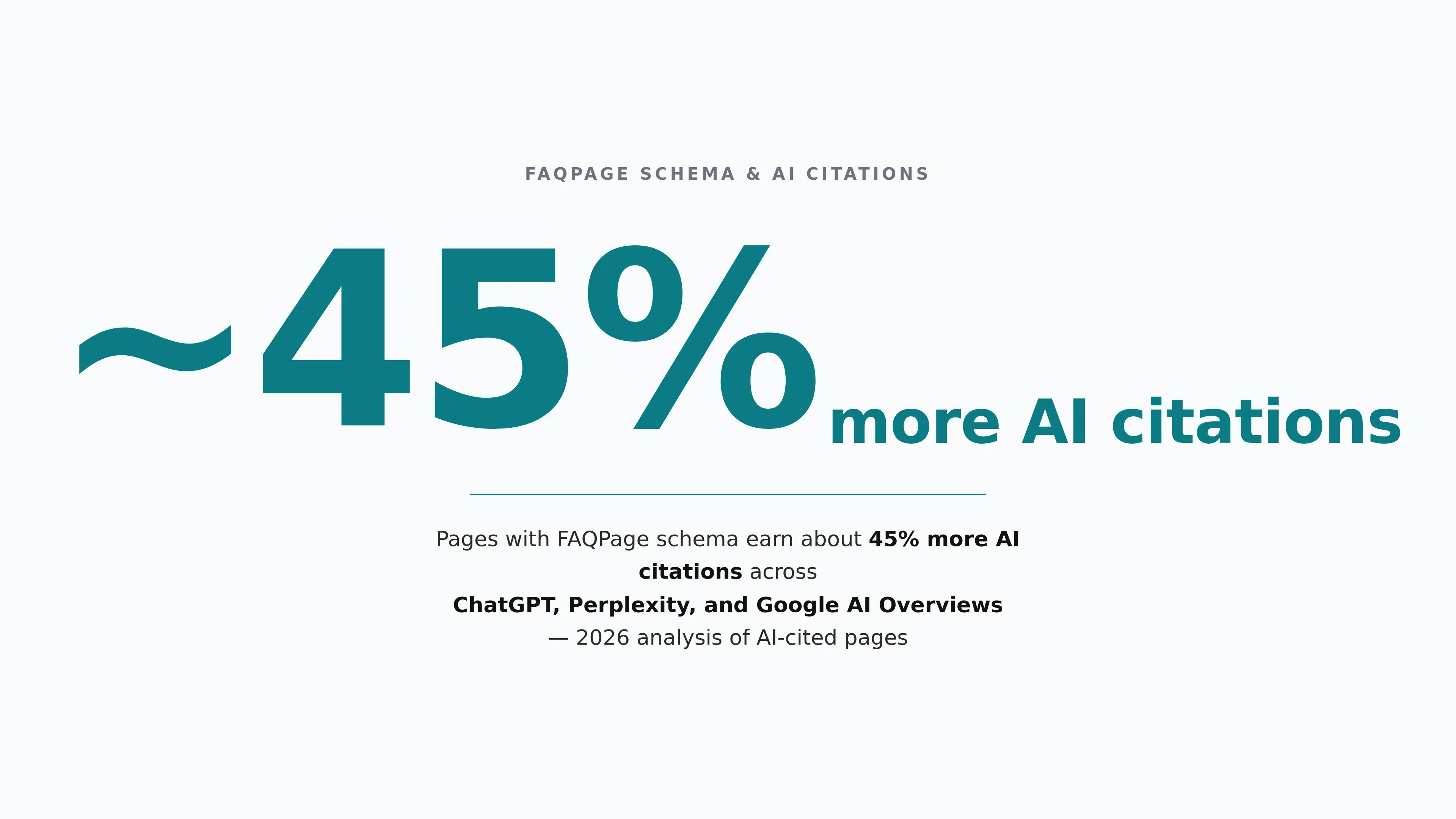
That correlation is easy to misread, so let's be precise about what it is and isn't. FAQPage schema is not the old FAQ rich result - the expandable accordion that used to sit under blue links. That visual feature is a separate thing, and it's largely gone. What the 45% figure describes is citation: the rate at which AI answer engines quote a page and name it as a source.
The mechanism is structural. When you wrap a question and its answer in FAQPage markup, you're telling a machine, in a format it parses natively, that this exact string is a question and this exact string answers it. That removes the guesswork an engine would otherwise do when it infers question-answer boundaries from raw prose. Lower ambiguity means higher confidence, and higher confidence is what earns FAQ schema ChatGPT citations rather than a skip. If you're new to structured data, our complete guide to schema markup and rich results lays the groundwork this article builds on.
Why does the structure matter so much to a machine that can supposedly read anything? Because answer engines optimize for confidence, not effort. A model can parse prose, but every inference it makes about where an answer begins and ends is a chance to get it wrong - and a cited answer that's wrong is a reputational cost the engine wants to avoid. Explicit markup removes that risk, which is why marked-up question-answer pairs punch above their weight in citation.
GetTraffic writes and publishes SEO content automatically - articles that build authority and drive organic traffic - start your free trial.
What changed in May 2026 for FAQ rich results?
In May 2026, Google stopped displaying FAQ rich results for non-government and non-health websites. FAQPage schema lost its search decoration but kept its strategic value - and arguably sharpened it. The markup that once earned expandable snippets in search now earns machine-readability for AI answer engines, which is where the citations are.
Plenty of teams read that announcement as a retirement notice and started ripping FAQ markup out of their templates. That's the expensive mistake. The same body of research that ties FAQPage schema to citation lift makes the point plainly: FAQPage rich results are gone for most sites, but FAQPage schema remains valuable precisely because AI engines still read it.
Think of it as a value migration, not a value loss. The audience for your FAQ markup used to be Google's search renderer. Now it's ChatGPT, Perplexity, Gemini, and Google's own AI Overviews. The format didn't change; the consumer did. If you're auditing which structured data types still earn their place on a publishing page, our schema markup coverage checklist for publishers shows where FAQPage fits alongside the rest.
How do AI systems evaluate and extract FAQ content?
AI systems read FAQPage schema as a map. Each question-answer pair becomes a self-contained unit with a clearly labeled query and a bounded response. When a user's prompt matches one of your questions, the paired answer is a high-confidence candidate for extraction - already scoped, already attributed, and cheap to quote.
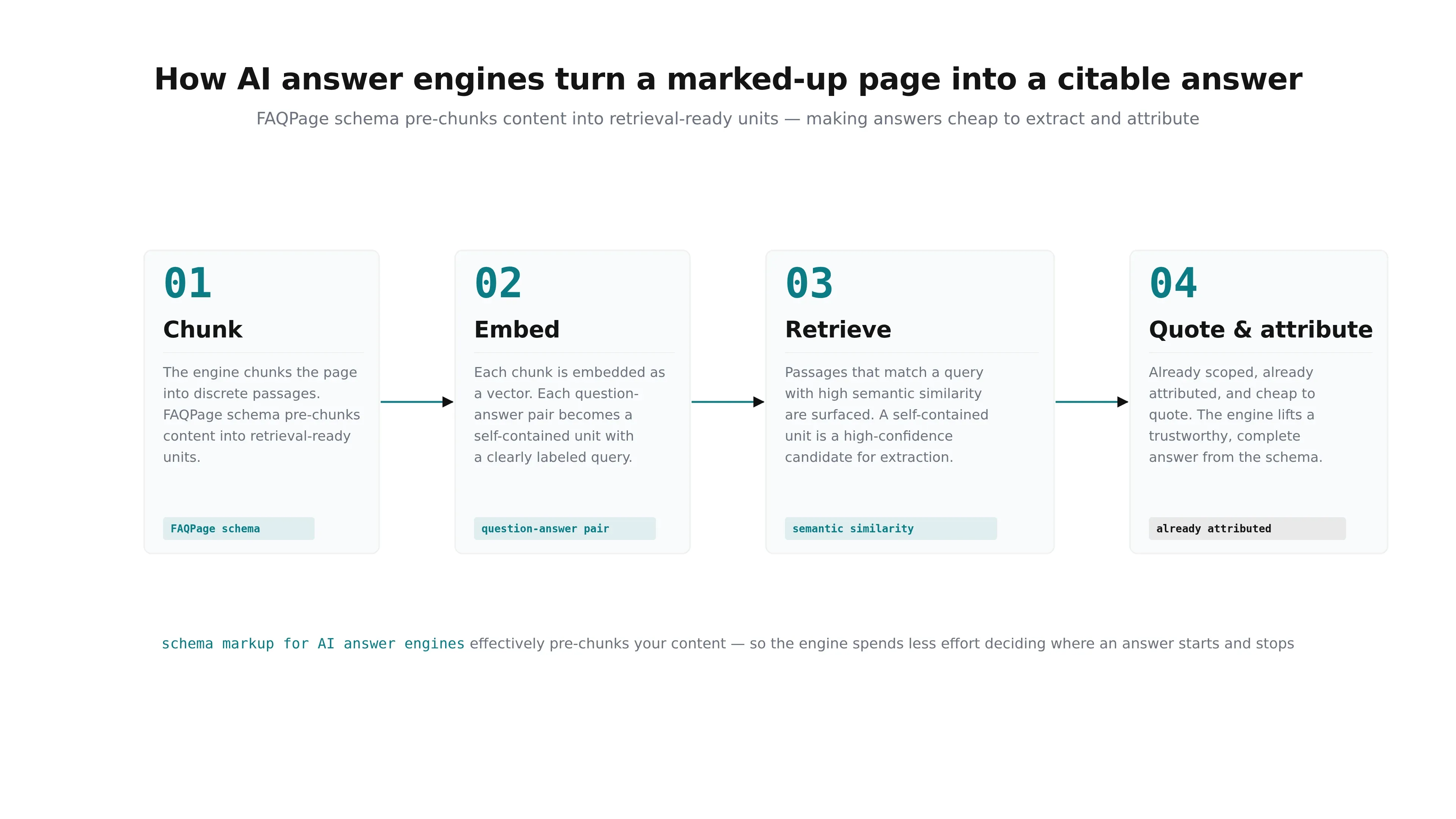
Here's the fuller picture. The large language models behind answer engines don't read a page the way a person does. They chunk it, embed it, and retrieve passages that match a query with high semantic similarity. Clean structure helps at every step: schema markup for AI answer engines effectively pre-chunks your content into retrieval-ready units, so the engine spends less effort deciding where an answer starts and stops.
But the engines are selective. They cite an FAQ answer when it directly resolves the query, reads as authoritative, and stands on its own without surrounding context. They skip it when the answer is vague, hedged into uselessness, or so dependent on the paragraph above it that it can't be quoted cleanly. This is the core of generative engine optimization: structuring content so a machine can lift a trustworthy, complete answer. It's also why structured data and Perplexity visibility tend to follow the same pages that do well in ChatGPT - the retrieval logic rewards the same clarity in both.
How should you structure FAQ content for AI extraction?
Structure FAQ content for AI extraction by writing questions the way users actually phrase them and answers that stand entirely on their own. Each answer should resolve its question in the first sentence, carry enough context to be quoted out of order, and connect visibly to a credentialed author on the page.
Crafting questions for semantic clarity
Write questions in natural, conversational language - the phrasing someone would type into a chatbot or say out loud. "How does FAQPage schema affect AI citations?" beats a keyword-stuffed fragment. Semantic clarity matters because the engine matches the user's intent against your question text; the closer your phrasing sits to real queries, the more reliably your answer surfaces.
Answer completeness and standalone context
Each answer has to survive being ripped out of the page. Assume the engine will quote it with zero surrounding context, so front-load the direct response, then add just enough supporting detail to make it complete. Resist two temptations: the one-line answer that's too thin to be useful, and the sprawling essay that buries the point. Somewhere around 40 to 90 words is usually the sweet spot for a quotable, complete answer, and this balance between conciseness and completeness is where FAQPage generative engine optimization actually lives.
Linking author credentials to FAQ answers
An answer earns more trust when the page around it shows who's accountable for it. A visible byline, a real author bio, and - where relevant - professional credentials rendered in HTML do more for citation than any markup field. FAQPage schema on an article works best paired with proper article markup; our BlogPosting schema implementation guide covers the author and publisher fields that make FAQ answers verifiable.
Why won't schema markup alone get you cited?
Schema markup alone won't get you cited. Visible authority signals - bylines, author credentials, and publication dates rendered in HTML - independently drive the overwhelming majority of frequently-cited pages. FAQPage schema amplifies content that already earns trust; it cannot manufacture credibility that a reader can't see on the page.
The numbers are blunt. Research on AI-cited pages found that visible signals drive 89.2% of frequently-cited pages, which reframes what schema is actually doing. Markup isn't the source of authority; it's a verification layer that confirms, in machine-readable form, the relationships already rendered in your prose. Person schema with no matching visible bio contributes almost nothing on its own.
This lines up with how citation works more broadly. An empirical analysis of AI answer engine citation behavior found that overall page quality is a strong predictor of whether a page gets cited. Schema is one input into that picture - a machine-readability layer for content that already passes the quality bar - not a shortcut around it. Add FAQPage markup to a thin, anonymous page and you've made a weak page more legible, not more citable.
SEO content that ranks, written and published for you
GetTraffic creates authority-building content clusters for your business. No writing, no freelancers, no content calendar. Agency-quality results at 91% less cost.
Start My Free TrialWhere does FAQPage schema fit in your answer engine optimization strategy?
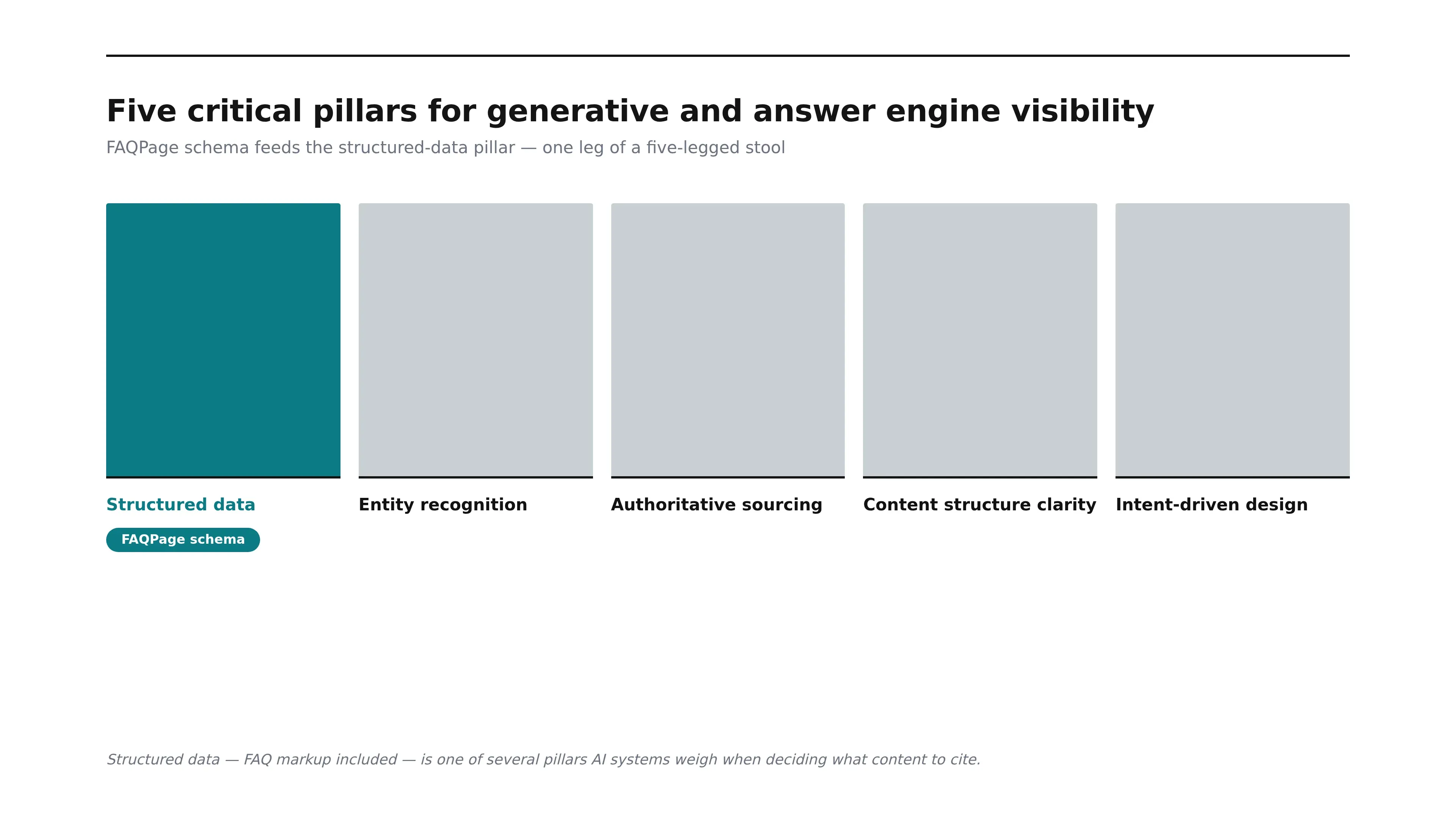
FAQPage schema is one component of answer engine optimization, not the strategy itself. It works when it sits on top of genuine topical authority, E-E-A-T structuring, and content quality. Structured data - FAQ markup included - is one of several pillars AI systems weigh when deciding what content to cite.
FAQPage in the GEO framework
Research on optimizing for AI-driven search consistently lists structured data as one of five critical pillars for generative and answer engine visibility, alongside entity recognition, authoritative sourcing, content structure clarity, and intent-driven design. FAQPage schema contributes to the structured-data and structure-clarity pillars, but it can't carry the others. A citation strategy that leans entirely on FAQ markup is standing on one leg of a five-legged stool.
Integration with topical authority clusters
FAQPage markup pays off most when it's consistent across an entire topical authority cluster rather than bolted onto one page. When every article in an interlinked cluster carries clean, validated FAQ schema plus visible author signals, you compound both search and AI-citation eligibility across the whole topic. The friction is operational: hand-implementing and validating FAQ schema per article invites gaps and developer delays. Automating it at publish time removes that friction - our guide to automating schema markup in your CMS workflow walks through how.
This is exactly where a content operations platform earns its keep. GetTraffic generates and validates FAQPage and Article schema as part of its publishing pipeline, and structures author information in both HTML and markup - so the visible authority signals that actually drive citations ship alongside the schema that verifies them, across every article in a cluster.
So the tidy story was wrong. FAQPage schema didn't die in May 2026 - its job changed. It stopped decorating search results and started earning citations in AI answer engines, correlating with meaningfully higher pickup across ChatGPT, Perplexity, and Google AI Overviews. But it earns that lift only as a verification layer on top of genuine authority: real answers, visible expertise, and content quality that would stand up without any markup at all.
Treat FAQPage markup as one disciplined move inside a broader answer engine optimization strategy - consistent across your cluster, paired with visible author signals, and validated before it ships. With GetTraffic handling schema generation and validation at publish time, that consistency stops being a manual chore.
Frequently asked questions
Does FAQPage schema still work after Google removed FAQ rich results?
Yes. Google stopped showing FAQ rich results for non-government and non-health sites in May 2026, but that only removed a search feature. FAQPage schema still makes your question-answer content machine-readable, which is what AI answer engines like ChatGPT, Perplexity, and Google AI Overviews use to identify and cite high-confidence answers. The value moved from search decoration to citation eligibility, so keep the markup.
How much does FAQPage schema increase AI citations?
A 2026 analysis of AI-cited pages found FAQPage schema correlates with roughly 45% more citations across ChatGPT, Perplexity, and Gemini. Treat that as correlation, not a guarantee: the markup helps engines extract clean answers, but the lift shows up on pages that already have quality content and visible author authority. Schema amplifies strong pages; it does little for thin ones.
Is FAQPage schema enough to get cited by ChatGPT or Perplexity?
No. Visible authority signals such as bylines, author bios, and dates rendered in HTML independently drive the large majority of frequently-cited pages, and overall page quality is a strong predictor of citation. Schema is a verification layer that confirms these signals in machine-readable form; it can't replace them. Pair FAQPage markup with real, visible expertise and complete answers to see any citation benefit.
Where should FAQPage schema fit in an SEO and GEO strategy?
Treat FAQPage schema as one pillar of answer engine optimization, not the whole plan. It supports structured-data and content-clarity signals, but entity recognition, authoritative sourcing, and E-E-A-T carry equal weight. It pays off most when applied consistently across a topical authority cluster and validated before publishing, so every interlinked article ships with clean markup and visible author credentials.
Sources and research
Get your business on page 1 of Google
Get your business found on Google - SEO content written and published automatically.
Start My Free Trial7-day free trial