
Schema Markup Generator Tools Compared: 8 Best Tools for Automating Structured Data in 2026


Table of Contents +
- Why Does Schema Markup Automation Matter for Content Operations?
- What Are the Four Approaches to Schema Markup Generation?
- How Do You Choose a Schema Markup Generator?
- Feature Comparison of 8 Schema Markup Generator Tools
- Which Schema Markup Tool Fits Your Content Operation?
- Common Questions About Schema Markup Generators
- Sources and Further Reading
Compare 8 schema markup generator tools by workflow fit, validation, and automation depth-and match the right one to your 2026 publishing volume.
Type "schema markup generator" into a search box and you get a wall of options: free code-snippet tools like TechnicalSEO and RankRanger, WordPress plugins such as Yoast and Rank Math, enterprise automation suites, and content-operations platforms that build the markup for you at publish. They all promise the same payoff - valid structured data that makes your content eligible for rich results and citable by AI answer engines. The choice between them decides whether structured data becomes a background guarantee or a recurring manual chore.
Here's why that choice matters: these tools don't work the same way, and the gap between them is operational, not cosmetic. A free generator that spits out JSON-LD you paste by hand is fine for one landing page and a quiet nightmare across forty articles a month. Pick the wrong tool for your volume and you inherit the exact friction automation was meant to remove - manual validation, developer handoffs, and inconsistent coverage that quietly leaves content ineligible for the rich results and AI citations you were chasing. The stakes scale with every article you publish.
Why Does Schema Markup Automation Matter for Content Operations?
Schema markup automation matters because hand-building structured data is a per-article bottleneck. Someone writes the JSON-LD, tests it in a separate validator, interprets any error messages, and often waits on a developer to deploy it. At two or more articles a week, that cycle stalls publishing. Automation embedded in the workflow removes the handoffs entirely.

Manual markup is a hidden per-article tax
Every article that needs structured data carries a small tax you pay again and again: pick the schema type, fill the fields, copy the code, paste it into the right template, and hope nothing broke. For a single page that is trivial. Across a content cluster of ten interlinked articles, it is ten rounds of the same fiddly work - and the first place teams cut corners when a deadline looms. If you want the full picture of what "complete" markup even looks like before you evaluate tools, our guide to structured data for SEO lays out the baseline.
Validation catches errors before they cost you
Structured data has to be both syntactically correct and semantically valid, or crawlers and AI systems simply ignore it - silently. Invalid markup does not throw a visible error; it just quietly makes your content ineligible for rich results and less likely to be cited, which is exactly why pre-publish validation belongs inside the content workflow rather than as an afterthought in a separate tab. Tools that validate at generation time stop the error before it ships.
Scaling output without scaling the team
The whole point of schema markup automation is decoupling content volume from headcount. A workflow that generates and validates markup automatically lets a small team publish at the cadence that used to need a developer on standby. That is the difference between schema as a chore and schema as a background guarantee.
GetTraffic writes and publishes SEO content automatically - articles that build authority and drive organic traffic - start your free trial.
What Are the Four Approaches to Schema Markup Generation?
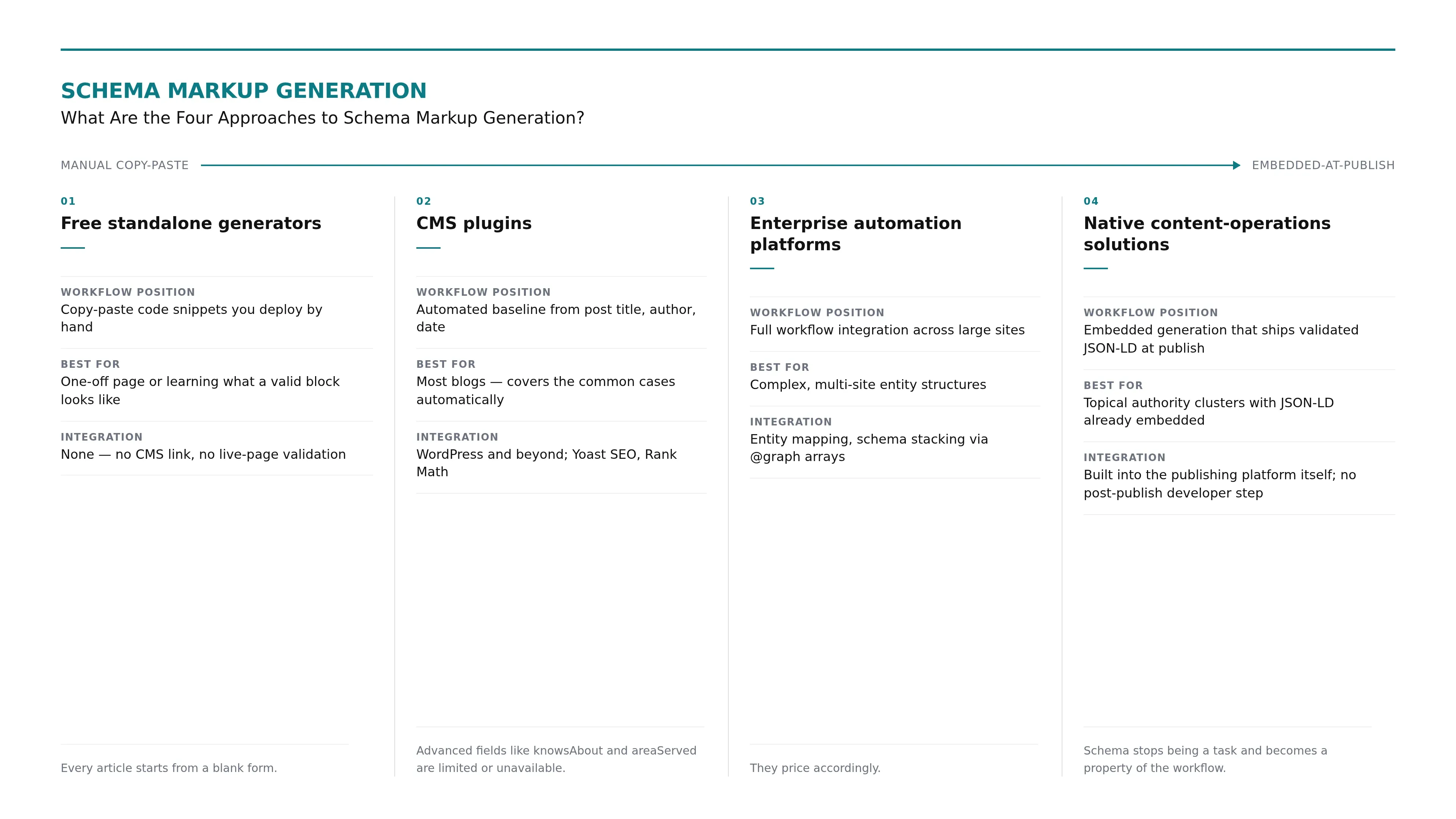
Schema markup generation falls into four approaches: free standalone generators, CMS plugins, enterprise automation platforms, and native content-operations solutions with built-in markup. Each sits at a different point in the workflow - from copy-paste code snippets you deploy by hand to embedded generation that ships validated JSON-LD the moment you publish.
Free and freemium standalone generators
Tools like TechnicalSEO's generator, RankRanger, SchemaMarkupGenerators.com, and SearchBloom produce JSON-LD from a short form: you choose a type, fill in the fields, and copy the output. They are excellent for a one-off page or for learning what a valid block looks like, and most are free. What they do not do is validate against your live page, integrate with your CMS, or remember the article you built yesterday. Every article starts from a blank form.
CMS plugins (WordPress and beyond)
WordPress plugins such as Yoast SEO and Rank Math automate the baseline - Article, Organization, and BreadcrumbList markup generated automatically from your post's title, author, date, and featured image. For most blogs that covers the common cases. The tradeoff is ceiling: advanced fields like knowsAbout and areaServed are limited or unavailable, so complex entities need custom work. If you are weighing the WordPress options specifically, our comparison of Yoast, Rank Math, and custom JSON-LD goes deeper.
Enterprise automation platforms
Platforms such as InLinks target full workflow integration: entity mapping, schema stacking via @graph arrays, and dynamic fields across large sites. They suit organizations with complex, multi-site entity structures - the kind of DACH B2B publishing where several schema types stack on one page - and they price accordingly.
Native content-operations solutions
The fourth approach builds schema generation into the publishing platform itself. GetTraffic generates and validates markup as part of drafting an entire topical authority cluster, then publishes to the CMS with the JSON-LD already embedded and internal links in place - no post-publish developer step. This is where schema stops being a task and becomes a property of the workflow. JSON-LD is the standard these platforms rely on precisely because it separates structured data from visible HTML, so updates never corrupt page layout.
How Do You Choose a Schema Markup Generator?
Choose a schema markup generator on six operational criteria: schema type coverage, pre-publish validation, CMS and workflow integration, ease of implementation, cost model, and how it scales with your team. Feature count matters less than whether the tool removes manual steps from the way you already publish - the right structured data generator disappears into your workflow.
Schema type coverage
At minimum a publishing tool should produce the core types for article content - Article and its subtypes (BlogPosting, NewsArticle), Organization, BreadcrumbList, and FAQPage where you have a genuine question-and-answer section. Article schema depends on core fields such as headline, image, and publication date to be eligible for enhanced result display. If a tool cannot cover the types your content library actually uses, you will be back in a standalone generator for the gaps. Our Article schema implementation checklist is a useful yardstick for what "complete" should mean.
Pre-publish validation
Because malformed markup is silently discarded, the tool should validate before content goes live, not leave you round-tripping through Google's Rich Results Test and the Schema.org validator by hand. Automated validation at generation time is the single feature that most reduces rework.
CMS integration and workflow fit
The best structured data generator for a content operation is the one that publishes where you publish. A tool that outputs code you paste manually adds a step; a tool that embeds validated markup into the CMS in one action removes one. Since structured data is a foundational pillar of generative engine optimization, getting it embedded reliably - not just generated - is what carries through to AI-answer visibility.
Ease of use, cost, and scaling
Finally, weigh implementation overhead against volume. A free tool has no license cost but a high labor cost per article; a subscription platform inverts that. The economics flip in favor of automation somewhere around two to four articles a week, where manual per-article markup stops being sustainable.
Feature Comparison of 8 Schema Markup Generator Tools
The eight schema markup tools below span all four approaches, compared on the criteria that matter to a publishing workflow: schema type coverage, pre-publish validation, CMS integration, automation depth, cost model, and AI-citation readiness. Read the table for the shape of the landscape, then the notes for where each tool earns its place.
| Tool | Category | Automation depth | CMS integration | Pre-publish validation | Cost model |
|---|---|---|---|---|---|
| TechnicalSEO Generator | Free standalone | Manual copy-paste | None | Separate tool | Free |
| RankRanger | Free standalone | Manual copy-paste | None | Separate tool | Free |
| SchemaMarkupGenerators.com | Free standalone | Manual copy-paste | None | Separate tool | Free |
| SearchBloom Generator | Free standalone | Manual copy-paste | None | Separate tool | Free |
| Yoast SEO | CMS plugin | Baseline auto (Article, Organization, Breadcrumb) | WordPress | Built-in basics | Freemium |
| Rank Math | CMS plugin | Baseline auto, more field options | WordPress | Built-in basics | Freemium |
| InLinks | Enterprise automation | Entity mapping, schema stacking | Multi-platform | Automated | Subscription |
| GetTraffic | Native content ops | Full: generated + validated at publish | Shopify, WordPress, Webflow, Wix, WooCommerce, Framer, custom API | Automated, six-gate | From €299/mo |
TechnicalSEO Schema Generator. A clean, free form-based generator covering a wide range of types. Best for one-off pages and checking what a valid block should contain.
RankRanger Schema Generator. Another free standalone generator covering the common types. Best for occasional manual markup when you have no CMS integration to lean on.
SchemaMarkupGenerators.com. A no-frills library of type-specific generators. Best for quickly grabbing a single block you'll paste and validate yourself.
SearchBloom Generator. A free generator aimed at marketers rather than developers. Best for teams dipping a toe into structured data before committing to automation.
Yoast SEO. The default WordPress plugin, auto-generating Article, Organization, and BreadcrumbList from post metadata. Best for standard blogs that stay within common schema types.
Rank Math. A WordPress alternative with broader field options out of the box. Best for WordPress publishers who want more control without touching template code.
InLinks. An enterprise platform built around entity mapping and schema stacking via @graph. Best for large, multi-site organizations with complex entity structures.
GetTraffic. A content-operations platform that generates, validates, and embeds schema as it drafts and publishes a full ten-article cluster. Best for teams that want structured data handled end to end, with no separate markup step. See how GetTraffic automates schema, or learn how CMS schema automation fits the full pipeline.
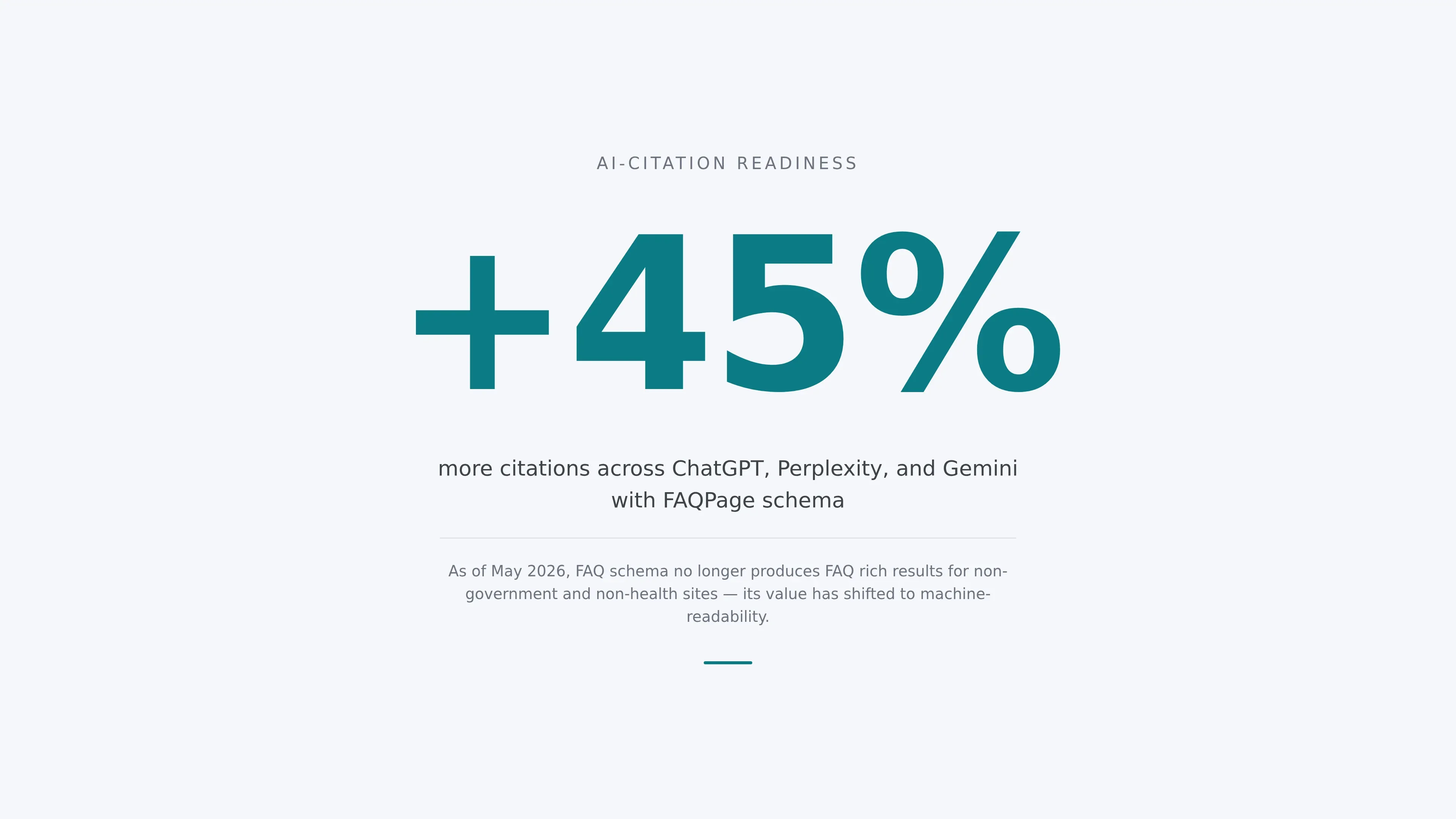
One column deserves a note: AI-citation readiness. FAQPage schema is the clearest example - as of May 2026 it no longer produces FAQ rich results in Search for non-government and non-health sites, so its value has shifted to machine-readability, where FAQ schema correlates with roughly 45% more citations across ChatGPT, Perplexity, and Gemini. Tools that generate and validate FAQPage markup automatically keep that upside without the SERP feature that used to justify it.
SEO content that ranks, written and published for you
GetTraffic creates authority-building content clusters for your business. No writing, no freelancers, no content calendar. Agency-quality results at 91% less cost.
Start My Free TrialWhich Schema Markup Tool Fits Your Content Operation?
The right schema markup generator depends on how much you publish and where. Individual publishers are well served by free standalone tools; small teams get baseline coverage from WordPress plugins; operations shipping five or more articles a week need workflow-integrated automation; and multi-language enterprise publishing needs native or enterprise platforms that handle entities and validation at scale.
Individual publishers and small sites
If you publish occasionally, a free standalone generator plus a manual pass through Google's Rich Results Test is enough. You trade time for money, and at low volume that trade is fine. A WordPress plugin like Yoast or Rank Math is the natural upgrade once you are on WordPress and posting regularly.
Growing content teams and agencies
Between two and five articles a week, manual markup becomes the bottleneck the automation was meant to remove. This is where a native content-operations platform earns its keep: schema generated, validated, and embedded as part of drafting, so no article waits on a developer. GetTraffic handles the markup automatically across an entire cluster, which is the point at which per-article labor stops scaling with output.
Enterprise and multi-language publishing
Large operations - especially DACH B2B publishers juggling stacked schema types, multi-site entities, and de-CH/fr-CH/it-CH variants - need either an enterprise platform like InLinks or a content-operations platform that generates validated markup per language instance. The deciding factor is whether the tool keeps entity and validation consistency across languages without per-language manual work.
CMS-specific guidance
On WordPress, start with a plugin and add custom JSON-LD only for advanced fields. On Shopify, Webflow, or a custom stack, plugin coverage is thinner, so a platform that publishes validated markup via API is the lower-friction path. Match the tool to your CMS and volume - not to the longest feature list.
Every tool in this comparison generates valid JSON-LD; the difference is how much of your workflow it absorbs. Free generators and plugins are the right starting point at low volume, but the economics tip toward embedded automation the moment you are publishing multiple articles a week and can't afford manual validation or developer handoffs. Decide on your real needs first - publishing volume, team size, CMS, and the schema types your library actually uses - then pick the tool that makes structured data a background guarantee rather than a recurring task.
Common Questions About Schema Markup Generators
What is JSON-LD, and why do schema generators prefer it?
JSON-LD is a script-based format for structured data that sits in a page's code separately from the visible HTML. Google recommends it over Microdata and RDFa because that separation means updating your markup never risks corrupting the page layout. For CMS publishers running template-driven, high-volume workflows, JSON-LD is faster and safer to deploy, which is why nearly every schema markup generator outputs it by default.
Can Yoast or Rank Math generate all the schema markup I need?
For most blogs, yes - both plugins automatically generate baseline Article, Organization, and BreadcrumbList markup from your post's title, author, date, and featured image. The limit is advanced fields: properties like knowsAbout and areaServed are restricted or unavailable, so complex entities and multi-type stacking usually need custom JSON-LD or a platform with deeper native generation. Treat plugins as strong baseline coverage, not complete coverage.
How should I validate schema markup before publishing?
Validate for both syntax and meaning, because search engines and AI systems silently ignore malformed markup rather than flagging it. Google's Rich Results Test and the Schema.org validator let you check a block before it goes live. The lower-friction approach is a tool that validates automatically at generation time, so invalid markup never ships and you avoid post-publish rework cycles entirely.
Is FAQ schema still worth adding in 2026?
Yes, but for a different reason than before. As of May 2026, FAQPage schema no longer displays as FAQ rich results in Search for non-government and non-health sites, so the SERP feature is largely gone. Its value has shifted to machine-readability for AI answer engines, where FAQ schema correlates with roughly 45% more citations across ChatGPT, Perplexity, and Gemini. Add it where you have genuine question-and-answer content.
Sources and Further Reading
Get your business on page 1 of Google
Get your business found on Google - SEO content written and published automatically.
Start My Free Trial7-day free trial